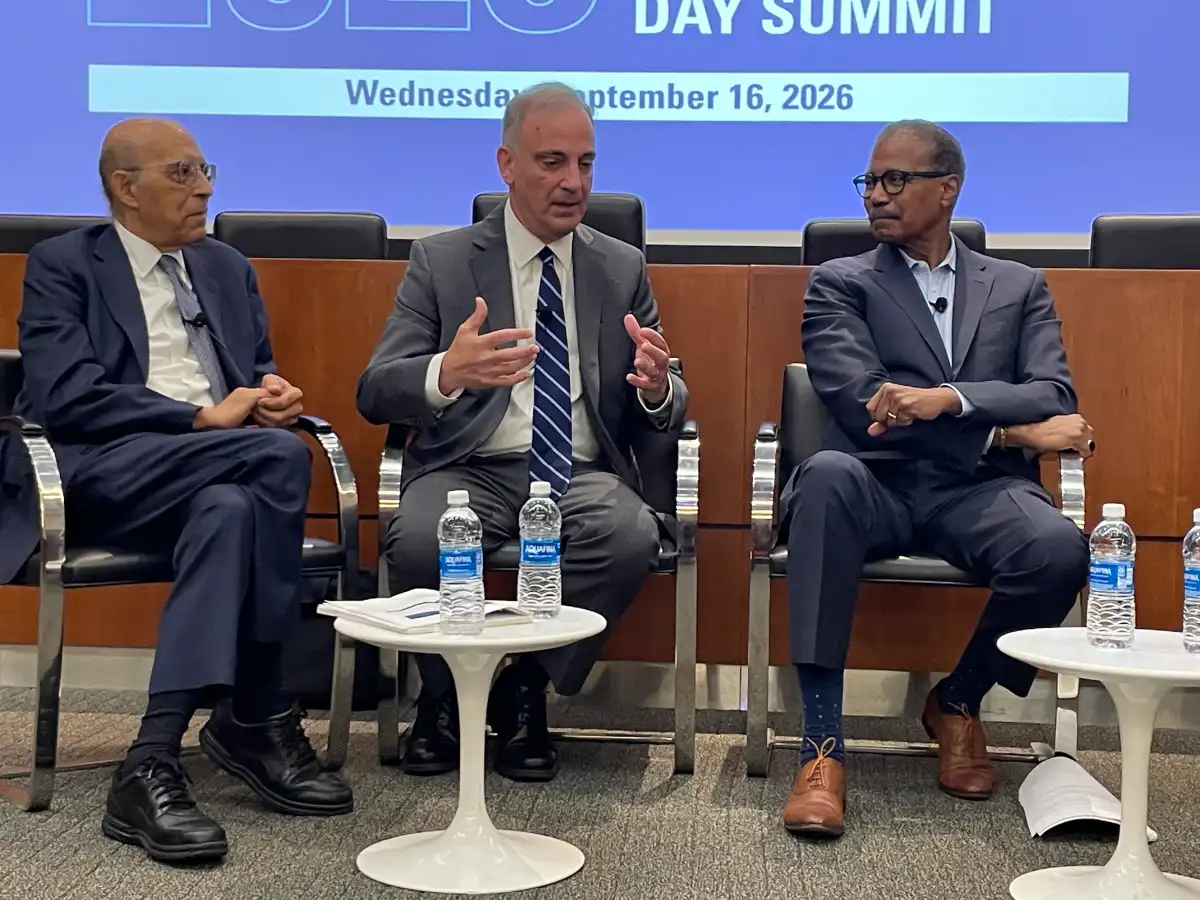
While American society at large is experiencing a crisis of lacking civic engagement, the court system is experiencing a concerning decline in trust, federal judges told an audience of New York City’s legal community Wednesday.
To combat it, they believe the judiciary needs to keep politics out of their decisions and ensure what they write is clear and contains thorough reasoning so it is not misunderstood by members of the press and public.
“Someone who just has a cellphone and can come and do a report about a decision that you have made, and that gets spread much more rapidly and further than your actual decision,” said 60 Minutes correspondent Bill Whitaker, who participated in a conversation with a pair of federal judges during a Sept. 16 event at New York Law School on the eve of Constitution Day, Sept. 17.
“I think that judges and lawyers need to understand that times have changed, and the idea of being smart and right is not enough. To get your information out there requires a little more outreach or a little more explanation, so that the truth of your decisions reaches the public,” Whitaker added.
Second Circuit Court of Appeals Judge Joseph Bianco and U.S. District Judge Victor Marrero told a group of lawyers and judges gathered for the law school’s second annual Constitution and Citizenship Day Summit that the judiciary’s role in supporting civic engagement is to communicate clearly and without fanfare through their decisions to instill public confidence that they’re truly an independent institution the public can trust.
“From the standpoint of the courts, independence and a commitment to the rule of law through that independence is critical,” Bianco said. “It’s a cornerstone of the judicial system. If a judge is deciding cases based upon his or her personal beliefs, based upon public opinion, based upon the president who appointed him or her, that’s poison to the system.”
He and Marrero emphasized that judges need to realize that, for all the control they have over their courtroom, they don’t have much control over how the inside of their courtroom gets portrayed to the public via the press.
“We have no control over it. We don’t have PR people,” Bianco said with a laugh. “So, what is a judge to do to make sure that what’s going on in the courtroom is being accurately told to the public? We speak through our judicial opinions and our rulings. I think judges need to show their work. If a judge gives someone a [prison] sentence and there’s only one line of reasoning, the public doesn’t understand what happened and why it happened.”

“Whether it be orally or in writing, we need to explain our decision, hopefully consistent in the way you’re approaching the law, regardless of who the parties are,” Bianco continued. “Another important part of that is the way you write it. When I read a judicial opinion, and it almost reads like a press release, with punchy lines in it, I worry that the public will not read it as an objective assessment of the law, but as an opinion piece, so that’s really troubling.”
That might not be the judge’s intention or even the reality of what the decision is, Bianco said, but what matters just as much is the appearance. If the public perceives a ruling as sounding political, it contributes to deteriorating their trust in the judiciary.
When he works with his colleagues to craft decisions on the appellate bench, Bianco said he helps ensure the words being used reflect the independence of the ruling, sometimes telling colleagues to “tone down” certain lines.
“We need to show the appearance of being above the political fray,” Bianco said. “Just follow the law and make sure that your decision-making reflects that.”
