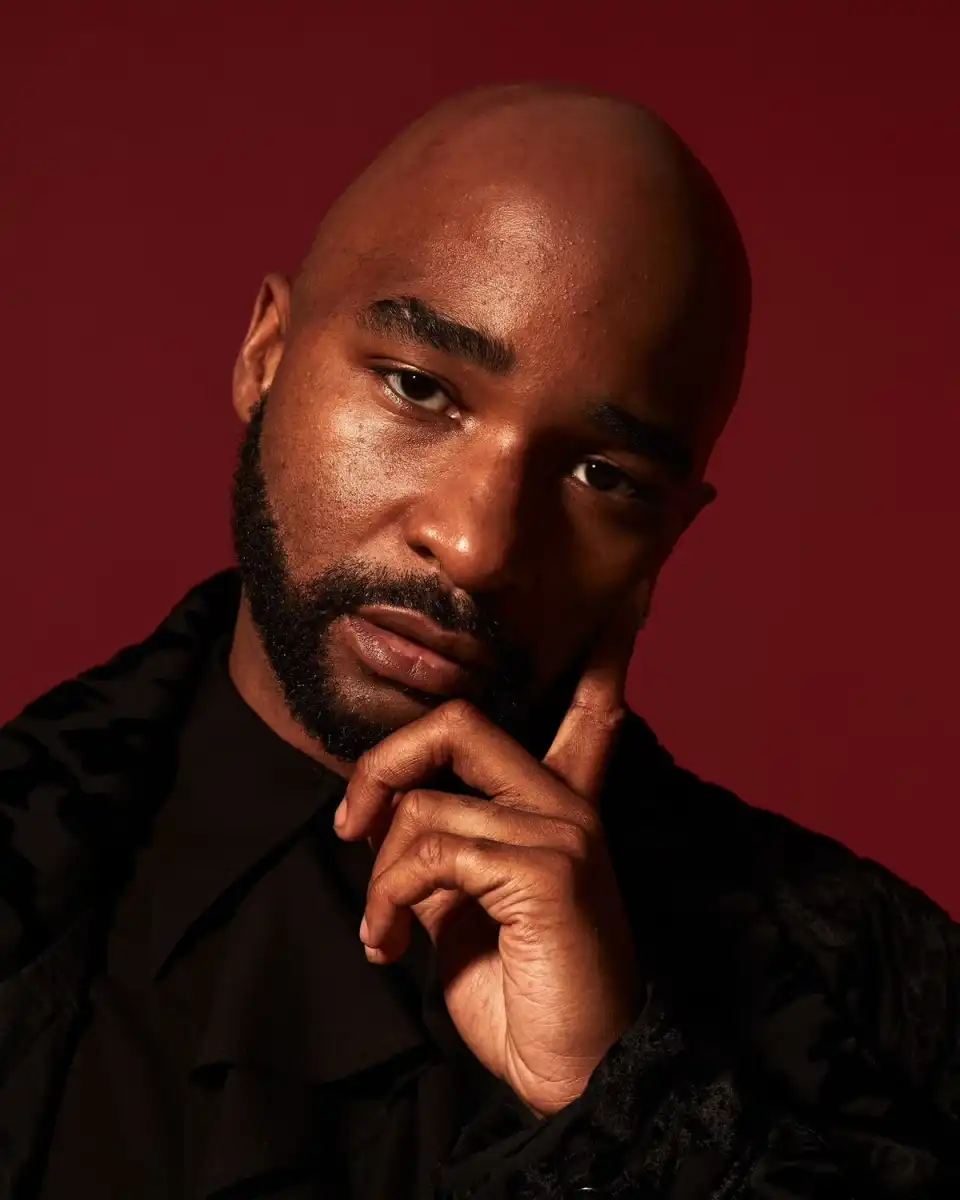
The most valuable thing at Tribeca Rooftop on October 28 will not hang on a wall. It will be time: months to heal, freedom to begin again and, perhaps most vitally, the unwritten masterpiece waiting inside living flesh.
As the Rema Hort Mann Fund marks thirty years of art and compassion, Jacolby Satterwhite will be honored as the inaugural recipient of its Artists Living with Cancer Grant. More than seventy pieces will rise for auction. Beneath the glamour, however, burns a ferocious question: What is a cultural treasure worth if its creator cannot afford to survive?
Satterwhite makes that reckoning devastatingly clear. His performances, paintings, animations, sculptures and virtual universes have entered the Metropolitan Museum of Art, MoMA, the Whitney and Lincoln Center. Yet outside the résumé stands our first studio, archive and perilously temperamental inheritance: the human form, so easily mistaken for a promise.
For him, that illusion collapsed at eleven, when bone cancer permanently altered his right arm and shoulder. A doctor warned that he might never use the limb normally again. His answer was neither surrender nor stillness.
He drew.
In retrospect, that gesture feels mythic. Before the avatars and monumental commissions, there was a child teaching wounded anatomy that it could still invent realities. The very arm cancer had threatened—and physicians feared might never fully function again—became, astonishingly, the instrument through which he would sketch past the boundaries assigned to him.


Nor did this instinct emerge in solitude. Art had already entered the home through his mother, Patricia, whose hundreds of drawings envisioned inventions meant to solve ordinary problems and, perhaps, open a passage out of illness and domestic isolation. These were not preparatory studies for an establishment awaiting her. Instead, they formed a private cosmology: eccentric, pragmatic, fantastical and insistently alive.
After Patricia’s death, her son refused to let that imagination disappear into a drawer. He scanned the pages, translated their lines into three-dimensional structures and released them through digital realms of music, movement and figures. What began in seclusion now commands screens and museum collections, granting public permanence to a woman whose circumstances offered no obvious route toward such esteem. For Satterwhite, that embrace means “the world.” More profoundly, preservation becomes collaboration, while legacy need not remain motionless to stay sacred.
From this filial communion arose an ambitious visual language. In A Metta Prayer, his 2023 Great Hall Commission for the Met, Buddhist loving-kindness traveled through an immersive technological dreamscape as avatars multiplied, silhouettes spun and police encounters dissolved into dance. Beauty never evades difficult material. As he told me, it can operate as “camouflage, seduction and survival”—radiance rendering searing truths possible to absorb.
Achievement, alas, confers no immunity. Decades after the original diagnosis, its consequences returned with terrifying force. Infection tore through the reconstructed flesh; sepsis loomed; multiple doctors refused the surgery required to save him. He could scarcely cross a hallway without dizziness or stars, much less sustain his demanding practice. Production ceased. Expenses did not. Institutional acclaim exposed its brutal limitation: prestige can fill one of the world’s grandest halls, yet it cannot rehabilitate damaged anatomy or purchase the respite in which recovery occurs.


When Satterwhite finally disclosed this emergency, upwards of 2,300 people answered. For someone accustomed to commanding his own image, such exposure must have been petrifying. Nevertheless, within that vulnerability appeared an architecture of communal devotion, while assistance from RHMF, he said, “saved me from disaster.” The award secured treatment, room to create and breath. Unexpectedly, it illuminated a network willing to carry the maker whose creations had already borne so many others.
That reciprocity leads to why the organization matters. Established around a kitchen table in 1995 after Rema Hort Mann died of stomach cancer at thirty, the initiative transfigured unbearable grief into a living safeguard. Rema had championed emerging talent before certainty arrived; Susan and Michael Hort, her widower Billy Mann, and loved ones continued this commitment by underwriting possibility itself. Since then, the Fund has raised more than $9.5 million, aided over 2,400 patients and recognized 460 emerging voices.
Fittingly, the anniversary gala extends that covenant. Co-founder Susan Hort will receive the Legacy Award, while George Wells and Manfred Rantner will be celebrated for philanthropic leadership spanning contemporary culture, representation and pediatric medicine. Their sponsorship of a $10,000 Artists Living with Cancer Grant makes the evening’s philosophy tangible. Patronage, in its truest form, is not merely acquiring what history has approved. It is safeguarding what has not yet had time to exist.
All of which returns us, with aching intimacy, to Satterwhite.
“I want to make a body for me,” he said of the chapter ahead.


At first, the declaration sounds private, almost protective. Within the larger conversation, however, it became something far more generous. Satterwhite is not rebuilding a fortress; he is restoring a conduit. After medicine examined his physique, illness invaded it and the industry consumed its labor, reclamation now means learning to give without disappearing. He imagines future work that “breathes” from him—offerings of love, political conviction and hard-won perspective.
On October 28, bidding will close, glasses will be cleared and Manhattan will resume its magnificent indifference. Beyond that room, Satterwhite will return to the studio carrying what the community gave him: time, breath and another beginning.
No one will own the next creation yet
Everyone who showed up will have helped it live.
Satterwhite’s We Are in Hell When We Hurt Each Other will be included in the Frist Art Museum’s Shimmer: Dreaming the Posthuman, opening September 25, 2026.