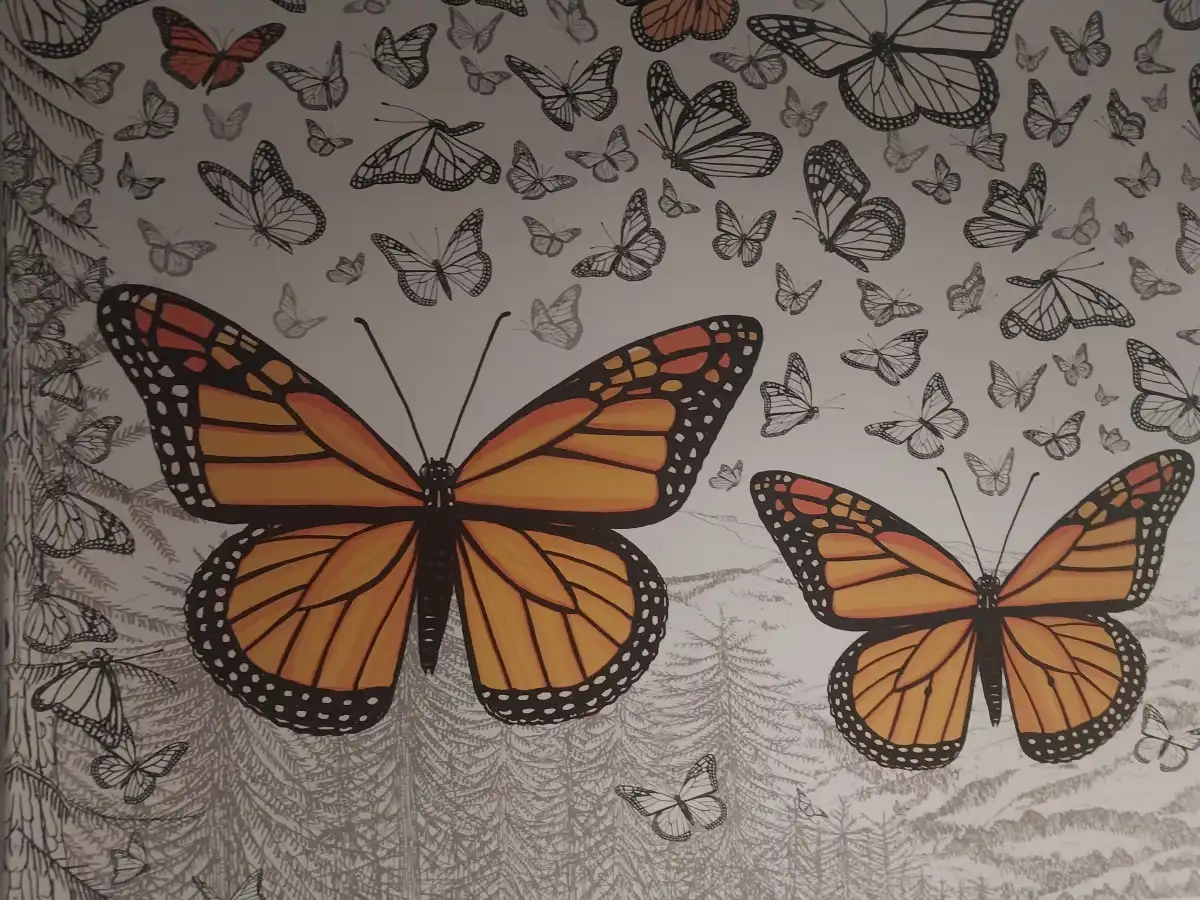
The American Museum of Natural History is bringing art and science together in “Monarch’s Journey,” a new exhibition that follows monarch butterflies on their nearly 3,000-mile migration from Canada and the northern United States to the mountain forests of central Mexico.
The exhibition features illustrations by award-winning cartoonist and graphic novelist Peter Kuper, a 2026 Pulitzer Prize finalist who has written and drawn “Spy vs. Spy” for MAD since 1997. His artwork wraps the walls of a second-floor corridor near the Museum’s butterfly research collection in the Richard Gilder Center for Science, Education and Innovation.
Rather than presenting the monarch’s journey only through specimens and scientific text, Kuper uses comics and large illustrations to show the dangers, landscapes and environmental changes the butterflies encounter along the way.
“I think everything is worth telling through comics,” Kuper said. “I visited the monarch butterflies in 2007 in Mexico and I raised them there as well. So I had a direct connection to it and I’m really interested in insects in general.”
Kuper said the concern about declining insect populations helped push him toward telling stories about insects. Monarchs, he claims, provide an accessible way for people to understand why insects matter.
“The monarch is kind of the poster child for insects in a lot of ways,” Kuper said. “A lot of people I know are afraid of insects, so I’m trying to move the dial so that if you’re afraid of them, you might like them. If you like them, you might love them.”


The exhibit tells much of its story without words. Kuper said the format connects the project to “Spy vs. Spy,” where visual storytelling works without dialogue.
“There’s no text there, per se,” Kuper said. “It’s like a language of its own and there are no language barriers. I love that about the form. I can show this to anybody and they’d be able to follow along and get a pretty good idea of what the story was.”
That story is an extraordinary one, according to Jessica Ware, curator of “Monarch’s Journey,” chair of the Museum’s Division of Invertebrate Zoology and an entomologist whose research helped ground the exhibition in science.
Ware said the migration is especially remarkable because it takes place across several generations.
“There are three to five generations that, over time, eventually make it down to this huge overwintering site with millions and millions of monarchs,” Ware said.
The butterflies rely on environmental cues during their journey, according to Ware, while scientists are still learning exactly how monarchs find their way across such enormous distances.
“They use environmental cues depending on what they’re eating or what’s happening in the environment that triggers certain genes to turn on and off. That tells them where they are on their journey,” Ware said.
For Kuper, the mystery is part of what makes the migration so compelling. He noted that scientists in North America did not fully understand where the monarchs traveled for the winter until the 1970s.
“How it knows exactly which forest to go to in Mexico is still a mystery,” Kuper said. “It’s this insane journey that has a lot of cards stacked against them and yet they pull it off.”


Both Kuper and Ware pointed to habitat loss as one of the biggest threats monarchs face. Monarch caterpillars depend on milkweed and without enough of it along their route, the butterflies cannot successfully continue their life cycle.
“They need the milkweed plant,” Kuper said. “Without the milkweed, they wouldn’t survive. We have to be really conscious of giving them a pathway.”
Ware said extreme weather can make that journey even harder.
“Habitat loss is a really big risk for them,” Ware said. “Depending on climate change, if there’s a period of drought, extreme flooding or extreme weather, that can also be disastrous for these tiny insects that are trying to fly through the sky.”
Kuper’s illustrations place monarchs against highways, cities, factories and other human-made landscapes. Ware said it reminds visitors that people and monarchs are not traveling through separate worlds.
“People need to understand that monarchs are part of our journey and we’re part of their journey,” Ware said. “It shows this urban landscape that starts in New York and it follows this monarch as it goes along the journey. It’s going through landscapes that we humans have altered.”
The exhibit sits near the Museum’s butterfly research collection, which includes about 1.3 million specimens. Visitors can also explore the Davis Family Butterfly Vivarium, home to as many as 80 species of free-flying butterflies from around the world.
Kuper said working with Ware and other scientists helped him make sure his drawings were both visually compelling and scientifically accurate.


“I wanted this to work for both a regular reading audience like myself, but also have an entomologist look at the book and say, ‘That’s correct,’” Kuper said. “It was really a dream to be able to speak to these people.”
Ware believes presenting science through comics can also help younger visitors understand issues like pollinator decline.
“You have to talk to people in languages that they like,” Ware said. “We need to care about insects. We need to understand about pollinators. We need to understand about insect decline. How do we get them to care? You have to give them the information in a digestible way and that’s what these cartoons do.”
The consequences go far beyond butterflies, Ware said. Pollinators help support flowering plants, food systems and habitats that other animals depend on.
“We lose pollinators, we lose plants, we lose food, it affects us all and ultimately we’re the ones that would also perish,” Ware said.
For Kuper, the exhibit’s message comes down to recognizing that even small creatures play an enormous role in keeping ecosystems functioning.
“All of us can participate in the process of helping to save monarch butterflies and insects in general,” Kuper said. “But it starts with recognizing, in the first place, how important they are to the survival of the planet for us.”