There have now been 14 confirmed cases of Legionnaires’ disease, one hospitalization and two deaths in the South Bronx, as city officials continue investigating an outbreak linked to cooling towers in two South Bronx zip codes.
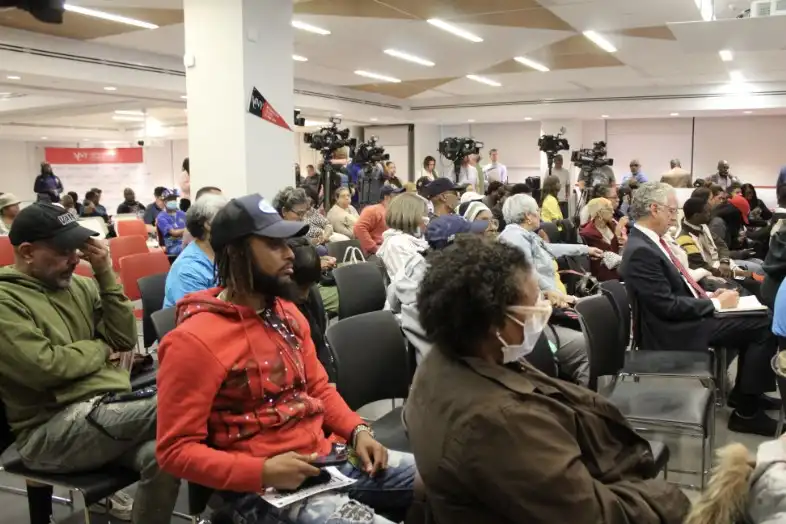
The NYC Department of Health and Mental Hygiene hosted a town hall at Metropolitan College on Sept. 15 to update residents on the outbreak, address concerns and explain the measures the city has taken to contain it.
The Health Department previously conducted a preliminary investigation that included testing of 24 cooling towers in zip codes 10451 and 10456. The testing determines whether Legionella bacteria DNA is present in water samples.
Ten cooling towers were found to contain Legionella bacteria, including towers at Yankee Stadium, Boricua College and Lincoln Hospital. City officials said all 10 towers have since undergone remediation.
Legionnaires disease is a type of pneumonia that is caused when bacteria is caught while breathing in contaminated water mist.
The Health Department is now conducting culture testing to determine whether live Legionella bacteria were present when the samples were collected. The process can take up to two weeks.
Commissioner of the New York City Department of Health and Mental Hygiene Dr. Alister Martin said the city is also conducting additional inspections of cooling towers in the affected area.
“We are conducting inspections of all of the regional positive cooling towers independent of the last inspection,” Martin said. “Basically this means that we’re going above and beyond to check and see what has been going on in this town.”
According to the Yankees, no current cases have been associated with Yankee Stadium.
“No current cases have been associated with Yankee Stadium,” the organization said in a statement. “Additionally, the New York City Department of Health has not at any point this month asked us to postpone our games.”
At the town hall, however, Bronx residents raised concerns about the city’s approach to tackling the outbreak and whether current regulations are being adequately enforced.
Some residents, particularly older adults and those with underlying health conditions, said they remain concerned about their exposure to Legionella while walking through the neighborhood.
Bruce Burgos, who is immunocompromised and has a lung condition, said the town hall did not ease his fears about the outbreak.
Residents, including Burgos, and city officials such as Assemblymember Chantel Jackson also raised concerns about enforcement of citywide regulations, particularly at privately owned buildings where cooling systems are monitored by landlords.
Concerns were also raised about health disparities in the South Bronx and how underlying health conditions could make residents more vulnerable to severe illness.
“Communities like the ones I represent in the South Bronx face disproportionate negative health disparities that make our residents far more susceptible to severe disease if they contract Legionnaires’” said New York State Sen. José M. Serrano.
“These disparities and preventable diseases like hypertension and diabetes create additional challenges whenever our city faces a health emergency. This is why we must continue to focus on the underlying health issues we face and prioritize access to primary health care and mandate cultural competency in our health care professions.”
Assemblymember Landon Dais, who represents the 77th District in the Bronx, acknowledged residents’ frustration and their desire for clear answers about the outbreak. He said officials are taking a more proactive approach to the investigation.
“We will continue working closely with the City and the Health Department, and my office will continue to be out in the district, canvassing and engaging with local residents, so that everyone is informed and knows the signs and symptoms of Legionnaires’” Dais said.
Record-high summer temperatures have also raised concerns about the conditions that can contribute to Legionella growth. Warmer temperatures can create environments favorable to Legionella growth in cooling towers.
Julian DeJesus, a Bronx resident who attended the town hall, said the city needs to develop long-term solutions as temperatures continue to rise.
“I believe that we all as a city have to come up with the common solutions for the things that we all share in common, which is remarkably heating and ventilation because everyday it’s going to get hotter and hotter,” DeJesus said.
Earlier this month, following a separate Legionnaires’ disease cluster on the Upper East Side, the mayor announced new measures aimed at strengthening the city’s response to the disease.
Martin also emphasized the importance of scientific research into new cooling-system technologies and alternative cooling systems that could reduce the risk of Legionnaires’ disease in the future.
“I think it’s important that we all have a conversation, and we all can come up with some sort of plan to prevent this from happening because any person that gets sick is a loss for New York,” DeJesus said.