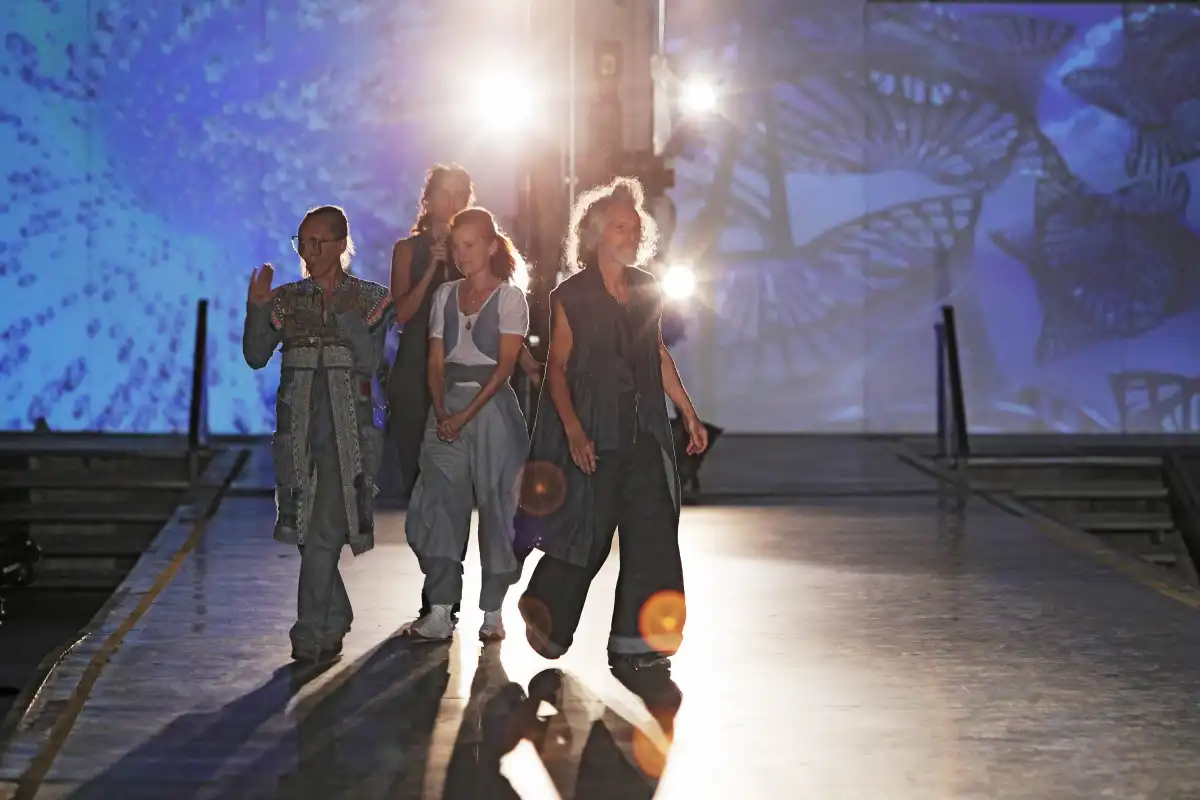
Getting to the future, at least on this particular Saturday night, required a tequila spritz, an encounter with Chairman Mao and, eventually, a walk through a parking lot.
Before threeASFOUR’s first runway show in five years, Mana Contemporary offered a cocktail hour and the rather civilized freedom to wander through several exhibitions. I was immediately caught by Andy Warhol’s original silkscreens. His Mao stared out with that familiar collision of propaganda, celebrity and immaculate color while I stood opposite, drink in hand. For a moment, there was simply me, Mao and a tequila spritz—an unexpectedly excellent trio well before the procession began.
Soon enough, guests moved across Mana’s industrial grounds, heels negotiating asphalt, toward a chamber so enormous that the crowd appeared briefly miniaturized. The journey felt less like ordinary event logistics than a transition between worlds: Warhol behind us, a new proposition in fashion waiting ahead.
Mana is, perhaps, precisely the right home for threeASFOUR. The sprawling former manufacturing complex contains studios, archives, installations and performance areas, allowing disciplines to meet without too much concern for labels. Art is not politely separated from movement, technology or dress. Everything overlaps, which is often where culture becomes interesting.

Founded by Gabriel Asfour, Angela Donhauser and Adi Gil, threeASFOUR has spent 25 years treating clothing as a system of ideas. Curvilinear patterns, fractal geometries and biomorphic construction transform the body into architecture—intimate, engineered and occasionally confrontational.
SAMSãRA brought that inquiry into muscular focus. Across 49 looks, fabric curved away from the figure, wrapped back around it and formed silhouettes that appeared part armor, part organism. Seams operated like lines of force. Certain pieces were imposing; others seemed almost weightless. Still, even the most sculptural garments retained movement. Structure did not consume the wearer. It gave them presence.
The craftsmanship, certainly, held the entire proposition together. Every contour appeared resolved; each reversible panel served the composition. Volume carried intelligence, while complexity remained disciplined. Nothing seemed applied merely for effect. These were clothes to be examined from several angles rather than absorbed in a single glance.

At the collection’s center was threeASFOUR Denim, based upon what the trio calls the “uniform of humanity.” Denim has dressed workers, rebels, cowboys, supermodels, adolescents and nightclub creatures with remarkably democratic ease. Here, indigo became newly unfamiliar through 14 designs derived from global garment archetypes. T-shirts, boot-cut jeans, button-downs, trenches and mini dresses were reconstructed through the collective’s visual language, with each piece reversible and wearable two ways.
The idea is practical, of course, although it is equally philosophical. A garment need not be consumed, photographed once and exiled to the back of a closet. It may change, return and acquire another identity. SAMSãRA invokes existence as recurrence; sustainability emerges through transformation rather than instruction.
Selections from the group’s 25-year archive appeared among the new work, allowing earlier forms to reenter the present with altered meaning. Memory became material. A spiral, sleeve or structural gesture returned not as nostalgia, but as evidence that innovation rarely travels in a straight line. The presentation also followed the Tribeca Festival premiere of Sean Ono Lennon’s documentary on the trio, lending the evening a quiet sense of culmination.

Live models shared the runway with digital fashion worn by threeASFOUR avatars, while Hen Yanni’s performance traveled through the cavernous hall. Happily, the technology never overwhelmed the clothes. Instead, it extended a central question: Where does the body end, where does the garment begin and what might identity resemble once physical limitations loosen their grip?
Warhol’s silkscreens, seen earlier over cocktails, suddenly felt like a rather exact prelude. He understood that repetition could alter meaning and that an image might become more seductive—or unsettling—the further it traveled. Beside threeASFOUR’s reversible clothing and virtual beings, his electric surfaces seemed less historical than prophetic.
Later, The Muses presided over the afterparty in their gorgeous glory, shifting the evening from presentation into performance. Artists, designers and familiar faces moved through the galleries as fashion, nightlife and visual culture began to merge.
That is Mana Contemporary’s peculiar intelligence. A cocktail hour becomes an exhibition visit; a catwalk turns into sculpture; an archive behaves like raw material; a party completes the argument. After five years away, threeASFOUR did not merely return. The collective made its history move again.