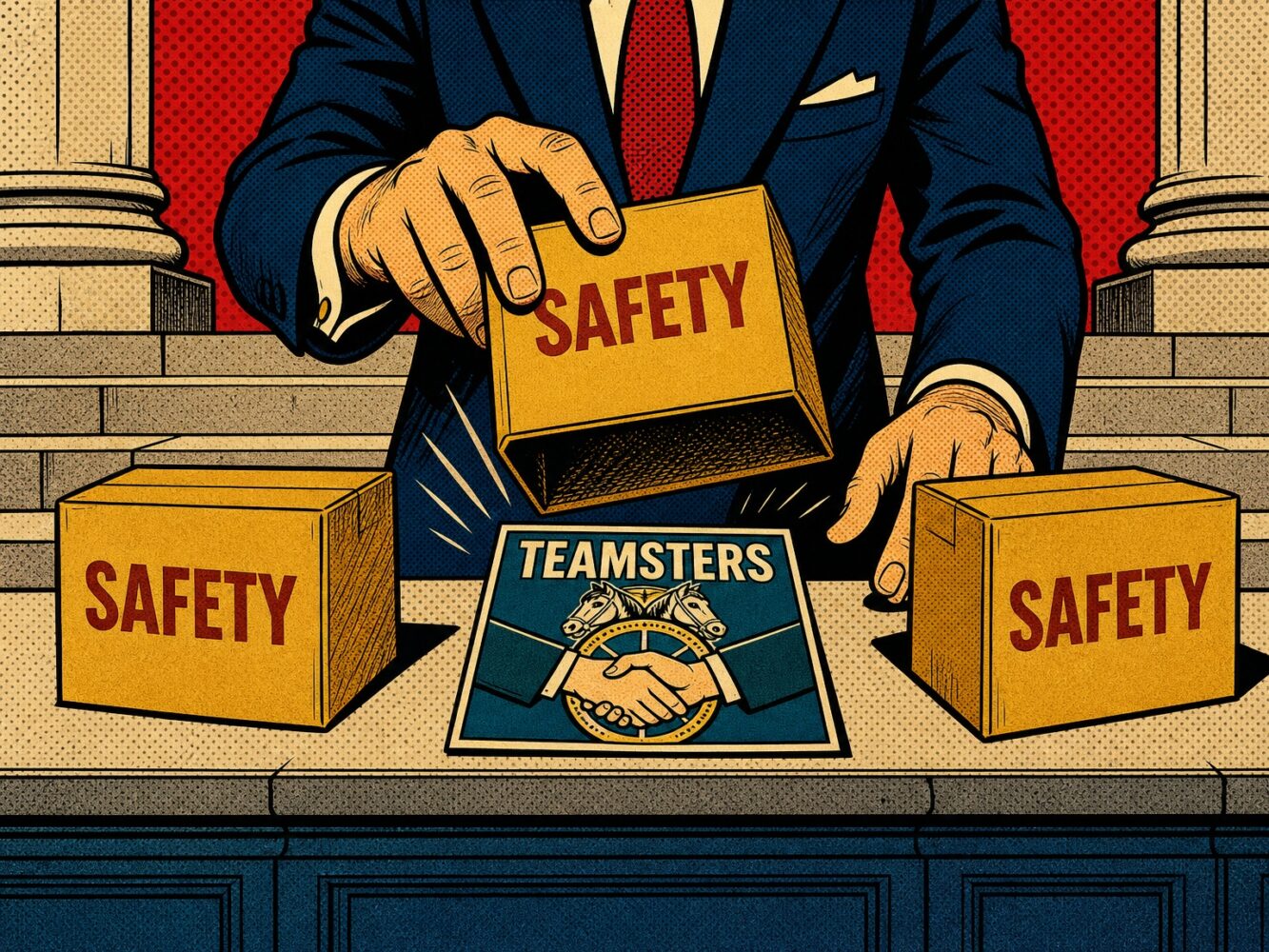
New York City has found an unlikely culprit for unsafe deliveries: the name on a driver’s paycheck. Its proposed cure would force Amazon to bring thousands of drivers in-house. The evidence that this would improve safety is thin. The implications for union organizing are anything but.
Last month, New York City Mayor Zohran Mamdani formally endorsed the Delivery Protection Act (DPA), a City Council bill sponsored by Council Member Tiffany Cabán. Though framed as a warehouse-licensing and safety measure, the bill would also require Amazon to employ its delivery drivers directly rather than contract with independent delivery businesses.
Just six days before Mamdani’s announcement, New Jersey sued Amazon over substantially the same delivery arrangements. The state alleges that Amazon uses its control over Delivery Service Partners (DSPs) to suppress compensation and worsen working conditions, including by pressuring drivers to meet unsafe delivery expectations. The geographic markets alleged in the lawsuit include New York City.
Both governments portray Amazon as directing the work while DSPs bear formal responsibility. Yet New Jersey treats limits on DSP independence as part of the problem, while New York would virtually eliminate that independence. Different statutes explain the different legal claims, of course. But they don’t explain how substantially the same conditions and harms can result from too little DSP independence in New Jersey, yet be cured by eliminating DSPs as employers in New York.
That contradiction frames the DPA’s central problem. Its supporters haven’t shown that DSP employment causes the harms they cite, or that direct employment would reduce them. Amazon’s extensive safety programs further complicate the case for abolishing the DSP model in the name of safety. What the mandate would unquestionably change is how New York City delivery drivers unionize and who they bargain with.
Rewriting Amazon’s Delivery Route
The DPA would create a licensing regime for last-mile warehouses—the facilities that handle the final leg of deliveries to customers—operated by services such as Amazon and United Parcel Service (UPS). It would also impose training, recordkeeping, discharge, and safety rules.
But the bill’s most consequential provision has little to do with licensing or street safety. After a phase-in period, it would require warehouse operators to directly employ workers who perform covered warehouse and delivery services, barring operators from contracting with third parties for that work.
For Amazon, that would mean ending its DSP program for covered work in New York City, subject to a revealing exception for collective bargaining discussed below. By Amazon’s count, more than 40 local DSPs employ over 5,000 drivers.
The bill would require facility operators to offer jobs to DSP workers terminated because of the required contract cancellations before hiring anyone else for the same work. But it wouldn’t preserve the DSP owners’ existing delivery agreements. These mostly small business owners could no longer perform work that Amazon would have to bring in-house.
Amazon also warned in City Council testimony that it would consider moving facilities outside the city (obvi, as the kids say), so the bill can’t guarantee that every route or job would survive, much less remain in New York City.
That’s a remarkably invasive response to unsafe driving or workplace injuries, and it demands persuasive evidence. As the bill’s supporting reports show, the city hasn’t supplied it.
The Nature of the Mandate
The DPA’s licensing provisions would apply to covered facilities regardless of how they organize delivery work. The New York City Department of Consumer and Worker Protection could suspend or revoke a license for noncompliance or a qualifying pattern of workplace, road-safety, environmental, consumer-protection, or worker-protection violations. Those provisions at least address the conduct the bill is supposed to target. The direct-employment mandate, by contrast, would prohibit a specific organizational arrangement regardless of the operator’s safety record.
UPS already employs its drivers directly, so the provision that would remake Amazon’s delivery operation in New York City would require little or no change from UPS. And—no doubt entirely coincidentally—UPS drivers belong to the Teamsters, whose Package Division identifies UPS as the union’s largest employer. The City Council would thus just happen to mandate the arrangement already used by Amazon’s unionized competitor. Whether that arrangement makes delivery safer is the question the bill’s supporters still need to answer.
As Ronald Coase explains in the classic law & economics essay “The Nature of the Firm,” firms compare the costs of organizing work internally with those of contracting for it. Amazon’s DSP program combines access to the company’s logistics network and technology with local responsibility for running a delivery business.
The arrangement may sometimes be suboptimal, of course. But it may also allow small businesses that couldn’t replicate Amazon’s logistics network to enter the delivery market, while leaving their owners room to experiment with hiring and supervision. Amazon’s common routes, safety standards, and technology don’t necessarily negate those advantages. Indeed, that coordination helps make the arrangement possible. Yet the bill would eliminate this choice without demonstrating that any resulting benefits would justify the loss.
A Crash Course in Causation
The mayor’s public case relies heavily on the New York City comptroller’s November 2025 report, “Fast Shipping. Slow Justice,” which recommended passage of an earlier version of the bill. The report argues that direct employment would improve safety, but its empirical analysis doesn’t isolate the effect of the employment arrangement on accidents. Evidence that delivery work can be dangerous doesn’t establish that DSP arrangements, in particular, cause the danger.
The mayor’s announcement repeats the report’s finding that 78% of areas within a half-mile of last-mile facilities experienced more injury-causing crashes after a facility opened. In other words, crashes rose near 14 of 18 facilities in a simple before-and-after comparison. The analysis includes no control group of comparable areas without new facilities, no adjustment for citywide trends, and no attempt to distinguish delivery drivers’ conduct from the additional traffic and new traffic patterns that accompany a new facility.
What’s more, most of the facilities opened in 2020 or later, so the “after” period also captures pandemic-era changes in e-commerce and delivery patterns. The report also cautions that its data don’t attribute individual crashes to vehicles connected with a last-mile facility.
Unsurprisingly, the data are decidedly mixed even on their face. Four sites recorded fewer crashes after opening, and three were Amazon facilities operating under the DSP model that the bill would ban. The largest increase in the raw number of crashes occurred near a UPS facility. Unlike the bill’s proponents, I wouldn’t go so far as to claim that these observations establish that the DSP employment arrangement is actually safer—but they sure don’t support the opposite claim. The crash data record what happened around warehouses. They tell us nothing about what would happen if Amazon employed its drivers directly.
The worker-injury data come closer, but they still don’t answer the relevant question. The report found that the Amazon DSPs it identified had higher reported injury rates than other New York City courier employers in 2023 and 2024. But it doesn’t control for the types of tasks workers perform, work intensity, tenure, or other employer-specific differences that may correlate much more strongly with injuries.
More fundamentally, the comparison group isn’t limited to drivers whom warehouse operators employ directly. It includes a range of employers in the broadly defined courier industry, rather than drivers doing similar work under different employment arrangements. The correlation may be somewhat suggestive, but it doesn’t come close to establishing that direct employment would reduce injuries.
Bill supporters have also cited Teamsters Local 804’s report, “The Last Mile in New York City.” Its analysis groups what it calls “e-commerce” and “legacy” delivery vehicles by make rather than by the company that employs their drivers. It then compares ticket counts without accounting for fleet size or miles traveled. That approach can’t distinguish a more dangerous employment arrangement from a larger or busier fleet. Its separate Amazon-specific analysis provides no direct-employment comparison, either. Neither analysis establishes that abolishing DSP employment would make deliveries safer.
One Company’s Safety Is Another’s Surveillance
The comptroller nevertheless treats UPS as the safety benchmark. The report cites UPS’ reported annual spending of more than $200 million on safety training and says the company has “invested heavily in data systems to optimize delivery schedules and reduce exposures to injuries sustained in driving.” It presents those investments as evidence of the incentives that direct employment creates.
To support its claim that UPS provides “more robust safety training,” the report cites only a 2019 ProPublica/BuzzFeed investigation. That investigation actually catalogs a wide range of safety measures Amazon implemented in 2018 as part of a company-wide safety initiative. Yet it largely dismisses the program based on reported implementation problems as Amazon rapidly expanded its operations.
Nowhere does the comptroller’s report assess Amazon’s current systems. Amazon reports spending more than $2.5 billion on safety across its operations since 2019, along with a 43% decline in its global incident rate between 2019 and 2025 (not limited to DSP-driver injuries, of course).
For transportation safety specifically, Amazon announced $200 million in technology spending for 2023. The company highlighted camera alerts, driver coaching, and its internally designed “Fleet Edge” system, which provides much faster updates about road conditions. Amazon’s testimony also reports that more than 180,000 drivers have graduated from its in-person driver academy. The report leaves these substantial programs out of its comparison.
The report does acknowledge Amazon’s training and monitoring elsewhere—but only to criticize the company’s alleged “power” over drivers. New Jersey likewise invokes Amazon’s “GPS tracking, in-vehicle artificial intelligence, and cameras surveilling drivers” as evidence of control and describes working conditions that include “invasive surveillance.”
Safety programs and intrusive monitoring can coexist, of course. But implementing common safety practices requires some authority over how drivers make deliveries. The comptroller praises UPS for exercising that authority. New Jersey treats Amazon’s exercise of it as emblematic of anticompetitive control.
Contentious characterizations aside, Amazon’s contracts apparently already permit substantial safety coordination, and the company has chosen to invest substantial sums in it. No evidence in the reports—or elsewhere—establishes that replacing DSPs with direct employment would improve safety. That’s a considerable omission from the case offered to justify abolishing an entire way of doing business.
Safety, Subject to Collective Bargaining
Section 20-566.8 may inadvertently reveal the bill’s real driver (no pun intended). Its collective-bargaining exception undermines the DPA’s entire stated purpose. The provision would allow waivers of the direct-employment mandate and every one of the bill’s safety rules—but not the licensing requirement, because we can’t cut government entirely out of the loop—if a collective-bargaining agreement with a “bona fide labor organization” grants them in exchange for “valuable consideration.”
No one in the history of contracting has used “valuable consideration” as a euphemism for “increased public safety.” Nor does the bill require any finding that such waivers would include safety guarantees. Apparently, the organizational arrangement deemed essential to safety becomes merely a concession to negotiate once a union enters the picture.
Indeed, the bill’s union-organizing rationale is considerably easier to follow than its safety arguments. The Teamsters say the bill would “put a stop to the abusive DSP model” and call direct employment necessary to end Amazon’s “exploitation of its workers.”
Direct employment would make Amazon itself responsible for collective bargaining, without requiring the union to first establish that Amazon is legally responsible for a DSP’s employees. The Teamsters could negotiate with a single firm, gaining greater leverage over a company with strong reputational incentives and substantial resources to fund concessions.
Direct employment would also prevent Amazon from ending its relationship with an organized workforce simply by dropping its DSP from the delivery network—unless, of course, a union decided, in the benighted wisdom the bill grants it, to allow contracting again. The Teamsters’ own account of its Amazon campaign also connects organizing Amazon with protecting union jobs at UPS.
Those benefits explain the Teamsters’ interest in direct employment. They don’t establish that contracting is inefficient or that making Amazon a direct employer would improve street safety.
Coase asked why firms organize some activities internally and obtain others through contract. New York City’s DPA would replace that economic choice with an employment mandate that offers no evident safety benefit—and then waive it when a union strikes a deal. The independent businesses whose contracts the bill would prohibit get no comparable consideration. Meanwhile, the cited analyses don’t establish that drivers and customers who would bear the costs of this crass, politicized choice would receive the promised safety benefits.
The bill’s clearest safety net is the one it extends to the Teamsters.