Competition policy is supposed to protect the competitive process, not do double-duty as price regulation. Yet the line between the two appears to be blurring in both a U.S. antitrust case and the European Union’s enforcement of the Digital Markets Act (DMA).
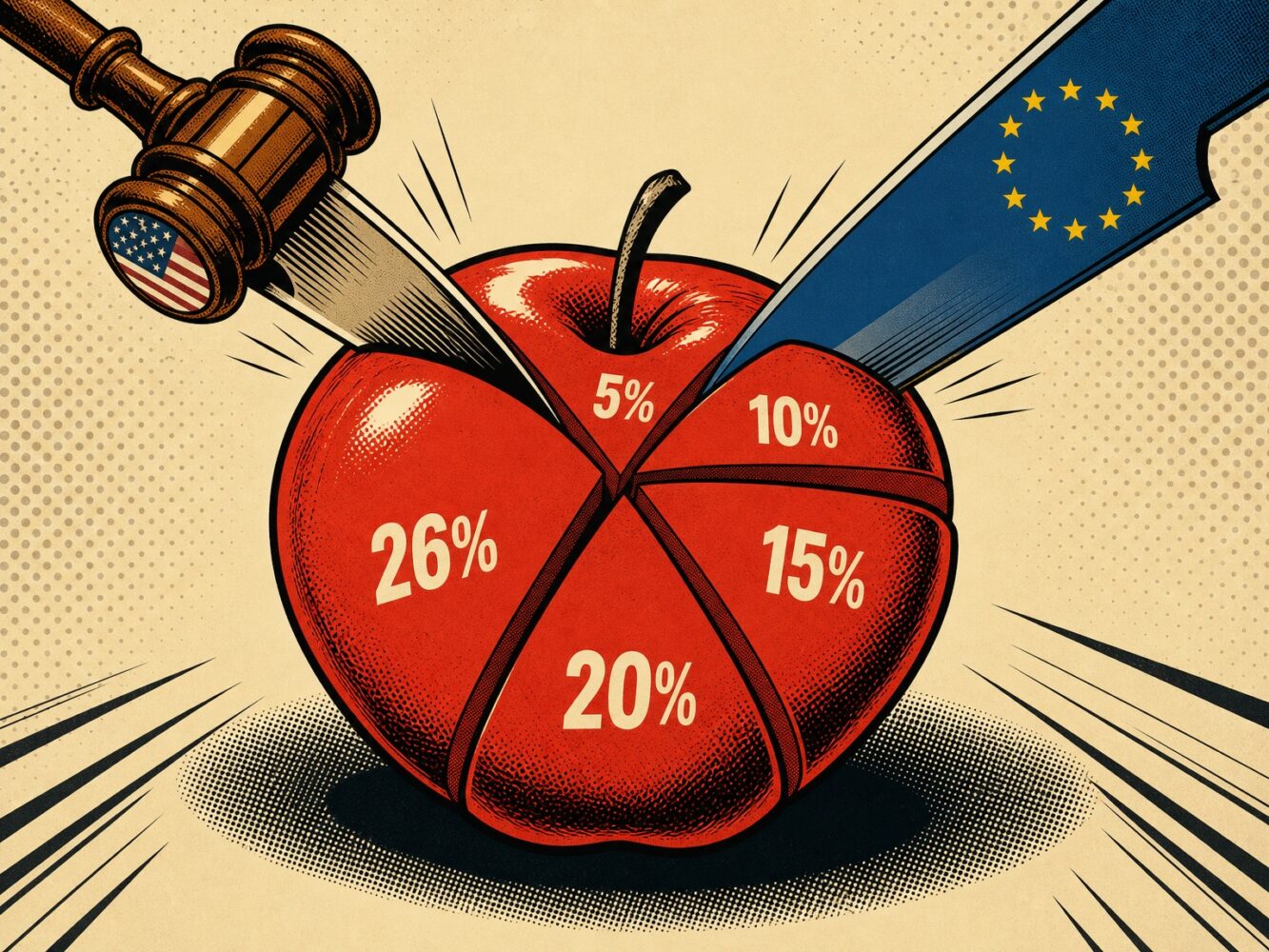
On Aug. 14, after years of litigation with Epic Games, Apple submitted a proposed commission structure to the U.S. District Court for the Northern District of California. Under the proposal, Apple would collect a 15% commission on purchases made through links from iOS apps and 10% on subscription renewals. Small businesses participating in Apple’s video, news, and mini-app programs would pay 5%.
Four days later, Apple announced new terms for developers in the European Union, following what the European Commission called a “close dialogue.” Apple would charge 26% on App Store sales made through its in-app purchase system, 20% when developers use an alternative payment processor within an app, and 15% on purchases made through external links. It would also impose a new 5% “Core Technology Commission” on apps distributed through rival marketplaces or the open web. Reduced rates of 15% and 10% would apply to small businesses, partner programs, and subscriptions after the first year.
The parallels are hard to miss. Both the U.S. and EU regimes ostensibly seek to protect competition, yet both pursue that goal by dictating the rates Apple may charge developers that rely on its platform and technology. That looks less like conventional competition enforcement and more like price regulation.
This raises several important policy questions. Are mobile ecosystems so uncompetitive as to warrant rate-setting, which is widely regarded as a policy of last resort? If so, do U.S. antitrust law and the DMA give courts and competition agencies the proper tools for the job?
The stakes extend beyond the distributional question of how Apple and Epic divide a fixed pie. Poorly designed price controls can weaken competition and innovation over time, ultimately harming the very consumers that enforcers ostensibly mean to protect.
Competition, Market Power, and Price Regulation
Markets generally allocate resources efficiently unless an identifiable “market failure” gets in the way. Classic examples include externalities, information asymmetries, public goods, and natural monopolies. Even in those exceptional cases, price regulation is usually considered a remedy of last resort.
After all, telling a private firm what it may charge is among the most intrusive tools in the competition-policy toolbox. The traditional justification for price regulation is therefore correspondingly narrow: a natural monopoly. That occurs when economies of scale allow one firm to serve an entire market at a lower average cost than two or more firms could, leaving competition unable to push prices toward costs.
Mobile operating systems do not fit that description. Start with one of the most exhaustive judicial examinations of the issue. In Epic Games v. Apple, the district court rejected the “market of one” theory, defined the relevant market as digital mobile-gaming transactions, and found that Apple’s 52% to 57% share did not establish monopoly power.
The reason was interbrand competition—that is, competition among rival brands and ecosystems. Dario Oliveira Neto and Mario Zúñiga have noted that Brazil’s Administrative Council for Economic Defense (CADE), for example, effectively made Apple a monopolist by definition when it limited the relevant market to “the non-licensable mobile operating system iOS.” But consumers do not buy an operating system in isolation.
Instead, they buy a bundled product that includes hardware, software, security, and an ecosystem of apps and services. Apple therefore competes directly with Samsung, Xiaomi, and Huawei for smartphone buyers. In the first half of 2025, Apple held 62% of Brazil’s “premium” segment, compared with 20% for Samsung and 8% for Huawei. Those are hardly the numbers of an unconstrained monopolist.
The smartphone ecosystem is better understood as an oligopoly: a market dominated by a small number of rivals. Apple’s iOS and Google’s Android compete vigorously and have repeatedly leapfrogged one another on features, privacy, and security. They now even offer tools designed to make switching between the two easier. The International Center for Law & Economics (ICLE) has made this point in submissions to CADE, the United Kingdom’s Competition and Markets Authority (CMA), and the Japan Fair Trade Commission (JFTC).
The CMA offers a counterargument that characterizes Apple and Google as a “stable duopoly,” citing low switching rates and the fact that most users do not consider alternatives when replacing their devices. But low observed switching tells us little by itself about the intensity of competition.
Consumers may stay because they are satisfied, not because they are trapped. Conversely, high switching can coexist with monopoly power when consumers respond to prices that a monopolist has already pushed above competitive levels—a version of what competition policy deems the “cellophane fallacy.”
Ultimately, what disciplines a platform is the credible threat that users will switch if prices rise or quality falls. If competition keeps prices low and quality high, few users may actually leave. Switching rates alone cannot reveal that competitive pressure.
Can Courts Set the Right Price?
Suppose, for the sake of argument, that one thinks Apple really is a monopolist, that App Store fees really are “too high,” and that someone should bring them down. The next question is who that someone should be.
In Verizon Communications Inc. v. Law Offices of Curtis V. Trinko LLP (2004), Justice Antonin Scalia warned that:
Enforced sharing also requires antitrust courts to act as central planners, identifying the proper price, quantity, and other terms of dealing—a role for which they are ill suited.
Scalia added:
Even if the problem of false positives did not exist, conduct consisting of anticompetitive violations … may be, as we have concluded with respect to above-cost predatory pricing schemes, “beyond the practical ability of a judicial tribunal to control.”
The Court then quoted antitrust scholar Phillip Areeda’s admonition:
No court should impose a duty to deal that it cannot explain or adequately and reasonably supervise.
When compulsory access requires “the day-to-day controls characteristic of a regulatory agency,” Areeda argued, courts should treat the problem as beyond antitrust law’s ability to remedy.
The point is that mandating access almost inevitably requires setting a price for that access. Doing so demands judgments about costs, investments, risks, product quality, and the value of supporting infrastructure. Those judgments must then be revisited as technological and market conditions change. Courts and competition agencies rarely have the information, expertise, or institutional capacity needed for the job.
Trinko also explains why monopoly prices are not unlawful by themselves:
The mere possession of monopoly power, and the concomitant charging of monopoly prices, is not only not unlawful; it is an important element of the free-market system.
The prospect of earning those returns, the Court reasoned, “induces risk taking that produces innovation and economic growth.” That principle clashes with the currently fashionable view that returns above cost are defects for competition authorities to engineer away.
Judge Yvonne Gonzalez Rogers, who oversees the Apple litigation in the United States, must now decide whether commissions of 15%, 10%, or 5% are acceptable. That means ascertaining the value of Apple’s distribution services, payment infrastructure, and application programming interfaces (APIs)—the tools that allow apps to interact with Apple’s operating system. For its part, Epic contends that, under the 9th U.S. Circuit Court of Appeals’ language concerning costs, the correct figure is 0%.
This is precisely the kind of judicial price-setting that Trinko warned against. Its rule does not control here, as the Apple case ultimately turned on California’s Unfair Competition Law, but its institutional warning applies all the same.
The Rate-Setter Without a Rate Book
Brussels and the DMA don’t offer an obvious answer to the “who” question either. The DMA gives the European Commission a broad remedial toolkit, but having the legal authority does not answer Areeda’s underlying concern. The problems here concern institutional capacity and information, not jurisdiction. The DMA granting the Commission authority to set rates is no substitute for knowing what the right rates are.
Proponents of digital-competition regulation initially insisted that the DMA would not become a price-control regime. Ioannis Lianos, Klaas Hendrik Eller, and Tobias Kleinschmitt argued that the DMA “does not aim to regulate entry or rates/output, as does traditional utility regulation,” but instead “sets some bright-line rules for business conduct” (p. 43).
Others pressing for gatekeeper rules shared that understanding. Writing in the CPI Antitrust Chronicle in 2021, Thomas Höppner argued that gatekeepers’ “tollbooths for market access” justified asymmetric regulation—special rules that apply only to designated gatekeepers. But he located the remedy in conduct rules, not price controls:
There is no need to outright prohibit any form of advertising or paid intermediation for gatekeepers. Neither is there a need to regulate their prices for such intermediation. In general, auction mechanisms are a competitive tool to determine an adequate price.
Höppner was writing about sponsored rankings rather than app-store commissions, but his reasoning applies in this context, as well.
Those reassurances are at odds with the DMA as enacted. Article 6(12) expressly contemplates fair, reasonable, and nondiscriminatory (FRAND) access terms and directs the Commission to assess them. Recital 62 specifically identifies pricing as part of that assessment. Article 5(4) also requires gatekeepers to let business users steer customers toward rival services “free of charge.”
Even that seemingly straightforward language raises difficult questions. Epic Games and other rivals interpret “free of charge” to mean that Apple and Google may not impose any fee, even one only loosely connected to steering. The Commission, by contrast, accepts that Apple may charge when it facilitates a user’s initial acquisition. That is a sensible compromise because it prevents rival marketplaces from free-riding on Apple’s investment in attracting users.
But the compromise simply tees up the harder question: How much may Apple charge? Once regulators create a right to steer customers elsewhere, they must decide what compensation, if any, the platform may collect.
The Commission made its rate-setting role explicit in an April 2025 noncompliance decision, which imposed a €500 million fine. The decision also established a three-part test. Any fee must relate only to the initial acquisition, correspond to the value of that acquisition after subtracting compensation the gatekeeper already receives for facilitating it, and not “remunerate the gatekeeper for gatekeeper value.”
That final restriction goes too far. By excluding compensation for the platform’s value as a gatekeeper, the test effectively expropriates part of Apple’s investment. As Lazar Radic puts it, this amounts to ex ante price regulation—without the institutional machinery that rate-setting ordinarily requires.
The DMA compounds the problem because it lacks a commitments procedure analogous to Article 9 of Regulation 1/2003, which allows the Commission to accept a company’s proposed remedies and formally close a case. Here, there is no reasoned decision explaining the accommodation, no press release announcing a resolution, and no closure of the April 2025 proceedings. They remain formally open, leaving no final action for anyone to appeal.
It’s also conspicuous that the same numbers keep appearing elsewhere. CADE’s December 2025 settlement in Brazil produced a 5% Core Technology Commission and a 15% fee on purchases through external links, months before Brussels blessed the same figures. The CMA is now drafting an explicit cost methodology, complete with a “market power adjustment,” while conceding that it cannot identify a “reasonable rate of return.”
In other words, four separate authorities have converged on essentially the same rates without a discernible methodology for deriving them. That suggests the goal is a symbolic victory, not the price most likely to promote competition and consumer welfare.
The Bill Comes Due
None of this would matter much if the only question were how Apple and Epic get to divide a fixed pot of money. But that’s not the case.
The broader stakes emerge from the free-riding problem that Brian Albrecht and Dirk Auer describe. Operating systems, app stores, and payment systems are not separate “bottlenecks” or choke points. They are parts of an integrated ecosystem funded largely by commissions. That business model has helped millions of consumers gain access to cheaper devices.
Restricting a platform’s ability to earn revenue from one part of that ecosystem can ripple through the rest. When authorities require platforms to permit alternative distribution free of charge, rival stores can use the platform’s APIs, security protections, and customer base without helping to cover the costs of building them.
Free steering of payments creates a similar problem. A developer can use an app store’s discovery and curation services to find a customer, then route that customer’s purchases elsewhere. The store bears the cost of bringing the parties together but loses the revenue that made the service worth providing.
That problem hits hardest for the entrants that these rules were supposedly enacted to help. A new app store launching on iOS must invest in curation, security reviews, fraud prevention, and customer support. Yet it faces the same free-riding problem, because its developers can steer customers elsewhere, too.
A coherent policy must decide how a trusted marketplace will recover those fixed costs. Neither the DMA nor the district court has done so. Both have instead pushed permissible fees toward incremental cost—the cost of handling one additional transaction—across every layer of the ecosystem at once.
Returns above incremental cost are not a regulatory defect that authorities should seek to engineer away. As ICLE told the CMA, those returns finance the substantial upfront costs of creating platforms, much as they finance the creation of intellectual property.
Investors fund improvements based on the returns they expect those improvements to generate. If regulation caps revenue from steered transactions near incremental cost, it tells investors that much of the upside from building a better platform will flow to someone else.
Cost-plus regulation therefore optimizes for the wrong kind of competition. It pursues static allocative efficiency by squeezing today’s margins. But consumer welfare in mobile ecosystems has come largely from dynamic competition—competition to develop new devices, capabilities, and form factors over time. That requires sustained reinvestment.
Consumers will not remember the year an app-store commission fell by four percentage points. They will notice when quality stalls, or when promised features never arrive.
Some of those costs are already visible. Apple has delayed or withheld iPhone Mirroring, AirPods Live Translation, and its revamped Siri artificial-intelligence system in the European Union. Google has withheld AI Overviews.
Regulatory compliance has also consumed one of the scarcest resources at leading tech firms: engineering talent. The Commission’s impact assessment had projected a total compliance cost of about €10 million for all gatekeepers. In reality, Meta reports assigning more than 11,000 employees and nearly 600,000 engineering hours to compliance. Google devoted about 3,000 engineers full time for two years to complying with a single article.
And what have consumers received in return? Apple’s November 2025 study examined more than 41 million EU transactions. It found that after commissions fell by roughly 10 percentage points, 91% of products either became more expensive or saw no price reduction. Non-EU developers captured 86% of the €20.1 million in estimated savings.
Apple commissioned the study, so its findings deserve appropriate scrutiny. But it remains the only transaction-level evidence available. It also survives a placebo test—a check designed to detect results that may be spurious—and no one has rebutted it.
Rather than lower prices, the apparent result is a transfer of economic rents from the platform to a largely non-European group of bigger developers, while consumers remain roughly where they started.
If consumers do not benefit, a lower commission is not a victory of competition policy. It’s just a new way to divide the spoils.