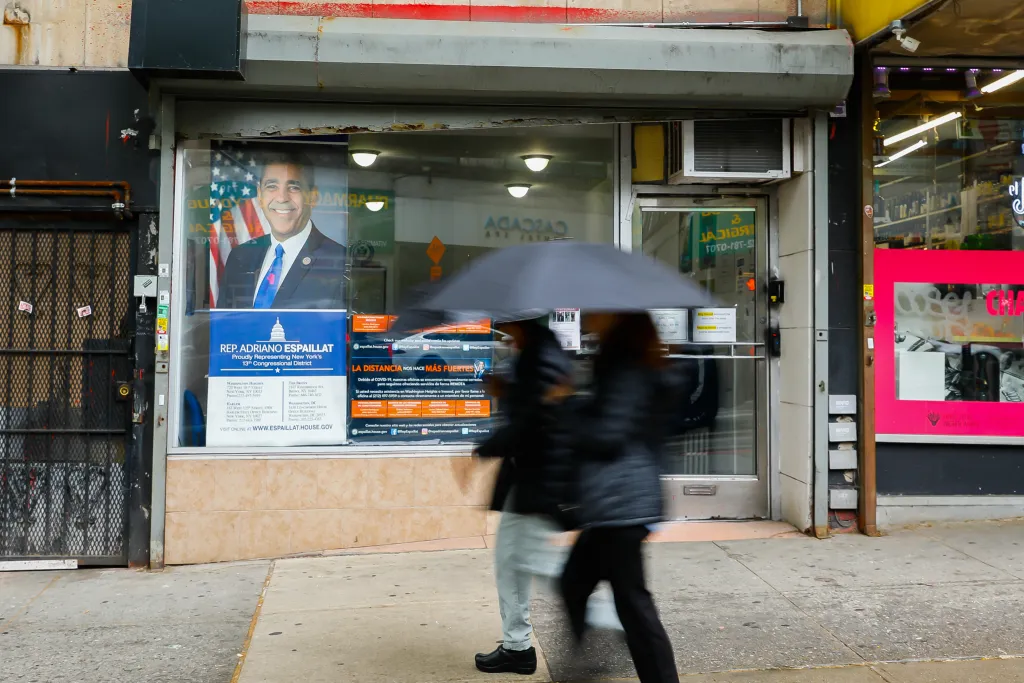
The primary election is quickly approaching on June 23, when New Yorkers will decide who will be their voice in Congress. Candidates are running in eight competitive congressional districts across a city historically dominated by the Democratic Party — at least outside of Staten Island.
When a candidate wins a party primary in New York City, it many times means they’ll sail to an easy win in the November general election. So, learn now who’s running in your district and why it matters — and remember, you must be registered with a party by June 13 to vote in the upcoming June primary election.
What can these individuals who represent you in Washington do for you back at home? A lot — if they put in the effort for their constituents. That entails handling problems with federal programs like Social Security or immigration services, complaints, red tape and more for locals.
THE CITY spoke with multiple experts who study the federal government, local politics and elections to find out how specifically federal representatives can serve their constituents on a local level.
Here is what they said:
Jump to …

What do federal representatives do?
New York City is made up of 13 congressional districts; Rep. Nicole Malliotakis, who represents a district encompassing all of Staten Island, serves as the sole Republican member of the New York City’s delegation.
The primary work of congressional representatives is what Eli Valentin, political analyst and founder of the Institute of Latino Politics and Policy, called the “constitutional duty to legislate” by sponsoring bills, voting on legislation and providing federal oversight.
All other duties, including constituent services — i.e. helping people in their districts with problems — are not actually part of their constitutional job requirements.
But “it is a role they have taken historically to provide their constituents with specific services,” Valentin said. “They become a liaison between constituents and federal agencies or any other governmental agencies.”
How can your federal representative help you?
Reps can help when programs, services and regulations have a federal dimension to them, including:
- passports and travel issues
- Medicaid and Medicare
- Social Security and disability checks
- SNAP and WIC benefits
- Veteran Affairs medical services
“There is not a downside to talking to someone in your representative’s office. There’s really only an upside,” said Lindsey Cormak, a professor of political science at the Stevens Institute of Technology and member of Community Board 8 in Manhattan.
Federal staff members often have experience in state and local government giving them wide expertise, said Andrew Sidman, professor of political science at John Jay College of Criminal Justice.
“There’s often a lot of cross-pollination across legislative offices, which helps when a constituent has questions and doesn’t really know who to turn to,” he said. “Even going to your house rep’s district office with a question that’s a local one, you still might get a good answer.”

Members of Congress can also nudge local lawmakers or help you navigate the bureaucratic processes of government.
Gina DiGiovanni, a Staten Island resident represented by Malliotakis, knows how maddening it can be to deal with red tape and slow-moving government. She had to contact her district office for help twice throughout a decade of dealings with the Social Security Administration after receiving disability benefits for a 2016 car crash that injured her knee.
First, she contacted Malliotakis’ office in 2017 after she lost healthcare due to an administrative error by Social Security. They wrote to the agency on DiGiovanni’s behalf and kept pushing until her healthcare was restored.
DiGiovanni again sought help from Malliotakis’ office in 2021 when Social Security said she owed nearly $8,000 in overpayments.
She went to Malliotakis’ staff again as a last resort. “You can’t get through to them,” she said about the Social Security Administration. “It’s only email correspondence — I couldn’t do it.”
A staff member advised DiGiovanni to get a lawyer, request a hearing with a judge and collect all correspondence. To her surprise, Social Security recently sent DiGiovanni a letter stating the nearly $8,000 payment had been resolved.
“Like a miracle, it happened,” she told THE CITY.
Broadly speaking, when an issue has a federal dimension, go to your congressional members, experts said. Seek out your state lawmakers and City Council members for state and local issues.
Certain representatives can have more sway than others — referred to as “people with presences” by Stephen Louis, distinguished fellow and counsel to the Center for New York City Law at New York Law School.
“For example, I would say that Hakeem Jeffries probably would get a lot of attention if a city official was called by him or someone in his office to help on an issue,” Louis said of the House minority leader, who’s touted by some as the next Speaker of the House. “If you have a lot of potential influence in Washington, people are going to pay attention to you.”
“Often, it’s a question of having been around for a long time,” he added.

How do constituent services work?
Constituent services are called “casework” by insiders, Cormack explained, which is when a person goes to their representative and requests help.
“Offices have dedicated staff just to help constituents resolve those issues, and in some cases they’re able to turn things around relatively quickly,” she said.
Staff at a district office will open a case for you, which often includes signing a privacy release form to authorize the representative to act on your behalf.
Harlem resident Matthew Reysio-Cruz, 30, contacted Rep. Adriano Espaillat’s office when U.S. Citizenship and Immigration Services rejected his husband’s green card application due to an error. His husband, a native of the Philippines, received special permission to leave the country during the green card process, which an immigration officer did not record on his case.
The couple appealed the rejection, which Reysio-Cruz said cost $800 to file and could have taken up to six months for a response. If successful, his husband would also have to start the green card application over.
Instead, they went to Espaillat’s congressional website and filled out a form requesting help.
Within a week, a staffer who specialized in immigration services contacted them. “She basically told us she would take care of it,” Reysio-Cruz said. “We didn’t have to explain. She understood exactly how the process would work.”
The couple had been hoping she would speed up the appeal process, but instead, the staffer called federal immigration services directly to rectify the immigration officer’s error.
“Within a couple of weeks, we got an email that his green card had been approved,” Reysio-Cruz told THE CITY. “We got the notification a day before the election in 2024. Amid everything happening, it was nice to know the security of him having his green card.”
Rep. Yvette Clarke, who has represented Brooklyn’s 9th Congressional District since 2007, advised constituents not to wait to reach out for help.
“Do not wait until things get really out of control, or the burden becomes overwhelming. Let us help you. That’s why we’re there,” she told THE CITY.
Well-run constituent services are indicative of a representative with an organized staff, according to Sidman. “It really has become a very heavily administrative task,” he said. “That is, if you hire a good staff, especially if you have a good chief of staff, then those things tend to be handled very well.”
Both Sidman and Louis mentioned former Rep. Joe Crowley of Queens as a “cautionary tale” — a representative who over the years became known for neglecting his constituents. He represented the 14th congressional district for 10 years before Rep. Ocasio-Cortez swept in as a political newcomer and ousted him.
“It was widely felt that he had ignored the district, and that cost him,” Louis said. “People didn’t even know her, but they knew that he had kind of stepped away.”

Beyond constituent services: Bringing home the bacon
Beyond directly aiding constituents, reps can also have a local impact by securing federal funding for district projects and providing major infrastructure funding. This includes projects like the Second Avenue Subway and the Gateway Project Tunnel.
Members of Congress also request and secure federal funds for specific, local issues in their districts.
Recent examples include Ocasio-Cortez getting $253,000 in funds to implement a space science program across seven libraries in Queens, Rep. Dan Goldman getting $250,000 for an alternative to incarceration program in his district and Rep. Ritchie Torres cinching $750,000 to support programming at the New York Botanical Garden, which encompasses his district in The Bronx.
They also act as oversight to federal agencies and facilities, like the Metropolitan Detention Center, a federal prison in Sunset Park, Brooklyn, that Rep. Grace Meng visited in March, or the immigrant detention facilities in 26 Federal Plaza, which Goldman said he has been visiting weekly since February.
Some members of Congress are more engaged with their local district than others, according to Louis. It is not atypical for reps to become involved in local issues or even to show support at press conferences for matters that do not concern the federal government, but if they do, would-be voters take note.
“They get appreciated,” he said. “If they’re known as someone who can be helpful, that’s a good, positive trait that would be presumably rewarded on Election Day.”
Our nonprofit newsroom relies on donations from readers to sustain our local reporting and keep it free for all New Yorkers. Donate to THE CITY today.
The post What Can a Congressional Rep Actually Do For You? A Guide for NYC Voters appeared first on THE CITY – NYC News.
