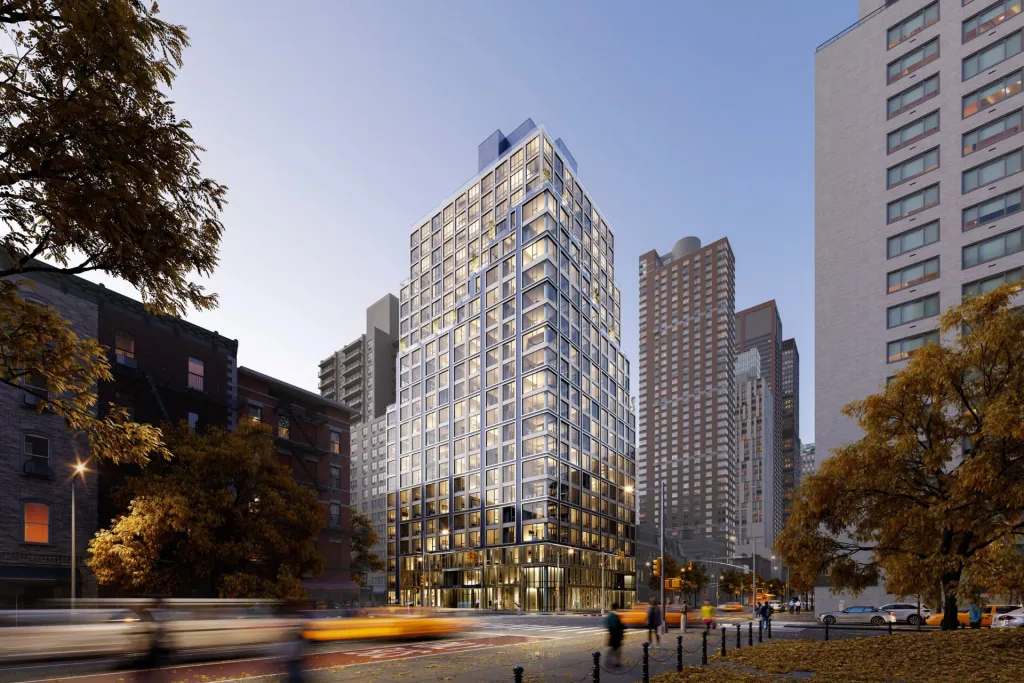
They’ve popped up all across the city, scores of new building plans by different companies in very different neighborhoods, with one thing in common: They all have exactly 99 apartments.
In the past two years, developers have filed permits for more than 150 residential buildings with that precise number of units, per city data.
Why? Because at that size, savvy builders looking to take a major tax break for residential developments can avoid paying a higher minimum wage to construction workers — while minimizing the number of affordable apartments they must include.
“It feels very counter to the overall goal of what we’re trying to achieve here, which is that we’re trying to build more housing,” said Justin Pelsinger of the development firm Charney Companies, which is not working on any 99-unit projects.
Just 1% of proposed developments that have registered to use the tax break have 100 units or more, according to the Department of Housing Preservation and Development (HPD). Several proposed 99-unit buildings are clustered on the same lots and share a common facade so that they appear to be a single, larger building.
For labor leaders, the trend is a big problem. Gary LaBarbera, president of the Building and Construction Trades Council of Greater New York, described the practice as “a scam,” and said he raised the issue earlier this year with city officials in an attempt to close the loophole.
“The sad part of it is, who suffers? The people suffer because they’re building less affordable units,” LaBarbera said.

But developers say their approach is just a reasonable, if creative, solution to make their budget math work under the constraints of the relatively new tax exemption program: 485-x. It came into effect in 2024 to replace another tax break program that helped spur the majority of new residential construction in New York City between 2010 and 2020.
The program is meant to create new housing developments with a combination of market-rate and affordable apartments — that is, units with rents determined by the income level of the tenant — using only private dollars, without government funds.
That program, 485-x, requires developers of buildings with at least 100 apartments to pay construction workers a minimum hourly wage of $40.
If a project has less than 100 apartments, only 20% of its units must be income-restricted, or “affordable,” and permanently rent-stabilized. No wage minimums apply.
The proportion of affordable apartments goes up the more units a 485-x building has. For buildings with 100 to 149 apartments, 25% of the total must be rent-stabilized and affordable for a family of four making about $129,600.
For buildings with at least 150 apartments in certain areas of the city — including Lower Manhattan and parts of the Brooklyn and Queens waterfront — a quarter of the apartments must be permanently rent-stabilized and affordable for families of four making about $97,200. There are also higher wage requirements.

Developers, architects and consultants say the requirements for minimum wages and affordability levels, taken together, increase costs and limit incomes of the development projects. They’re finding ways to work around them in order to build much-needed housing.
“For a bigger building at the edge of 99, you can goose the unit count down by combining the units,” said John Woefling, partner at Dattner Architects. “So you’re not providing more housing, you’re just providing bigger units.”
Elie Pariente, principal at EMP Capital Group, said his company plans to construct several projects with 99 apartments each, some with multiple 99-unit buildings on the same lot, though he didn’t specify where. He said if his developments were any larger, and thus subject to the 485-x requirements, he wouldn’t be able to lean on his longstanding relationships with certain contractors.
“A lot of the trades that we normally use wouldn’t work,” he said. “If we were to go for more than 99 units, we would have to hire brand-new trades and brand-new contractors that we’ve never worked with before.”
Of the 299 proposed developments that have registered to use the tax break, about 10% of them contain exactly 99 apartments, according to data from HPD.
Between April 2024 and 2026, developers have filed permits for more than 120 additional buildings with exactly 99 apartments, but those do not appear in HPD’s registration data, according to a review by THE CITY.
This is a notable leap from the 13 buildings with 99 apartments that developers proposed between 2008 through 2023, a previous analysis by the Real Estate Board of New York found.
Mayor Zohran Mamdani campaigned on building 200,000 affordable apartments over a decade, using union labor. The early results of the 485-x program — which was authorized by the state in 2024 — may raise questions about how feasible that goal is, but City Hall spokesperson Matt Rauschenbach said officials are monitoring the program’s implementation.
“We will continue to work with our partners in Albany, labor, tenants and the City Council to build a more affordable city — including by both building new housing and ensuring that the people building it have good, safe, quality jobs,” he said in a statement.
More Buildings, More Costs
Some of the developments Pariente is working on are single buildings with 99 apartments, such as one that will be located on the border of Crown Heights and Prospect Heights in Brooklyn. Others, he said, will have multiple 99-unit buildings on the same lot.
“Different lots lend themselves to the 99-unit concept more than others,” he said. “The larger the lot, the more flexibility you have subdividing it.”
Such developments — say, three 99-unit buildings acting as one — have duplicative elements, which can add both up-front costs and be more expensive to maintain than a comparable individual building with 297 apartments in it.
“We’re now putting in added walls, added trash rooms, added stairs, added elevators, so we’re basically losing square footage that would have been available for units, and putting it into these new structural elements that are some of the most expensive and highest-carbon elements in a building,” said Toby Snyder, senior associate at FXCollaborative Architects, referring to energy-intensive materials and processes.
Examples abound: On the Upper East Side, a building under construction appears as one tower, but is technically two, each with 99 apartments. In Highbridge, not far from Yankee Stadium, a developer planned twin buildings nestled together on one leafy street corner, with 99 apartments each.

In Boreum Hill, a developer filed permits for three buildings with 99 apartments each. In architectural drawings, the buildings appear seamlessly connected. One lot in Downtown Brooklyn will see five buildings with 99 units each.
But breaking apart a development into separate 99-unit segments on one lot meets its limit on small lots in dense areas. For instance, in Midtown and Long Island City — all neighborhoods recently rezoned for more housing — a lot that could accommodate a tower with several hundred apartments would likely be too small to split the building apart into several 99-unit buildings.
“If we’re not building those larger projects where the zoning and density allow for it, then we’re leaving units on the table, and we’re not really solving for our affordability or housing crisis,” said Basha Gerhards, executive vice president of public policy at REBNY.
Labor leaders are critical of the 99-unit playbook.
“Of course the developer is going to say, ‘Oh, the numbers don’t work,’ because they’re trying to justify the scheme that they’re engaged in,” LaBarbera said. “They don’t want to pay fair wages. They want to profit, profit, profit.”

Kevin Elkins, political director of the carpenters’ union, said developers risk losing their tax breaks as they move forward with multiple, clustered buildings each containing 99 apartments.
“A lot of these buildings are sharing the same mortgage. They’re sharing the same amenities. They’re sharing the same tax lots. It’s so clear what’s going on,” Elkins said. “We will be providing, if necessary, evidence that this is one building, that workers weren’t paid the wages they were supposed to be paid.”
New York City Comptroller Mark Levine would ultimately be the enforcer of the prevailing wage portion of the tax exemption, though his office hasn’t received any related complaints.
Exception to the Rule
There is one exception to the 99-apartment trend, based on city data. Developer TF Cornerstone will rely on the 485-x tax program and still go big, with 1,060 apartments planned across three buildings on the Greenpoint waterfront, and 278 apartments planned in Chelsea.
Jon McMillan, TF Cornerstone’s senior vice president and director of planning, said those developments are possible because the company has long been a union contractor, and by using its own money, it doesn’t have to rely on others for financing. But the process hasn’t been easy.
“This is very, very challenging for us. We want to move forward with these two projects but they don’t work for us nearly as well as projects we’ve done in the past, or as we’d like for projects to work,” McMillan said. “We’re doing these buildings at a lower rate of return than we normally do and than is sustainable, but we want to keep our organization busy.”
Still, there’s a chance more developers could use 485-x to construct larger apartment buildings in the future, like those finishing projects under a previous tax exemption program. And some are waiting on higher-level changes before moving forward, including the lowering of interest rates, costs of goods and materials and tariffs.
“If we were in a lower interest rate environment and commodity pricing came down, and insurance pricing was not at record high, could we make something work with the $40 wage floor?” said Eli Weiss, principal at Joy Construction Corp, whose projects typically contain 150 to 175 apartments. “Absolutely.”
Additional reporting by Kennedy Sessions and Haidee Chu.
Our nonprofit newsroom relies on donations from readers to sustain our local reporting and keep it free for all New Yorkers. Donate to THE CITY today.
The post 99-Apartment Building Boom Makes 99 Problems for NYC Housing Crisis appeared first on THE CITY – NYC News.
