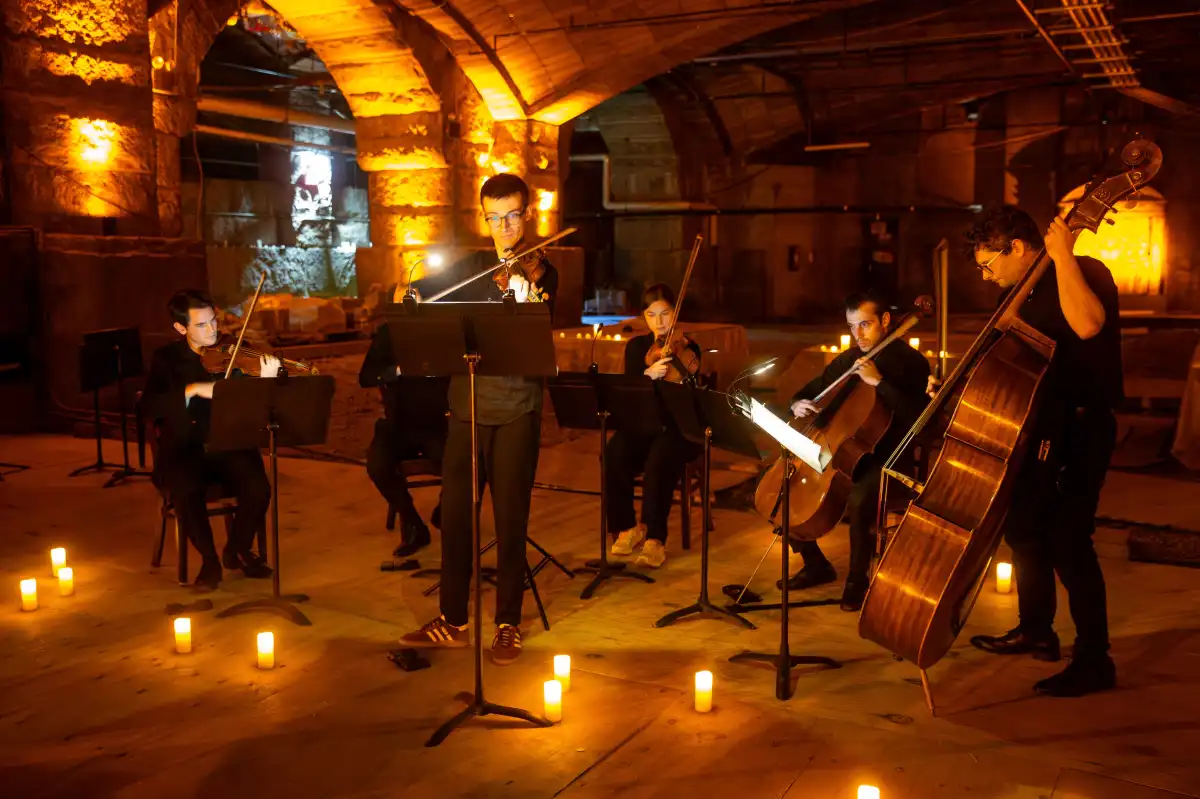
Long before music belonged to the concert hall, it belonged to stone.
It belonged to churches, chapels, cloisters, crypts, courts, salons, and chambers where sound was never entirely separate from ritual. A note did not simply travel through air; it gathered against limestone, slipped into arches, trembled beneath vaults, and returned to the body altered by architecture. Music, in these earlier spaces, was not merely entertainment. It was atmosphere, ceremony, devotion, warning, consolation, and social intelligence. It understood, almost instinctively, that where we listen determines how deeply we listen.
With this in mind, Death of Classical’s After the Fall, presented on the first of May in the Crypt beneath the Cathedral of St. John the Divine, felt less like a novelty and more like a restoration of context. Created by Andrew Ousley, Death of Classical has become known for presenting classical music and opera in crypts, catacombs, cemeteries, and other charged spaces, often paired with food, wine, and spirits. The premise could, in less careful hands, become theatrical excess. Here, however, the effect is more disciplined, more cerebral, and more persuasive. Atmosphere is not used to decorate the music. It is used to recalibrate the act of listening.
The evening began above ground, beneath the vast Gothic body of the Cathedral, where a few sips of whiskey seemed to soften the ordinary defenses of the day. From there, we were led through the stone quarry and down into the candlelit Crypt. The descent mattered. One does not simply enter a crypt in the same way one enters a concert hall. The body registers the change before the mind has language for it. The city recedes. The air cools. Stone begins to govern the senses. Candlelight flickers against the walls with a severity that feels almost medieval, though never ornamental. The space creates a form of attention that is more vulnerable, more alert, and perhaps more honest.
The program paired Richard Strauss’s Metamorphosen with Missy Mazzoli’s Dark with Excessive Bright, two works deeply concerned with artistic response to destruction, grief, and cultural fracture. Death of Classical returned to the Crypt under St. John the Divine for this program, presenting Strauss in a rarely performed string septet arrangement and Mazzoli in an arrangement for string quintet with violin soloist.
Strauss’s Metamorphosen arrived first, and rightly so. Written in the final days of World War II, as Europe’s cultural inheritance appeared to be collapsing around him, the work is often understood as an elegy for art under siege. In the Crypt, that historical burden did not feel abstract. The music unfolded as a long, continuous meditation on mourning, not in the sentimental sense, but in the structural one. Grief became architecture. Memory became pressure. The strings seemed to hold the room in suspension, asking how beauty might continue after the institutions built to protect it have failed.
There was something quietly devastating in how the piece occupied the space. The Crypt did not dramatize Strauss so much as clarify him. The stone absorbed any temptation toward excess and returned the music as something leaner, darker, and more severe. In that setting, Metamorphosen did not sound like a relic of European despair. It sounded like a living argument about what remains when civilization has embarrassed itself beyond recognition.
Mazzoli’s Dark with Excessive Bright followed with a different kind of difficulty. Its title comes from Milton’s Paradise Lost, from the paradoxical language of a blind man attempting to describe his vision of God. The phrase is extraordinary because it refuses the simple opposition of light and darkness. It suggests, instead, that light can become so overwhelming it resembles blindness, and that darkness may contain forms of perception unavailable to ordinary sight.

In the Crypt, that paradox became almost physical. Candlelight did not simply illuminate the space; it complicated it. Shadows pooled and shifted. The room seemed to move between exposure and concealment. Mazzoli’s music, with its Baroque echoes and contemporary unease, appeared to operate within that same unstable register. It glowed, then withdrew. It sharpened, then dissolved. It suggested radiance without comfort, darkness without emptiness, and beauty without the obligation to soothe.
What made the programming especially strong was the philosophical sequence. Strauss offered the aftermath of collapse. Mazzoli offered the disorientation of perception after collapse, when one is no longer certain whether the light ahead is salvation, hallucination, or merely the eye adjusting to ruin. Neither piece provided consolation in any cheap sense. Both seemed to propose something more rigorous: that art does not repair destruction by denying it, but by giving it form.
This is perhaps the larger intelligence of Death of Classical. The project does not treat classical music as fragile, which is refreshing. It treats the contemporary frame around classical music as the more fragile thing. By taking the work out of the expected hall and placing it within spaces marked by death, memory, and sacred residue, Ousley’s series returns the music to a more primal social function. It allows classical music to feel less embalmed and more immediate, less inherited and more necessary.
By the end of the evening, the Crypt beneath St. John the Divine had become more than a setting. It had become a collaborator. Strauss mourned through it. Mazzoli refracted through it. The audience listened inside it.
The result was not escapism. It was calibration. For a brief and rather extraordinary hour beneath the city, beauty was not presented as relief from history. It was presented as one of the few remaining ways to survive it.
DEATHOFCLASSICAL.COM
