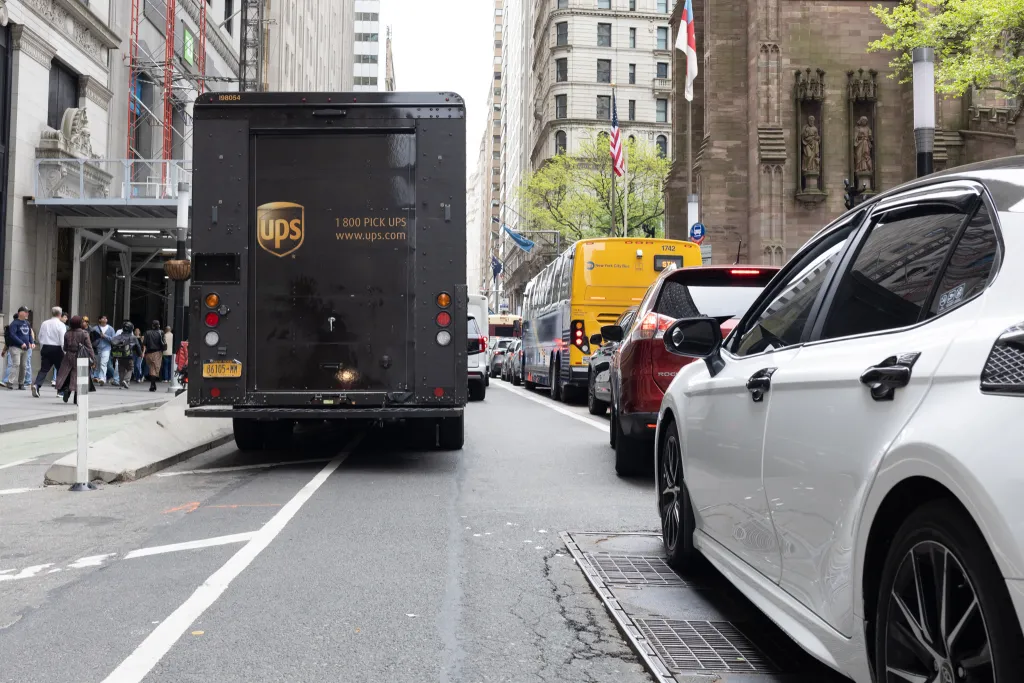
Here’s what brown can do for you: turn commuting on the country’s pokiest buses into even more of a slog.
UPS trucks were flagged more than 25,000 times last year for obstructing New York City bus lanes, MTA data reveals. That’s nearly twice as many as Amazon, whose 12,975 violations ranked second.
The images of bus-lane blockers were captured by automated camera enforcement, a system now in use on buses that run along 60 MTA routes.
The penalties against UPS — whose slogan was once “What can brown do for you?” — far outnumber Frito-Lay, Verizon, FedEx and Con Edison on the list of businesses caught obstructing bus lanes the most.
“These companies seem to have made illegal parking — especially blocking the bus lanes — part of their business model,” Janno Lieber, MTA chairperson and chief executive, told THE CITY. “It’s time to motivate them to get over that bad habit.”
UPS did not respond to requests for comment, nor did representatives for most of the other companies.
The push to get vehicles out of bus lanes comes as Mayor Zohran Mamdani has repeatedly pledged to make buses faster and after he brought in a new adviser for his “fast and free” buses campaign this week.
The top 25 bus-lane intruders last year combined for close to 130,000 violations, according to numbers provided to THE CITY. Frito-Lay trucks received 6,740 violations, Verizon vehicles were caught by the cameras 5,669 times, while FedEx and Con Edison were respectively hit with 4,240 and 3,546 violations.
In all, 843,000 violations were issued for bus lane blockers in 2025, according to a September report by the city Department of Finance.

An Amazon spokesperson said the company works with more than 40 locally owned and operated delivery service partners that are responsible for day-to-day operations. The independent businesses employ more than 5,000 workers to make deliveries across the city.
“We expect all delivery partners to comply with local traffic regulations, and we’re investing in long-term solutions, including fleet electrification, e-bike and walker programs to reduce our impact on city streets and be a good neighbor,” said spokesperson Leigh Anne Gullett.
A Con Edison spokesperson noted that the utility’s crews operate around the clock as part of the city’s emergency response network.
“At times, that work requires prioritizing safety access over parking regulations,” said spokesperson Anne Marie Corbalis. “While safety always comes first, we work to minimize disruptions whenever possible.”
When buses on a route are equipped with cameras, there is a 60-day warning period before motorists begin racking up fines.
The violations were most common along the M101, where more than 50,000 violations were issued along the route that runs between the East Village and Upper Manhattan. Just under 41,000 bus-lane blockers were flagged along the M15, which links East Harlem and South Ferry. On the Bx19, which runs between the New York Botanical Garden in The Bronx and Riverbank State Park in Manhattan, close to 23,000 violations were cited.
“Our hope is that the [automated camera enforcement] program won’t be just another fee that these companies see as a cost of doing business in New York,” said Brian Fritsch, associate director of the Permanent Citizens Advisory Committee to the MTA. “I hope that they realize these are their workers trying to get to and from work.”
The penalties kick in once a vehicle is caught on camera twice for standing in a bus lane for longer than five minutes, with the initial $50 fine matched for each additional violation, up to a maximum of $250. Vehicles can also get flagged if they are observed blocking bus stops twice for more than two-and-a-half minutes.
A Fine Mess
Altogether, the city issued $54.9 million in fines for bus-lane violations in Fiscal Year 2025, just under 5% of the $1.1 billion in overall penalties for parking and camera violations.
That’s a fraction of the $244.1 million in fines issued for speeding in school zones, according to the September Department of Finance report.
Department of Transportation officials said that ongoing and planned street redesigns — including some that will place bus lanes in the middle of busy thoroughfares and not at curbside — are key factors in curbing bus-blocking violations and accelerating service.
“ACE enforcement is remarkably successful at changing driver behavior, with just 5% of vehicles receiving more than two violations, but delaying bus riders and creating dangerous street conditions cannot be written off by these large corporations as the cost of doing business,” said Vin Barone, a DOT spokesperson.
Mamdani has committed to speeding buses by expanding the reach of bus lanes citywide and embarking on a series of street redesigns. One street overhaul announced this week for Flatbush Avenue will eventually have buses running in the center lanes. Buses along Flatbush can crawl as slowly as 4 mph, according to DOT.
“New York City DOT is working to improve our street designs to better keep bus lanes clear for the more than 1 million daily riders and recently launched a new Curb Management Unit to improve how the city handles the increasing number of deliveries on our streets,” Barone added.
Still, the number of violations points to some of the obstacles in the way of Mamdani’s fast buses commitment, which the mayor has paired with his hope of eventually securing fare-free service. According to MTA data, buses last month moved at a citywide average of 8.3 mph, including a low of 6.2 mph in Manhattan.
The Bronx was a tick higher at 6.6 mph. In contrast, Staten Island buses traveled at an average speed of 15.2 mph.
Donald Yates, a vice president with Transport Workers Union Local 100, cited taxis, for-hire vehicles, ice cream vendors and delivery trucks as roadblocks in bus lanes. He’s skeptical about vehicles clearing out of the way.
“There’s not enough real estate to make things change,” said Yates, who represents Manhattan and Bronx bus operators. “The city’s got to run, and I guess these deliveries help with commerce. I just don’t see it changing.”
The TWU Local 100 official acknowledged that vehicles for Con Edison sometimes land in bus lanes while crews are on emergency duties and also expressed sympathy for drivers of delivery trucks.
“They have to do their deliveries,” Yates said. “Anybody with common sense has some sympathy for that.”
As Olga Villate waited for a southbound M15 bus at Second Avenue and East 50th Street, she said she is sometimes frustrated by what she encounters in the bus lane.
“You say, ‘Why? Why is someone in the bus lane?’” said Villate, 45. “Drivers see the signs for not going into the bus lane, and they just keep going in there.”
“I don’t understand why they don’t respect it,” she added. “No respect for the bus lane.”
Our nonprofit newsroom relies on donations from readers to sustain our local reporting and keep it free for all New Yorkers. Donate to THE CITY today.
The post UPS Tops List of Bus-Lane Blockers Caught on Camera Last Year appeared first on THE CITY – NYC News.