Long before illusion became playful, it was, in many ways, sacred. Renaissance painters stretched ceilings into heavens, dissolving architecture into divine possibility, while itinerant madonnari traced holy visions directly onto stone streets, transforming public ground into fleeting portals of belief. That lineage—equal parts devotion and deception—evolved quietly through centuries until it found a more psychological charge in Surrealism, where reality itself softened at the edges and the subconscious began to surface. Salvador Dalí bent time into liquid, René Magritte turned logic into a riddle, and somewhere within that continuum, illusion stopped imitating the world and began, perhaps quite deliberately, rewriting it.
Enter Melanie Stimmell, who, quite elegantly, absorbs that history and reframes it through a lens that feels, at once, tactile, mischievous, and undeniably seductive.
Her work does not announce itself loudly. It seems to pull the viewer inward with a quiet insistence.
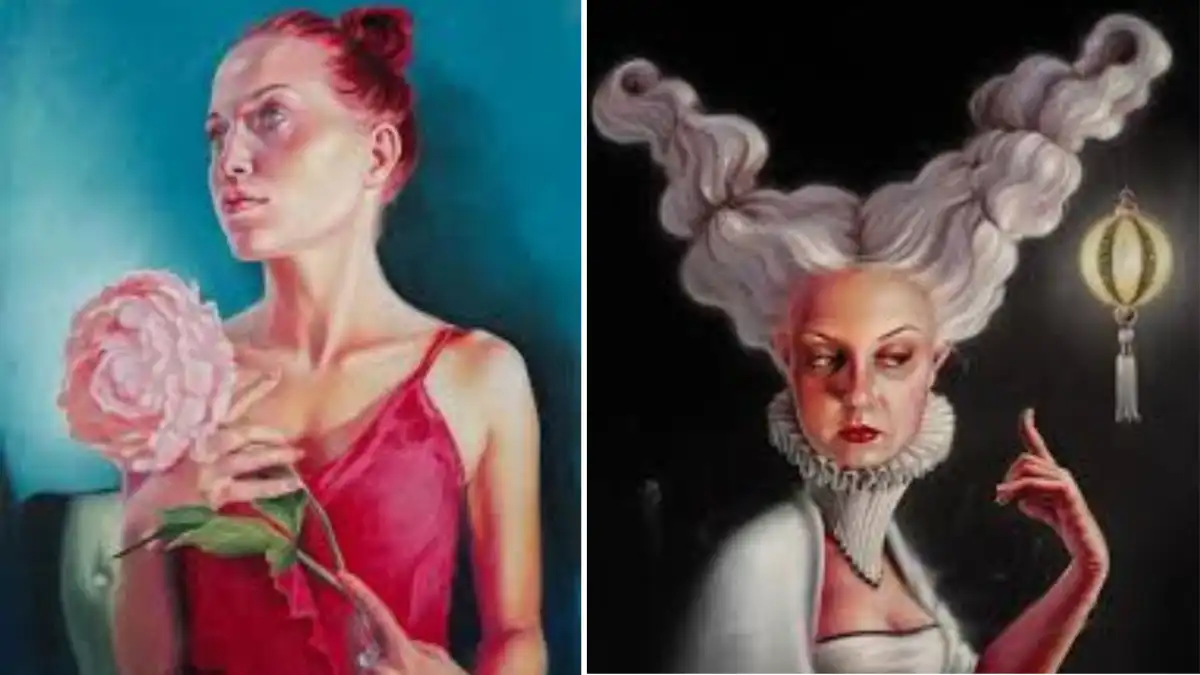
At first glance, there is beauty—luminous, balanced, almost classical in its compositional harmony. The longer one remains, the more the surface begins to shift. Hair becomes architecture. Space folds gently in on itself. The pictorial plane refuses, almost playfully, to remain obedient. This is not illusion as novelty. This is illusion as invitation, a subtle recalibration of perception that unfolds gradually, revealing itself over time.
There is, perhaps, a delicious tension between control and fantasy.
Stimmell’s background in street painting, rooted in the centuries-old tradition of I Madonnari, situates her within a lineage of artists who understood that the ground itself could become a stage for transformation. Chalk resists permanence. It insists on immediacy, arriving vividly and then dissolving back into absence. That awareness lingers in her studio practice, where compositions feel as though they are still negotiating their own boundaries, hovering somewhere between presence and disappearance, between the fixed and the fluid.
Her imagery carries a kind of contemporary myth-making that feels both familiar and, at times, quietly subversive.
Echoes of the divine feminine emerge, though refracted through a surrealist sensibility that resists sentimentality. Faces hold a serene stillness, while environments destabilize just enough to introduce a trace of the uncanny. Botanical elements, creatures, and dreamlike forms intertwine, creating visual systems that feel cohesive yet slightly beyond reach. A lineage from Botticelli through Surrealism may be traced, though Stimmell does not linger in homage. She expands the language, softening its edges while maintaining its conceptual depth.
That balance, perhaps unsurprisingly, is achieved through a synthesis of discipline and imagination.
Training at the ArtCenter College of Design established a rigorous understanding of composition, while her early work as a technical director on South Park sharpened her command of visual timing and narrative structure. These foundations allow her to construct images that feel intuitive while remaining carefully considered, giving the work its distinctive sense of ease.
Her work, now represented by Park West Gallery, enters a contemporary dialogue that increasingly values experience over observation.
These paintings do not remain static. They engage. They invite the viewer to question the stability of what is seen, to consider, perhaps more openly, that reality may be more fluid than it appears. Beauty exists alongside disruption, and perception reveals itself as something malleable rather than fixed.
There is also, quite subtly, a generosity embedded within her visual language.
The work invites entry without intimidation, offering a point of connection before requiring interpretation. That approach recalls one of the oldest functions of art—to communicate across experience, to enchant without exclusion, to create a shared moment of recognition that lingers.
What makes Stimmell’s practice so compelling is its understanding of illusion as expansion rather than escape.
The world, in her hands, becomes negotiable. Space bends. Meaning shifts. Perception itself becomes a material, shaped with both intention and a certain quiet grace.
The result resists passive viewing.
It becomes, instead, something one steps into.
Follow www.parkwestgllery.com for more information on this incredible artist.
