Two weeks ago, a 15-year-old boy was fatally shot with a handgun on a Queens playground during a water gun fight. This Monday, another 15-year-old boy was shot multiple times on the A train.
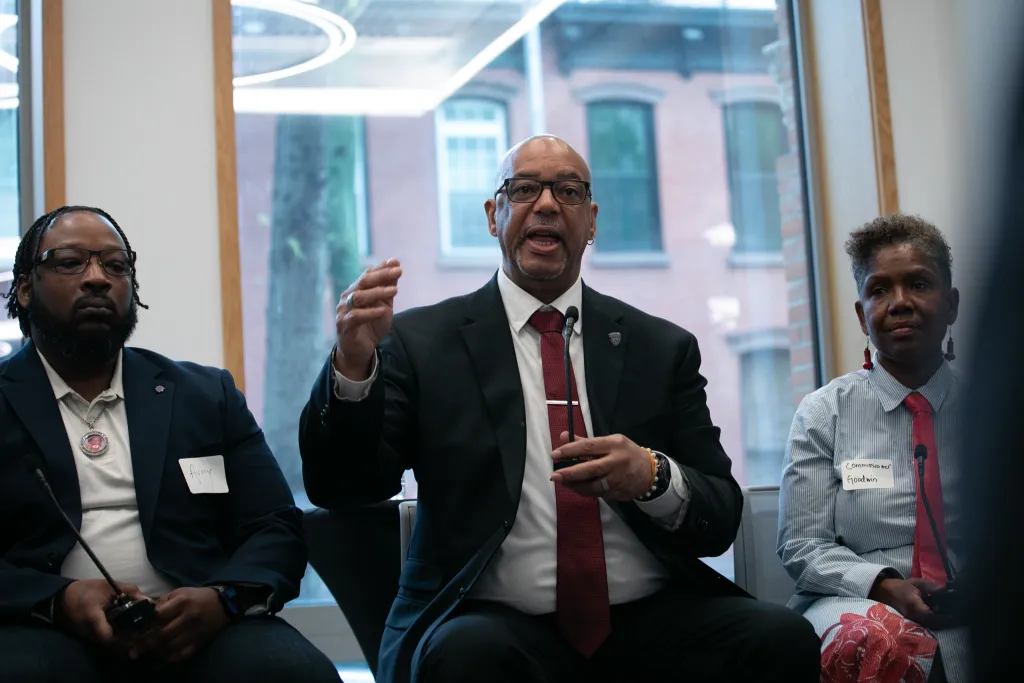
On Thursday, groups that work to curb teen gun violence gathered at a forum in Brooklyn to highlight the programs that they say give kids the help they need but are woefully underfunded.
“What they do is develop trusting relationships that express to young people that you are loved, you are not thrown away by us–like, that’s not happening,” said Stanley Richards, the new city Correction Commissioner who is the first formerly incarcerated person to lead the Department.

“And so there needs to be an investment in that relationship, because that’s the relationship that will disrupt and interrupt and break down the cycle of incarceration.”
While overall shootings are down in New York City in recent years, shootings involving young people have remained elevated since spiking as the COVID-19 pandemic shut down the city in 2020, NYPD data shows.
On average, roughly 127 minors have been shot each year over the past five years, and 111 minors have been identified each year as shooters, according to police data.
There have been 29 people under 18 shot so far this year, in a city of 8.5 million. But in communities where gun violence is concentrated, the fear and grief can be pervasive.
“Young people who carry guns are afraid of being killed,” said Julia Davis, who heads the service provider and advocacy group Youth Represent. “They experience life as an urban siege.”
There is no great mystery about why shootings persist on the city’s historically violent corners, especially among teenagers.
Poverty and isolation send young people into the street, where impulsive teenage decision-making plays out amid mortal fear and the pressure to conform, advocates said. Social media serves as a new crucible in which threats beget threats.
“They want to be a part of something,” said Jamaal Clarke, 30, who works as a peer facilitator with Haywood Resilience Project in the Bronx.
“You feel less valuable, you yearn for social acceptance and social equity, and that causes people to go shoot people.”
‘Simply Not Enough’
During the forum, the conversation centered on hundreds of millions of public dollars set aside for such youth.
In 2017, elected officials passed the Raise the Age law to stop treating most 16 and 17 year olds facing criminal charges as adults.
That reform was designed to be paired with significant resources to address the root causes that often lead young people into the adult criminal justice system. Lawmakers allocated $300 million in 2018 and 2019 and $250 million annually after that.
But only a fraction of that funding has been used statewide, as Politico previously reported. As of last year, localities have spent just $569 million of the $1.55 billion set aside, state budget records show.
And the law was written so that not a penny of its funds reach New York City, despite the fact that in 2024, the most recent year for which state data is available, there were more juvenile murder arrests in the five boroughs than in the rest of the state combined.
“The current programs as they exist are simply not enough,” said Renita Francois, the Mamdani administration’s Deputy Mayor for Community Safety.
Advocates are calling for a change to the state law that would direct $50 million of the annual $250 million straight to community-based organizations that provide support services to young people for mentorship, family therapy, and programs that get kids back in school and into jobs, among others.
That change would allow some of the funding — which has been limited to localities that agreed to a 2% cap on their property taxes at the insistence of then-Governor Andrew Cuomo — to reach the city.
Former Department of Correction Commissioner Vincent Schiraldi said the critical funding had been lost to then-Governor Andrew Cuomo’s political fight with then-Mayor Bill de Blasio. .
“When Raise the Age was enacted and all this stuff was negotiated, Cuomo and de Blasio were really at each others’ throats,” Schiraldi said. “And New York City got no money to support Raise the Age, got no access to the $250 million allocated.”
At the forum, Shawnda Chapman of Women Building Up questioned why existing funding has yet to reach frontline groups.

Even the proposed $50 million for the Youth Justice Innovation Fund is “probably not enough,” she said.
“What does it mean that the money exists but hasn’t reached the communities doing this work?”
Davis of Youth Represent said a public records request filed three years ago revealed how little of the money set aside for Raise the Age implementation had actually reached communities.
“What it showed us is that the politics around serving young people are a powerful barrier to the change we need,” Davis said. “When advocates and young people aren’t at the center of those decisions, the money goes right back to the usual suspects.”
She said most counties spent little on prevention, early intervention or alternatives to incarceration, and instead directed funds toward policing, detention and probation.
State lawmakers are currently hashing out proposals to send some of the funding for alternative to incarceration programs tied to the Raise the Age legislation, City & State reported in February.
‘High Risk and Hard to Reach’
Thursday’s forum, entitled “High Risk and Hard to Reach: Solutions for Young People Often Over-Prosecuted, Underserved, or Ignored,” was held at the headquarters of Women Building Up in Boerum Hill. More than 100 people attended, including nonprofit leaders, formerly incarcerated people, and top city officials.
The forum focused on the idea of directing intense resources and attention on a concentrated group of young people deemed most likely to be involved in gun violence, either as victims or perpetrators.
Schiraldi described a program he led in Maryland that targeted a group of youths deemed at extremely high risk of shooting or getting shot and surrounded them with an engaged life coach who had the resources to help them pay for school, get housing and otherwise stabilize their lives.
“When someone’s friend got shot, that’s the day they become high risk,” he said. “And that day we need to be there for them.”
But advocates also noted the needs of girls, who are less likely to be shooters. The gun violence is a smoke signal, in a way, pointing to a much larger class of kids trying to meet basic needs without much support.
“These young people are not even able to be young,” said Naquasia Jones, the founder and CEO of PureLegacee, a group that aims to empower girls and young women impacted by incarceration, foster care, and systemic trauma. “They got adult problems.”
Our nonprofit newsroom relies on donations from readers to sustain our local reporting and keep it free for all New Yorkers. Donate to THE CITY today.
The post Unspent State Funds for Youth At Risk of Gun Violence Are Needed Here, City Leaders Say appeared first on THE CITY – NYC News.
