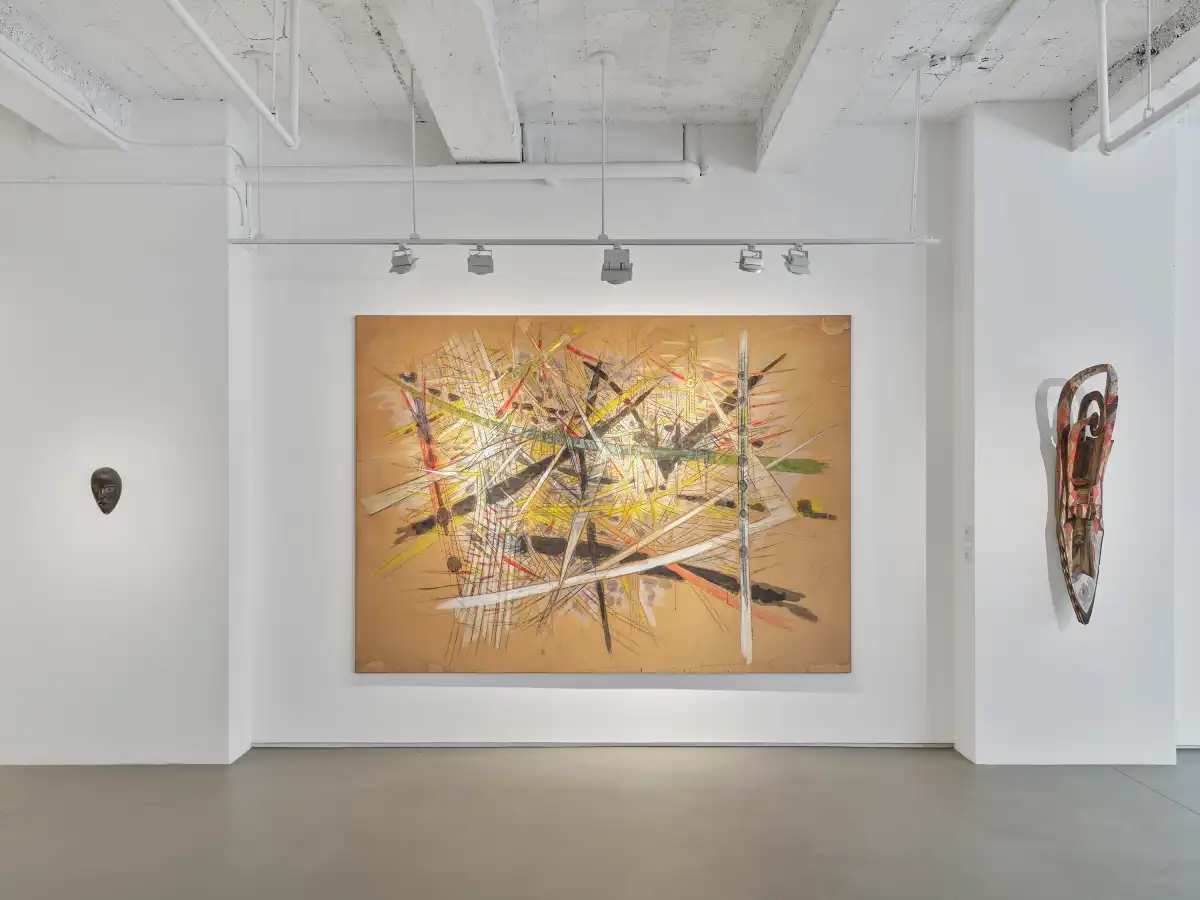
Modernism has always loved its mythologies—Paris cafés, studio rivalries, artistic rupture, men with cigarettes deciding the fate of form somewhere between wine, war, and genius. Yet every so often, history offers a relationship that is not merely anecdotal, though catalytic, a collision of two imaginations that alters the atmosphere around them. The dialogue between Pablo Picasso and Wifredo Lam belongs precisely to that category, and at Galerie Gmurzynska in the Fuller Building, that exchange is given the intimate, scholarly, and utterly seductive treatment it deserves.
The opening itself had the unmistakable shimmer of a true New York art night, the kind where the room seems to glitter as much from the people as from the works on the walls. Diana Picasso, Eskil Lam, Grace Hightower, Katherine Embiricos, Andrea Catsimatidis, and gallerist Isabelle Bscher joined more than 150 friends, collectors, and art-world luminaries to celebrate Pablo Picasso and Wifredo Lam, an exhibition that brings together approximately fifty works spanning 1918 to 1978, including paintings, frescos, works on paper, collage, and ceramics. The Fuller Building gallery was alive with that rare blend of intellectual charge and social voltage—fabulous art, even more fabulous people, and the unmistakable sense that something historically meaningful was unfolding in real time.
Galerie Gmurzynska, long known for museum-quality exhibitions and serious scholarship around twentieth-century masters, is particularly suited to this kind of undertaking. Founded in 1965, the gallery has built its reputation through historically rigorous presentations, more than three hundred art historical publications, and deep relationships with artist estates including Wifredo Lam, Yves Klein, Louise Nevelson, Roberto Matta, and Miró. Its own history carries the mood of European modernism: Cologne origins, Zurich’s Paradeplatz, a location tied to the birthplace of Dada, and even Zaha Hadid’s final interior architectural project for the gallery’s DADA centennial exhibition. This is not a gallery casually borrowing prestige from the past. It knows how to stage history with teeth.
That intelligence matters here, as the Lam-Picasso relationship is not simply a convenient pairing of two famous names. Lam and Picasso first met in Paris in May 1938, and the encounter proved foundational. Picasso introduced Lam to the Paris avant-garde, to André Breton, the Surrealist circle, Michel Leiris, and the larger constellation of artists and writers reshaping the twentieth-century imagination. Picasso also personally brought Chagall, Giacometti, Le Corbusier, Léger, and Miró to Lam’s 1939 solo exhibition at Galerie Pierre in Paris, while Picasso and Dora Maar held Lam’s entire oeuvre for safekeeping during World War II when Lam returned to Cuba.
Yet this is not, blessedly, a simplistic tale of master and protégé. Lam absorbed Cubism and Surrealism, certainly, though he brought to them something Picasso could not possess: the spiritual, symbolic, and historical force of Afro-Cuban culture, Santería, colonial fracture, Caribbean mythology, and ancestral memory. Picasso had a lifelong engagement with African art, visible in works such as Animaux naturels (Arts Primitifs) from 1943, included in the exhibition. Lam, conversely, approached these visual and spiritual languages from within a more lived and charged inheritance. His figures do not merely borrow the mask. They become hybrid beings of ritual, resistance, jungle, spirit, and psychological force. André Breton understood this reversal with striking clarity when he wrote in 1941 that Lam had reached consciousness by taking the “very opposite path” from Picasso, beginning with the primitive myth within himself and assimilating European disciplines along the way.
That reversal is everything. Picasso famously told Lam, “I think that you have my blood in you,” calling him a cousin, a primo, a statement that lands with strange intimacy and historical voltage. The exhibition allows that remark to live in all its complexity, neither flattening Lam beneath Picasso’s shadow nor diminishing Picasso’s role in the encounter. Their friendship was affectionate, generative, and artistically consequential. Between 1940 and 1946, the two artists regularly exhibited together at the Pierre Matisse Gallery in New York, astonishingly in the same Fuller Building now occupied by Galerie Gmurzynska, where this conversation has returned with near-cinematic force.

The timing also feels deliciously precise. Following the finissage of MoMA’s highly lauded retrospective Wifredo Lam: When I Don’t Sleep, I Dream, Galerie Gmurzynska brings several significant Lam works previously exhibited at MoMA into a more intimate gallery context. A rare Étude pour La Jungle from 1943 sits among masterpieces from Lam’s estate, including part of his indigenous art collection, while Picasso is represented through works that include rare frescos from his 1918 honeymoon in Biarritz and six oil paintings. The museum gave Lam institutional scale. This exhibition gives him dialogue, proximity, and historical return.
The evening’s fashion presentation added another layer of pleasure and intelligence. Rachel Scott, Creative Director of Diotima and Proenza Schouler, spoke about her Lam-inspired collection and invited guests to examine key looks on view, including a skirt featuring an interpretation of Lam’s 1943 work Omi Obini. That pairing felt far more than decorative. Lam’s work has always been bodily—elongated, masked, ritualized, hybrid, charged with transformation—so seeing that language move into fabric felt natural, almost inevitable. Art left the wall and entered motion, passing from image to garment, from painted mythology to living silhouette.
Perhaps the most affecting moment, however, was the presence of Eskil Lam. Meeting Lam’s son gave the exhibition an emotional immediacy scholarship alone cannot provide. Legacy, in that moment, was not abstract. It stood in the room, speaking, remembering, extending the life of the work beyond canvas and catalogue. There is something profoundly moving about encountering an artist’s history through a living thread, especially when the work itself is so concerned with ancestry, spirit, and survival.
Galerie Gmurzynska’s forthcoming 350-page scholarly volume, featuring previously unpublished archival materials and new research by Jérôme Neutres, Jacques Leenhardt, Fabrice Flahutez, and Dorota Dolega-Ritter, deepens the stakes further. It is, remarkably, the first publication to focus directly on the relationship between Lam and Picasso, a fact that feels almost astonishing given the magnitude of their exchange.
The power of the show rests in its refusal to simplify modernism into a one-way European invention. It insists instead on collision, migration, inheritance, exchange, and spiritual insurgency. Picasso cracked form open. Lam filled that rupture with gods, ghosts, ritual, history, and an entirely different kind of knowing.
Together, they do not merely converse.
They ignite.
