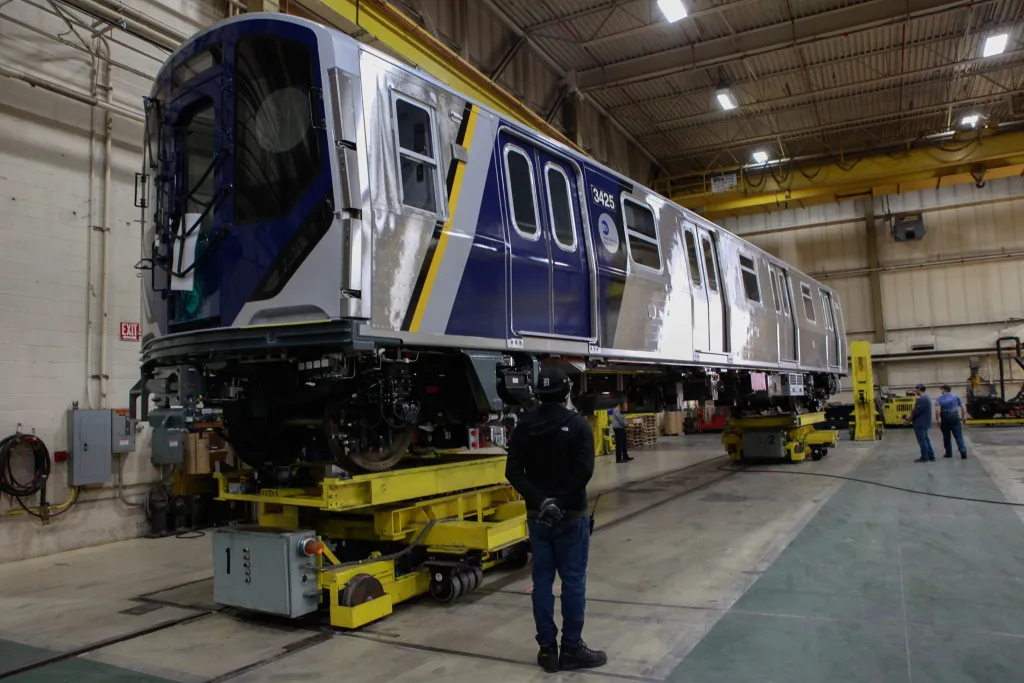
MTA officials warned Wednesday that “high and unpredictable” tariffs brought on by the Trump administration could jack up the cost of new trains and buses by $1 billion by the end of this decade.
The hit on the thousands of components used to build trains and buses — including electronics, wheels, axles and vehicle frame parts — would come as the country’s largest mass transit system is in the midst of its most ambitious effort in decades to upgrade the fleet that moves millions of commuters daily.
“It means higher costs to the tune of a billion dollars,” Jessie Lazarus, chief of the MTA’s rolling stock program, said at the authority’s board meeting. “It means a billion dollars we might not be able to spend on new trains and buses that our riders deserve and, of course, a billion dollars we can’t pay American workers to make them.”
In response to the potential surge in costs, Gov. Kathy Hochul and MTA officials floated the possibility of the Trump administration exempting the purchase of new subway cars and buses from what Lazarus described as “the unprecedented nightmare” of tariffs.
But the White House sneered at the suggestion while slamming past projects that have been plagued by high costs.
“Both MTA and New York have long been incompetent and poor stewards of taxpayer money — with mismanagement driving chronically overbudget and behind-schedule projects,” said Olivia Wales, a White House spokesperson. “Democrats should stop attacking how President Trump is delivering historic trade and investment deals and instead focus on cleaning up their own act.”
In a statement, the transit advocacy group Riders Alliance said federal officials are “desperate to waste New York commuters’ precious time and money.”
“These added burdens are intolerable,” said Danny Pearlstein, policy director for Riders Alliance. “Amid an affordability crisis, they would set us back as a region and destroy jobs both in the city and across the country.”
As part of the MTA’s nearly $70 billion 2025-2029 capital plan, the transportation authority projects it will spend $7.6 billion on replacing more than 1,500 new subway cars that have been running for more than four decades. The oldest cars are among the least reliable in a fleet of more than 6,500.
“As you can see, we have a really big problem on our hands,” Lazarus said.
The MTA also plans to buy 1,000 new buses so the ones now on the road can be retired after 12 years of service — an industry standard, instead of the two-decade lifespan some buses are operating on now — and to replace Metro-North and Long Island Rail Road coaches and locomotives.
Lazarus said that if the tariffs weren’t eating up $1 billion, the MTA could purchase up to 150 railcars for the LIRR to replace some that have been in service for more than 40 years.
“These additional cars will ensure that everyone would have space on the trains for years to come,” Lazarus said. “Nobody likes to stand from Ronkonkoma to Penn.”
Federal contracts require transit agencies to meet “Buy American” standards, with 70% of parts made in the U.S., as well as being assembled domestically. The MTA said new trains and buses contain up to 30% foreign-sourced components that are subject to the tariffs.
So even as the MTA’s most recent bulk order of more than 1,600 new subway cars were designed and engineered by the Japanese manufacturing giant Kawasaki, cars are assembled at plants in Nebraska and just north of the city line in Yonkers, with parts that include seats from Canada and poles from Pennsylvania.
Lazarus pointed out how the MTA has topped 75% on “Buy American” requirements for its newest R211 subway cars, which are made up of more than 20,000 individual parts. But she noted that the cars, which run on the A, C, B, D, G lines and the Staten Island Railway, also have parts that are “so specialized” that importing them is a must.
“For example, highly specialized carbon steel and wheel parts, those come from Japan,” Lazarus said. “We’ve got application-specific motors and compressors — like a fan motor, those come from Italy.”
The components end up in the Nebraska plant where they are assembled into subway cars before being delivered to Yonkers for final assembly and testing.
Reinvent Albany, a state government watchdog, estimated in June 2020 that from 2011 to 2018, the MTA spent $7.8 billion in states outside of New York, while creating as many as 100,000 jobs across the country.
“Tariffs absolutely will raise the costs for the MTA because they rely on the global supply chain, as well as multinational vendors for some of their purchases,” said Rachael Fauss, senior policy advisor for Reinvent Albany. “While [the MTA is] increasing their New York suppliers, a portion of their spending has been international.”
In response to a question from an MTA board member on the tariffs’ potential impact to workers, Lazarus estimated that “up to 5,000” jobs could be affected.
“We are impacting jobs in every congressional district, in every state senate district in the state of New York,” said Janno Lieber, MTA chairperson and chief executive.
Our nonprofit newsroom relies on donations from readers to sustain our local reporting and keep it free for all New Yorkers. Donate to THE CITY today.
The post Trump Tariffs to Add $1B to Cost of New Trains and Buses in NYC: MTA appeared first on The City Reporter.