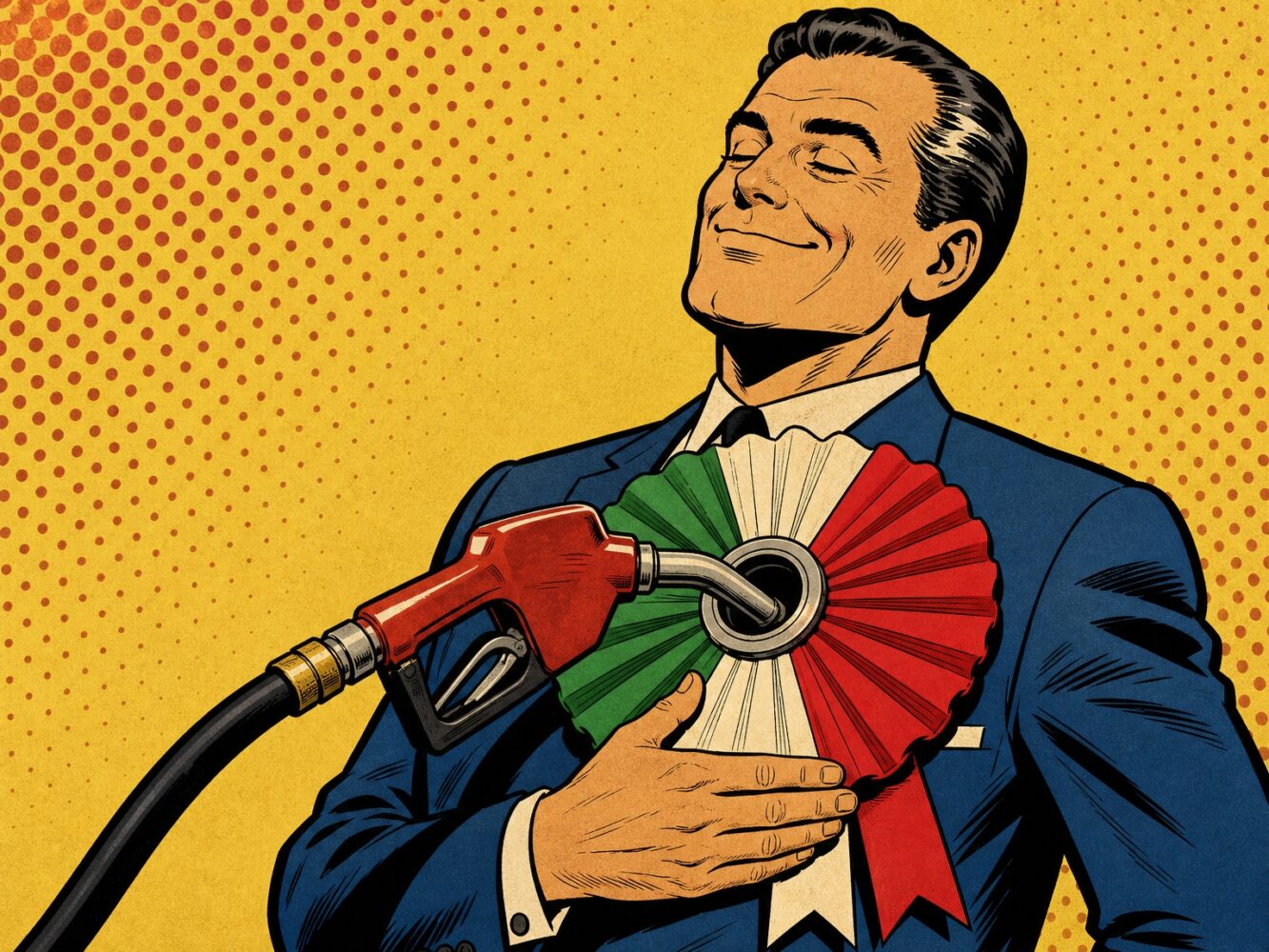
The Italian government is claiming a victory at the pump. Eni, the country’s largest oil company, has announced a 30-day cap on retail fuel prices. Italy’s second-largest fuel retailer, IP, controlled by the State Oil Company of Azerbaijan Republic (Socar), followed suit, as did the third-largest, Q8. Smaller rivals warn that the caps could squeeze their margins. Politicians, meanwhile, credit their pressure on Eni’s executives for delivering relief to motorists.
While the political appeal is clear, the implications for competition deserve a closer look.
Fuel prices are a politically combustible topic in Italy, as elsewhere. Despite a temporary fuel-tax cut (now being phased out), Italian gasoline prices averaged €2.090 per liter in August 2026, 2.3% above the European Union average of €2.044. Prices have since risen sharply.
Policymakers have sought ways to bring them down without straining public finances, including through a potential tax on windfall profits or a cap on refining margins—the difference between refiners’ fuel revenues and crude-oil costs. Both proposals have some obvious shortcomings. Eni’s cap gives policymakers some breathing room.
There is some precedent. In France, TotalEnergies recently announced a similar cap, drawing similar reactions. And earlier this year, Eni kept its prices slightly below market levels without committing to an explicit target. It did the same in 2012, during another fuel-price spike.
Three questions warrant attention. Is Eni engaging in predatory pricing—that is, pricing below cost to drive out rivals and recoup its losses later? How does publicly announcing its intended price affect competition? And are commercial considerations the only explanation for the move?
Predation Needs a Payday
One possible explanation for Eni’s move is predatory pricing. The standard theory holds that an incumbent may cut prices below cost in order to weaken or eliminate rivals, then raise prices above competitive levels to recover its losses. The intuition is straightforward. Evidence of successful predation followed by profitable recoupment is harder to find, as Truth on the Market readers well know. Below-cost prices can hurt rivals in the short run, but unless the strategy creates lasting market power, competitors can return when prices rise, leaving the predator with losses it cannot recover.
Does Eni’s cap fit that story? A credible account would need to explain why Eni could expect to recover any losses the cap generates through higher prices later. That prospect is far from obvious in Italy’s fuel market.
A 2023 investigation by the Italian Competition Authority (AGCM) found that international benchmark prices for refined fuels (particularly gasoline and diesel) drove domestic price movements. Italy’s relatively high pump prices largely reflected higher taxes. The pretax component, by contrast, ranked among the lowest in the EU. Those findings offer little support for the claim that Italian motorists generally pay high prices because domestic oil companies systematically exercise market power.
Rivals’ willingness to match Eni’s cap also suggests that the announced prices may be commercially sustainable. That alone settles neither the predation question nor the broader competitive concerns. Still, a conventional predatory-pricing story is difficult to sustain. Italy’s retail fuel market offers no obvious route for Eni to absorb substantial losses today and recover them through sustained monopoly profits tomorrow.
A Cap and a Wink
The more intriguing competition issue may lie in the announcement accompanying Eni’s price cut.
Eni has publicly committed to a maximum price for at least 30 days, potentially through year’s end. Price announcements have long attracted antitrust scrutiny because they can help rivals coordinate. Transparency helps consumers compare prices, but it can also tell competitors what to charge—or what others plan to charge next.
The AGCM has repeatedly raised this concern in the fuel sector. In 2007, it alleged that the largest vertically integrated oil companies (those operating at multiple stages of the supply chain) had colluded, partly through periodic press releases disclosing recommended prices. It closed the case after the companies committed to stop those releases and made other changes the authority deemed sufficient to remove the mechanisms facilitating coordination.
In 2023, the AGCM opened another case, alleging that major oil companies coordinated how they passed mandatory biofuel-blending costs on to consumers. EU rules require suppliers to meet progressively higher biofuel targets as a share of road-fuel sales. According to the authority, periodic announcements by Eni and others about the resulting price increases helped facilitate the alleged cartel. (Full disclosure: I served as an economic adviser to one of the parties in that case, which is now under judicial review.)
The AGCM has even opposed legislation requiring greater fuel-price transparency. At a 2026 Italian Senate hearing, it said that publishing recommended prices daily, down to individual filling stations, could facilitate collusion and potentially violate antitrust law. It described that position as consistent with competition authorities’ established approach.
Eni’s announcement deserves to be seen in the context of that backdrop. A temporary price cap differs from daily publication of recommended prices, but the resemblance is hard to miss. The European Commission’s Horizontal Guidelines distinguish advertising current retail prices from making nonbinding announcements of future pricing intentions. But Eni’s commitment is stronger and extends further ahead—“an initial period of 30 days, with the possibility to be extended through the end of the year.” It gives rivals a view of the company’s pricing strategy over time, beyond today’s price at the pump.
Could that visibility make coordination easier? IP’s announcement of the same cap proves no such thing, but it does render the question more interesting. The competition concern is whether these public announcements—and any resulting price alignment—could help rivals sustain parallel pricing. But to be clear, announcing a price does not, by itself, establish unlawful conduct.
That leaves the AGCM in an awkward position. A heavily publicized pricing commitment seems an odd choice for a company hoping to avoid antitrust scrutiny. Yet Eni acted under strong government pressure, and the cap enjoys broad popular support. The authority now faces a test of its consistency. How should it assess a measure that appears to benefit consumers in the short run while resembling practices it has repeatedly scrutinized? Political applause adds no obvious answer.
Filling Up on Political Goodwill
Aggressive marketing may explain part of Eni’s move, but its relationship with the government might also form part of the explanation.
The Italian government is Eni’s largest shareholder, holding roughly one-third of its shares. Prime Minister Giorgia Meloni publicly thanked Eni for its announced cap. Within hours, after IP followed suit, she also thanked Azerbaijani President Ilham Aliyev and Socar Chairman Rovshan Najaf. She later extended her thanks to “Kuwait and the company in control of Italy’s gas stations” branded Q8.
The acknowledgments suggest a political dimension to these commercial decisions. Are companies forgoing legitimate profits in anticipation of favorable government treatment? One explanation, widely discussed in the Italian press, is that the large oil companies hope voluntary price restraint will ward off a windfall-profit tax.
Whether that bargain exists remains unclear. Smaller and independent retailers, meanwhile, warn that matching the caps would squeeze their margins. Government pressure to cap prices may offer motorists relief while placing unequal burdens on their suppliers. Large integrated companies may have more room to absorb those costs than smaller independent retailers.
Whether those effects prove temporary or durably reshape competition is an empirical question that requires evidence. The AGCM’s own sector inquiry identifies independent stations as an important competitive constraint on rivals. It also finds that access to wholesale fuel poses a critical challenge for retailers without their own refining operations, especially during supply shortages. Squeezing those retailers could carry costs beyond their balance sheets.
Eni’s motives—and the cap’s ultimate competitive effects—remain uncertain. The episode nevertheless shows how quickly rising prices can turn pricing into a political negotiation. Governments and consumers understandably want relief. But high prices also communicate scarcity and encourage suppliers to bring more fuel to market and consumers to seek alternatives.
A voluntary cap may ease motorists’ bills, but it creates no additional refined fuel or alternative sources of energy. If the cap starts holding prices below the level market conditions would otherwise produce, as some politicians want, it may weaken the incentives to expand supply and switch to substitutes.
Political gratitude alone won’t fill the tank.
