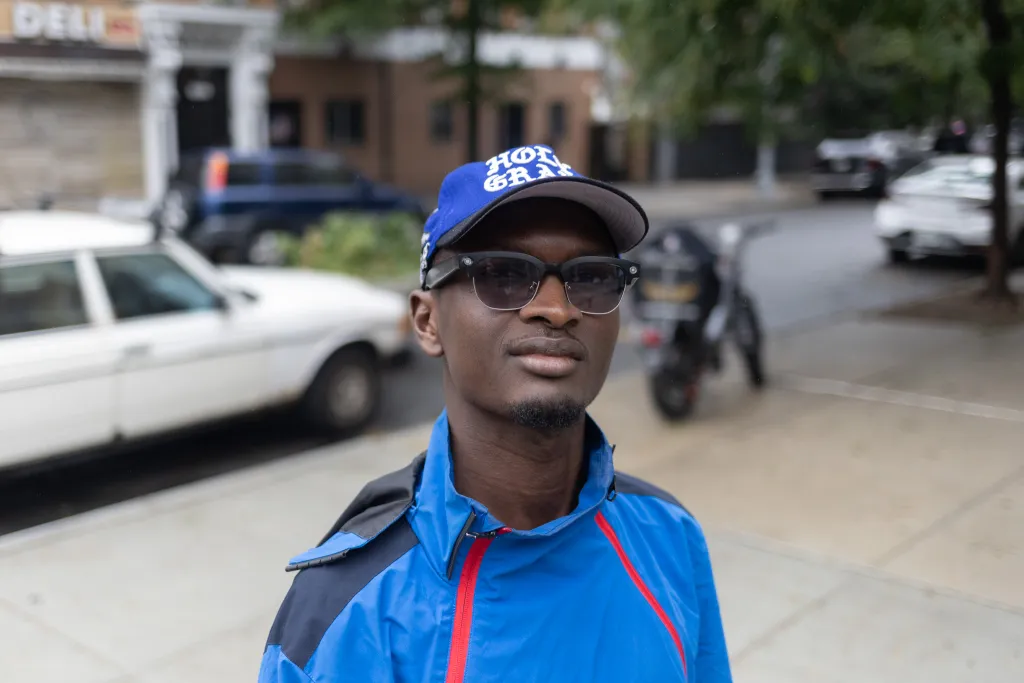
A new report by the CUNY School of Public Health and the Workers Justice Project, first obtained by The City Reporter, zeroes in on the issue of deactivation and reveals the vast physical and mental toll of delivery work on the city’s estimated 70,000 deliveristas.
The CUNY research team polled 561 delivery workers between March and May; of those, more than half said they’d been injured on the job, more than five times the national rate among delivery messengers. A staggering 40% of respondents met the criteria for severe psychological distress.
Workers have spoken out for years about the dangers of the job, detailing incidents of close calls and bad crashes on the city’s streets. Delivering on time — and remaining in good standing with their employer — is their primary concern.
The researchers found that workers are often pressured by the platforms to deliver as quickly as possible — essentially incentivizing workers to race through the city’s streets at unsafe speeds, risking injury to themselves and others. The constant threat of job loss contributed to feelings of anxiety and depression among the mostly immigrant workforce, the researchers concluded.
‘Totally Trapped’
The term deactivation refers to when a company locks workers out of their accounts, essentially firing them. More than half of the respondents – 52% — said they worry about their accounts getting deactivated if they do not work quickly enough.
Protection from deactivation tops the list of workers’ needs, ahead of more working hours, crime protection and pay transparency.

“The apps, the algorithm controls major aspects of the job, and then if workers don’t comply, the companies have this punitive tool that they deploy whenever workers fall short of their expectations,” said Mustafa Hussein, health policy and economics professor at the CUNY School of Public Health and one of the lead authors of the study.
The threat of deactivation “has significant implications for workers’ mental health, for their injury rates, their risk-taking, and even for the safety of pedestrians and other cyclists on the street,” he added.
MORE: ‘We Screwed Up’ – DoorDash to Pay $131.5 Million to Stiffed NYC Delivery Workers
But leaders in the industry have long maintained that they only deactivate workers’ accounts on rare occasions and only as a last resort.
DoorDash has previously said that it allows workers to appeal their deactivations. Certain behaviors, such as evidence that a “Dasher” submitted a fake ID or tax number number, are red flags. A spokesperson said that deactivations are reserved for serious or repeated violations of its policies. The company has offered no-cost occupational accident insurance coverage, though workers have said they’ve struggled to access relief in the past.
Uber says that it only deactivates accounts it deems engaged in fraudulent conduct — such as using false IDs or sharing accounts — or other unsafe behavior. Company spokesperson Josh Gold said account deactivations are “rare, but when they do happen, we aim to make the process as transparent and fair as possible, including by having “every appeal reviewed by a real person.”
“Our work is never done and we’re always working to make this process clearer, more consistent and more fair,” he said.
In response to questions from The City Reporter, a representative for Grubhub struck a similar chord, and noted that the company does not incentivize or encourage fast driving in any of its markets, including New York.
NYC’s ‘Just Cause’ Law
The report’s findings are almost certain to reverberate across the industry and with policymakers. On Wednesday, the City Council will hold a hearing on nearly two dozen bills that seek to address the issue of street safety. Among the proposals: banning the sale of some e-bikes, stepping up speed limit enforcement for e-bikes and mopeds, and creating new licensing requirements in the delivery sector.
Ligia Guallpa, the head of the Workers Justice Project, said that what deliveristas need “is protected bike lanes, loading zones, and the tools to fight back against deactivations and an algorithm that is abusing and endangering workers.”

A law creating “just cause” protections for delivery workers goes into effect next year and prohibits delivery apps from deactivating workers unless for just cause or “bona-fide economic reasons” and requires at least 14 days’ notice before locking workers out of their accounts. Workers have long said they have been locked out of their accounts for arbitrary and unjust reasons with little or no explanation.
Carlos Ortiz, policy chief at the city’s Department of Consumer and Worker Protection, said the agency is finalizing its rulemaking for the law, which is slated to go into effect on Jan. 17, 2027.
Ortiz said that CUNY report’s findings that deactivations are workers’ primary concern are consistent with the agency’s own data and with the feedback it has received from workers in private meetings and other forums.
Bearing the Brunt
The issue of deactivations governs how workers behave on the streets and interact with restaurants and customers.
Mamadou Ba, a former delivery worker, recalled being locked out of his UberEats account last April after he failed to complete a takeout delivery. He collided with another cyclist, sending food flying everywhere. The previous week, he received a negative review from a customer; there was apparently an issue with their drink order.
Ba lost money — and sleep — over the sudden loss of his job. For a while, he struggled to make ends meet by collecting cans, netting about $60 to $70 a day. He now works at an Amazon warehouse. He wasn’t surprised to learn that the CUNY researchers determined that delivery workers endure high stress on the job. In fact, he said, “it should be 99%” of workers.
CUNY’s study, the first of its kind since a 2022 report by the city’s worker protection agency and the first since New York implemented a suite of laws governing the industry in 2023, also offers a fresh look at how much the workforce has transformed in recent years. And it is bound to introduce fresh scrutiny of the city’s minimum pay standards, which currently sit at $22.13 per hour.
The report found that while workers are earning an average $23 an hour including tips, more than two-third live in households earning under the federal poverty level. A majority of workers say they work full-time toiling delivery for the apps, a figure consistent with earlier findings from the DCWP and Cornell University in 2022 and 2021, respectively.
Changing Demographics
The workforce itself has also changed dramatically since its pandemic boom.
A majority of workers surveyed by CUNY were African or South Asian, with Latinos coming in third among ethnic groups at 20% — a stark change from a dominance of Latin American immigrants just a few years ago that remains evident in the name of the leading group representing the workers, Los Deliveristas Unidos.
Worker complaints of wage theft stemming from deactivations are what spurred an investigation that last week led to a historic $131.5 million agreement between DoorDash and the administration of Mayor Zohran Mamdani to settle wage theft complaints from thousands of workers. The probe, which began under Mamdani’s predecessor Eric Adams, is the largest of its kind in the city’s history.
Several workers who submitted the initial 2023 complaint told The City Reporter at the time that their DoorDash accounts had been deactivated without cause, and said the company illegally withheld their final payments.
Our nonprofit newsroom relies on donations from readers to sustain our local reporting and keep it free for all New Yorkers. Donate to THE CITY today.
The post NYC Delivery Workers Report Staggering Rates of Injury, Mental Health Issues appeared first on The City Reporter.
