This story is part of Summer & THE CITY, our weekly newsletter made to help you enjoy — and survive — the hottest time in the five boroughs. Sign up here.
Jessica Bonamusa’s mind is in the water, and where the gutter meets the shore.
Bonamusa, a research scientist at New York City’s Department of Health and Mental Hygiene, spends all year thinking about pools, spas and saunas and the microbes that might be thriving in those spaces.
But when the weather gets warmer, in the lead-up to the first beach weekend, she turns her attention to the sea.
Bonamusa is part of a team of five scientists who visit the miles of shoreline along the ocean, bays and rivers in New York City to make sure they’re safe for swimming.

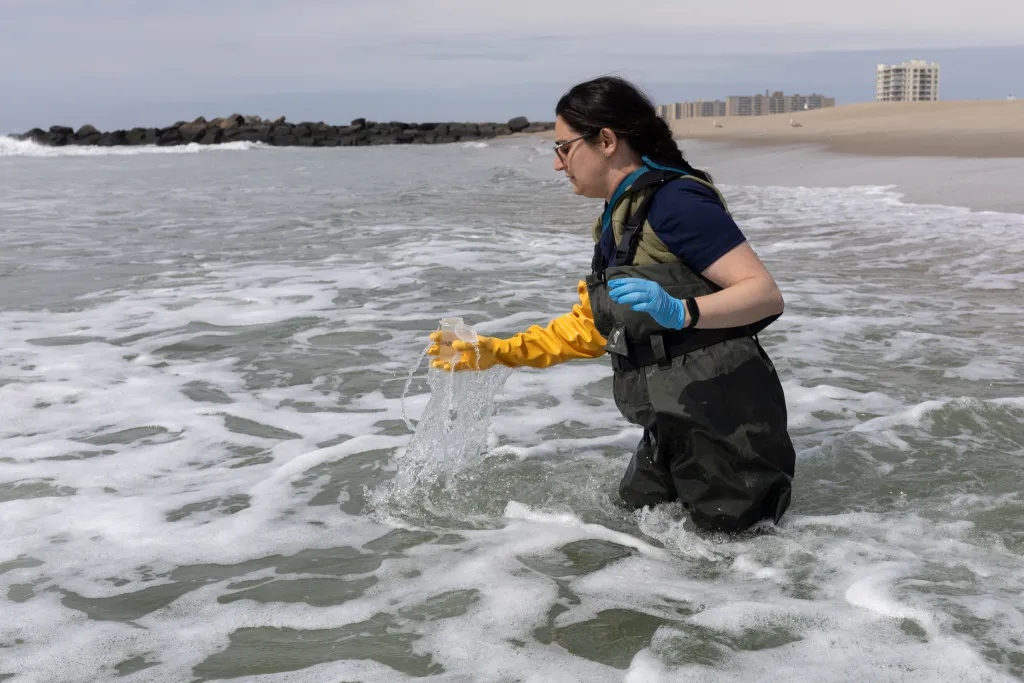
Donning waist-high waders, they plod into open waters and submerge test tubes to take samples, making sure they get a scoop without sediment or debris.
The biggest threat to the water quality at some beaches is rain, and the dread combined sewer overflow — when excess stormwater mixes with untreated or partially treated sewage, turning a trip to the ocean into an iffy-at-best excursion.
On a recent April morning, Bonamusa kicked off the summer’s testing along the Rockaway peninsula, starting at Beach 9th Street and traveling west to test the private beaches at Breezy Point. As she went, she spotted a dolphin swimming not too far from where she took a sample.
The scientists begin testing a month before beaches open to get a fuller picture of water quality, she said.
“That tells us how long the beach has been clean for,” she said in between collecting water.
Once she’s finished, Bonamusa drives them to the health department lab in Manhattan. Once there, the water is exposed to a type of food for what’s called “flora substrate testing.”
The city’s health commissioner, Dr. Alister Martin, tagged along for the first water quality test, heading into the ocean at Beach 17th Street up to his waist.
“If the bacteria is present it eats the food and its waste is fluorescent under a black light,” she said.

The work in that lab will decide if a beach is safe for swimming, is placed under an advisory, or closed.
Bonamusa showed him how to submerge the clear plastic cup into the water and he followed, pulling the second of eight samples that would be taken that day along the coast.
“There are a million invisible ways we keep people safe in the city as the health department,” he later told THE CITY. “This morning here at Rockaway Beach is one of those stories. We know when our beaches are safe for swimming thanks to our water ecologists like Jessica.”
Waterborne History
The health department has tested the city’s water for more than 100 years thanks to the pioneering work of Dr. George Soper, a sanitary engineer at the health department in the early 1900s who connected waterborne disease transmission to sewage and bad water quality.
He is best known as the epidemiologist who traced a typhoid fever outbreak on Long Island back to the asymptomatic Mary Mallon, a cook who worked in many homes that all had the virus. His work became vital for understanding healthy carriers of a virus — and she became known as Typhoid Mary.

But Soper’s work and legacy as a sanitary engineer has continued for generations.
The first Harbor Water Survey to measure bacteria levels was conducted in 1909, in conjunction with what is now the Department of Environmental Protection.
In the decades since, there have been more changes and updates to ensure the water is safe, including a health code update in 1959, and 1972’s Clean Water Act also improved water quality. The health department has published its water quality data since 2005.
They test the water and eight public beaches operated by the Parks Department, 17 privately-operated beaches, and one privately operated freshwater lake at the Staten Island YMCA.

There are places to swim in open water in every borough except Manhattan. Of the spots tested, The Bronx technically has the most, with nine separate private beaches in the borough, mostly on City Island, in addition to the public Orchard Beach.
Each tested beach has different advisory thresholds, based off of predictive modeling using years of historical data that shows the bacteria level after rain at each beach. For example, at many of the beaches on Staten Island, if there is between 1.5 and 2.5 inches of rain within 24 hours, there will be an advisory there for 12 hours afterwards.
But at other beaches, including Manhattan Beach and Kingsborough Community College in Brooklyn, if more than 2.5 inches fall in 24 hours, an advisory could last for a full day.

The Rockaway peninsula, the city’s only ocean-facing beach, is generally the cleanest in the city; it’s only tested every other week because of that. All the others are tested weekly.
Last summer, five of the city’s eight public beaches had at least one swimming advisory notice due to water quality, lasting between 2 and 32 days for Midland Beach, which had three beach closures. Nearby South Beach, also on Staten Island, had 31 advisory days and also had three beach closures.
Sixteen of the city’s 17 private beaches were open last year, and 15 had at least one swimming advisory. “Boosters Beach” along the East River, which is operated by the Whitestone Booster Civic Association, had the largest number of advisory days last summer with 99. The White Cross Fishing Club beach along Eastchester Bay in Throgs Neck in the Bronx has the most closure days, with nine.
Bonamusa, who grew up in Manhattan, has been fascinated by the ocean since she was a child, she said.
“My dad took me snorkeling when I was a kid, so maybe it was that,” she said. And she stressed the importance of the city’s work so everyone can enjoy the water safely.
“I want everyone to be able to swim and have a wonderful time,” she said. “This is what keeps us able to do that and able to enjoy our beaches.”
Our nonprofit newsroom relies on donations from readers to sustain our local reporting and keep it free for all New Yorkers. Donate to THE CITY today.
The post Testing the Water: Meet the Team Who Checks NYC’s Beaches For Sewage appeared first on THE CITY – NYC News.
