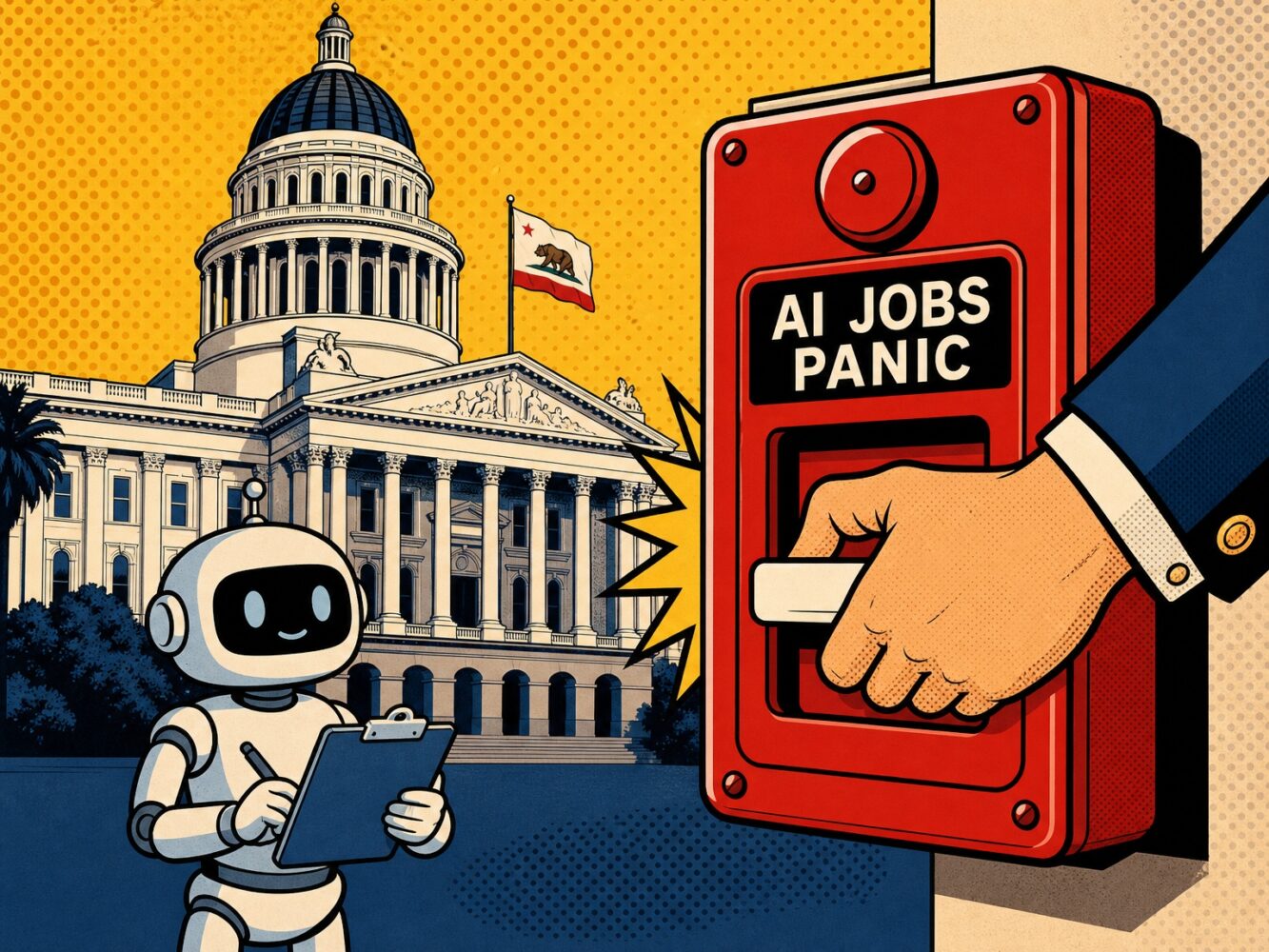
California has seen the future of work, and Sacramento’s first instinct is to convene 14 task forces about it.
Gov. Gavin Newsom signed Executive Order N-6-26 today, setting California’s workforce agencies in motion on directives involving research reviews, revisions to the state’s Worker Adjustment and Retraining Notification (WARN) Act, studies of new safety-net programs, a review of collective bargaining frameworks, an employment dashboard, and—near the end—a study of programs that would redirect artificial intelligence (AI) company revenues toward state-selected applications.
The animating concern is AI-driven labor disruption. Newsom’s order treats that disruption as sufficiently imminent to justify building new regulatory infrastructure across California’s workforce apparatus.
The empirical literature suggests that concern is running well ahead of the evidence. That includes a literature review published by the International Center for Law & Economics (ICLE) that I co-authored with Kristian Stout.
The Labor Panic Is Outrunning the Data
Generative AI has spread faster than any comparable technology. By late 2024, nearly 40% of U.S. adults ages 18-64 reported using AI tools—a pace that exceeded personal computers and the internet at comparable stages of adoption, according to a 2025 National Bureau of Economic Research (NBER) working paper by Alexander Bick, Adam Blandin, and David Deming.
The productivity gains are real and remarkably consistent across settings. Controlled studies show GitHub Copilot users complete coding tasks 55.8% faster. A randomized experiment by Shakked Noy and Whitney Zhang found ChatGPT reduced professional-writing completion times by 40% while improving quality scores by 18%. A Fortune 500 customer-support deployment produced a 15% average productivity gain, including a 36% gain for workers in the bottom skill quintile.
Those gains have not produced aggregate job destruction. The Budget Lab at Yale found no clear correlation between AI exposure and unemployment through August 2025. Jonathan Hartley, Filip Jolevski, Vitor Melo, and Brendan Moore found that, by December 2025, 35.9% of U.S. workers were using generative AI, with small positive wage effects and no statistically significant declines in job openings or aggregate employment in exposed occupations. Anders Humlum and Emilie Vestergaard linked survey-reported ChatGPT adoption to Danish administrative records across 11 occupations and found essentially no effects on earnings or hours through 2024.
Employment effects do appear, but in a narrower and more specific place: entry-level positions. Erik Brynjolfsson, Bharat Chandar, and Ruyu Chen found that workers ages 22-25 in highly AI-exposed occupations experienced employment declines of roughly 16% relative to trend following ChatGPT’s release, while employment among senior workers held steady. Bouke Klein Teeselink found a similar pattern in UK data, with losses concentrated among junior roles, advertised salaries in exposed occupations declining, and average firm-level compensation rising as firms shed lower-paid entry positions.
Across these studies, the pattern is task reallocation and adjustment at the start of workers’ careers—not mass displacement. That distinction matters. WARN Act expansions, new safety-net programs, and revenue levies on AI companies are calibrated for broad labor-market disruption. The available evidence describes something much narrower.
Before New Mandates, Try Using the Old Ones
One of the executive order’s “whereas” clauses makes an admission that sits awkwardly with what follows. The order states that “California already has robust worker protection laws that apply to firms adopting emerging technologies,” and that existing programs like Work Sharing “are currently underutilized.”
Work Sharing allows employers to reduce employees’ hours instead of conducting layoffs, while unemployment insurance partially compensates workers for lost income. The program is designed for exactly the sort of gradual, partial labor adjustment that AI appears to be producing. If employers are not using it, the more likely explanation is lack of awareness and administrative friction—not a gap in the law.
Directive 3(b) sensibly responds to that diagnosis by calling for a plan to expand awareness of and enrollment in Work Sharing. That provision, though, sits alongside 13 others that would build new regulatory mechanisms atop programs the order itself acknowledges are already underused.
Before California imposes new mandates, it should answer a more basic question: Why are existing tools underutilized, and could better outreach address the problem without expanding the regulatory state?
Regulating AI Like a Factory Shutdown
Directive 2 instructs the Labor and Workforce Development Agency to recommend revisions to California’s WARN Act to make it “responsive to, and effectively provide[] early warning data on, emerging industry trends.”
California’s WARN Act addresses discrete mass-layoff events. If a firm closes a facility or lays off 50 or more workers, the law requires 60 days’ advance notice so employees have time to prepare.
The disruption described in the executive order is different in kind. The concern is not factory closures or sudden mass layoffs, but individual workers in AI-exposed occupations gradually losing hours or positions as firms reorganize tasks over time. Extending WARN-style notification requirements to that sort of reorganization could mean requiring advance notice whenever a firm reallocates work from employees to AI tools.
The compliance burden from such a regime would fall especially hard on smaller California employers. More fundamentally, the evidentiary case for expansion remains thin. The available data shows entry-level hiring reductions and task reallocation—not the plant closures and mass layoffs WARN was designed to address. Expanding the law to cover AI-driven labor adjustment would require rewriting the statute’s underlying logic.
That matters because California is home to 33 of the world’s top 50 private AI companies. The compliance costs from such a rewrite would fall directly on the industry the executive order’s own preamble identifies as a strategic asset.
The State’s New Idea: Tax AI, Then Pick Winners
Directive 9 asks the Government Operations Agency to recommend options, including “voluntary or mandatory programs that direct a portion of revenue generated by AI companies to support beneficial deployments of AI that otherwise would not be pursued based solely on market incentives.”
Economically, that amounts to a proposal to study a levy on AI-company revenues, with the proceeds directed toward state-selected applications. The proposal rests on two claims: first, that AI markets systematically underprovide socially beneficial uses; and second, that California officials can identify and fund those uses more effectively than private actors can.
The first claim requires identifying a concrete market failure—a situation in which the social benefits of an AI application genuinely exceed what any private buyer would pay for it. The executive order asserts such a failure without establishing one. If AI tools that improve government services, expand health care access, or address climate challenges are genuinely valuable, there are—and will be—actual buyers for them.
The Organisation for Economic Co-operation and Development’s (OECD) 2025 cross-country survey found that 31% of small and medium-sized enterprises had already adopted generative AI by 2024 without state direction, with most citing improved performance and reduced workloads. Government agencies are themselves buyers. The executive order’s own recitals note that California has already signed memoranda of understanding with NVIDIA, Adobe, Google, IBM, and Microsoft for AI-literacy programs. Those are voluntary market arrangements, not revenue levies.
The second claim runs into a more fundamental problem: information about which AI applications create the most value is dispersed across millions of firms, consumers, and developers. A mandatory revenue diversion would replace that distributed information with the preferences of the agencies allocating the funds. There is little reason to assume those preferences will reliably track actual social value.
The proposal also raises a straightforward competitive concern. If California requires AI companies to redirect revenues toward state-directed purposes, it creates incentives for those firms to incorporate or expand operations elsewhere. The executive order itself describes California’s AI dominance as a strategic asset. Strategic assets, though, are portable. Policies that structurally disadvantage AI firms operating in the state should clear a high evidentiary bar before adoption. This proposal does not.
Some Parts of the Order Actually Fit the Evidence
Several provisions in the executive order are better matched to the available evidence.
Directive 7 calls for an employment dashboard using unemployment-insurance data to track AI’s effects across sectors in real time. That is exactly the kind of infrastructure policymakers need before committing to larger interventions. One genuine constraint in the current debate is the lack of reliable, real-time labor-market data on AI’s effects. Building monitoring capacity now would allow future policy decisions to respond to actual disruption, rather than speculative forecasts.
Directive 5’s workforce-training review also addresses a documented productivity complement. Controlled experiments consistently find that AI’s productivity gains are largest when workers know how to evaluate AI outputs critically—when to rely on them and when to override them. Fabrizio Dell’Acqua and colleagues found that Boston Consulting Group consultants working within AI’s capability boundaries improved performance substantially, while consultants using AI for tasks just beyond those boundaries performed worse because they overrelied on plausible but incorrect outputs. Training workers to recognize that distinction has real value. California’s community college system, which serves more than 2.1 million people each year, along with university extension programs, is well-positioned to provide that training at scale.
Directive 11, which instructs the Governor’s Office of Business and Economic Development (GO-Biz) and the California Office of the Small Business Advocate (CalOSBA) to support small-business AI adoption, likewise targets a concrete barrier. The OECD found that 50% of non-adopting small businesses cited insufficient internal expertise as a reason for not adopting AI tools. Technical assistance and outreach can reduce that barrier at relatively low cost, without imposing additional compliance burdens on the firms receiving help.
Regulate the AI Economy You Have, Not the One You Fear
Executive Order N-6-26 contains provisions calibrated to two very different visions of AI’s labor-market effects.
The data-gathering and training provisions align with the adjustments the evidence actually documents: entry-level disruption, task reallocation, and a growing need for workers to build AI literacy. By contrast, the proposed WARN Act revisions and revenue-levy study are calibrated to a mass-displacement scenario the evidence does not yet support.
That distinction matters because the two categories carry very different cost profiles. Building an employment dashboard and expanding community-college AI training impose relatively low costs while generating useful information and human capital. WARN Act expansions and mandatory revenue diversions, by contrast, would impose real compliance costs on California employers today based on a disruption that may never arrive in the form the order anticipates.
The labor adjustment currently underway is narrower and more specific. AI appears to be compressing career ladders in some occupations, reducing demand for the discrete tasks that traditionally served as professional entry points, while leaving senior employment largely intact. That is a real problem for younger workers trying to build skills, experience, and credentials. Better on-ramps to midlevel work, expanded AI-literacy training, and redesigned career pathways address that problem directly. Mandatory notice requirements and revenue levies do not.
California also has a concrete interest in getting the calibration right. The state’s AI sector—which includes 33 of the world’s top 50 private AI companies—is producing the productivity gains the executive order seeks to distribute more broadly. Regulatory costs that push those firms toward lower-cost jurisdictions would not redistribute AI’s benefits to California workers. They would relocate them.
The provisions worth enacting now are the ones that build information and workforce capacity: the employment dashboard, the workforce-training review, and small-business outreach. The provisions worth deferring are those premised on speculative mass displacement. If disruption at that scale eventually materializes, the data infrastructure created by the order will reveal it, and California can respond with evidence in hand, rather than panic in search of a justification.
