Admittedly, I am not a car girl. I have rarely found myself moved by the kind of breathless automotive monologue that can turn horsepower, torque, and restoration details into a private religion. Yet Kozo’s Permanent Impermanence may have extended my listening time, if only because this particular machine on wheels had been transformed into something far more dangerous than a status object. It had become a canvas, a relic, a provocation, and perhaps even a moving chapel.
The Ford Mustang was never just a car, of course. Since its mid-1960s debut, it has carried the American fantasy of appetite and escape: speed, rebellion, asphalt, and desire pressed into one body. Kozo seems to understand that a car, like a painting, is never merely an object. It is a vessel for mythology. It carries memory, masculinity, class, labor, fantasy, and longing.
During Frieze Art Week, the multidisciplinary artist and CART DEPT took that truth and drove it directly into art history with Permanent Impermanence, an exhibition at Free Parking in the West Village. At the heart of the show sits a 1965 Ford Mustang Coupe, painted at Red Hook Detail Co., across which Kozo meticulously rendered François Lemoyne’s The Apotheosis of Hercules, the celebrated ceiling painting of the Salon d’Hercule at Versailles.
Not every car enthusiast will see Kozo’s almost Michelangelo-like touch in the gesture, although that may be precisely what makes the work so compelling. The artist does not simply decorate the Mustang. He consecrates it. Hercules, once suspended above the viewer in the aristocratic heavens of Versailles, is brought down to earth and stretched across steel, speed, and American appetite. The palace ceiling finds a new body. The muscle car becomes myth.
Lemoyne’s original work, completed in the 18th century for Versailles, was itself an act of theatrical elevation. Hercules, the mortal hero turned god, rises into Olympus as a symbol of triumph, labor, suffering, and transcendence. The painting belongs to a European language of power, one in which kings, gods, ceilings, and splendor were designed to remind the viewer of hierarchy. Kozo, conversely, reroutes that grandeur through an object born from mid-century American rebellion. Versailles meets Red Hook. Olympus meets asphalt.


With this in mind, the Mustang becomes far more than an art car. It becomes altar, artifact, and insurgent body at once. The divine hero is no longer safely preserved inside European inheritance. He is stretched across chrome and muscle, across an object that belongs to motion rather than stillness. Arguably, that is where Kozo’s intelligence burns hottest. He understands that permanence is often a fantasy we attach to the things we fear losing, while impermanence is the force that keeps culture alive.
The title, Permanent Impermanence, could so easily collapse into cleverness. In Kozo’s hands, however, it becomes an operating principle, a gorgeous contradiction with teeth. Painting has long promised preservation. The automobile, by contrast, promises velocity. Together, they create a strangely sensual argument about what art does in order to survive. It migrates. It mutates. It changes bodies. It leaves the palace and finds the street.
Surrounding the monumental automotive centerpiece are 24 of Kozo’s paintings, which deepen the exhibition’s sense of restless translation. The works suggest an artist unwilling to accept a single surface, discipline, or historical register. Kozo moves through painting, object, and environment with the velocity of someone fluent in both reverence and disruption. He does not reject history. More interestingly, he gets close enough to touch it, cut into it, reframe it, and send it back into the present with a different pulse.
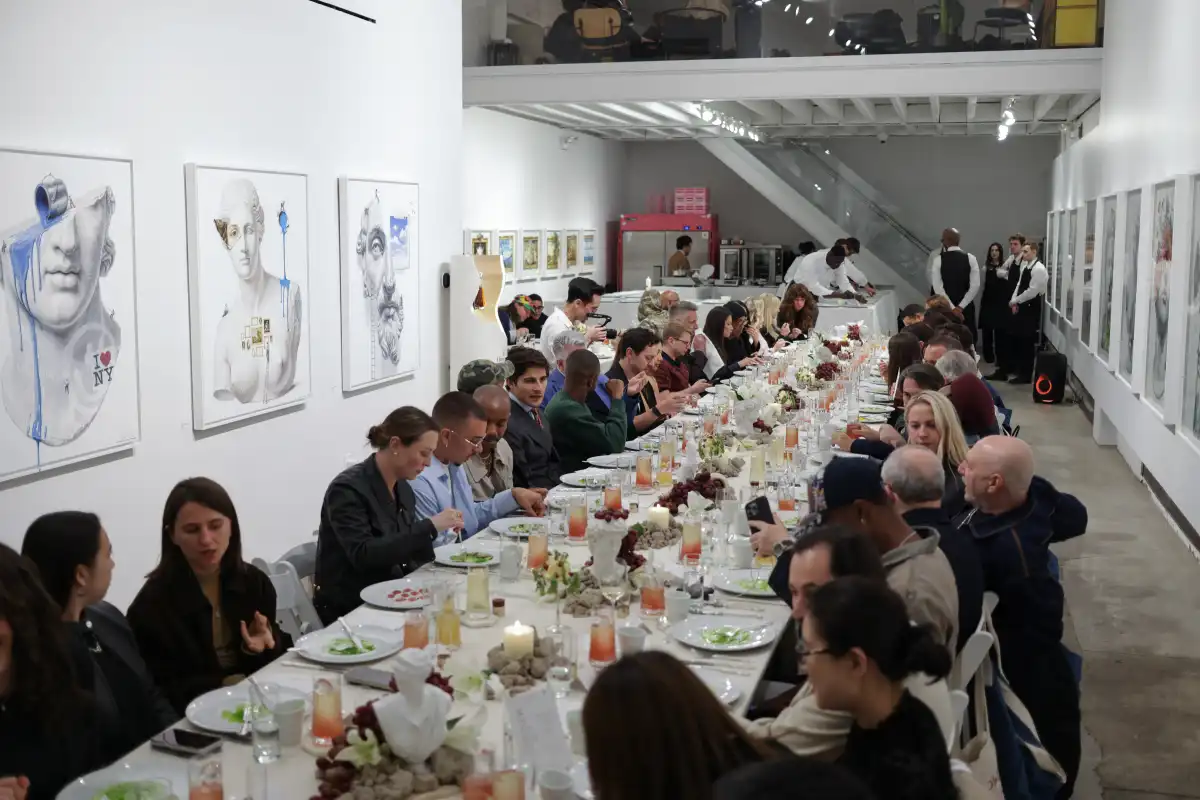
Naturally, the dinner extended that same philosophy. Served by HexClad, the evening married contemporary art with culinary art, turning the gallery into a charged salon of taste, texture, and theatricality. The menu was designed by celebrated artist and chef Roze Traore, whose culinary language seems to understand that food, at its highest level, is not merely consumed. It is composed.
Created in collaboration with HexClad CEO and co-founder Daniel Winer, the dinner had been dreamed up months earlier on Winer’s Tribeca penthouse terrace, which feels precisely like the kind of New York origin story one wants for an art-week feast. The menu moved with elegance and nerve: yellowfin crudo with pickled daikon, nori dust, and babeurre herb oil; branzino with saffron beurre blanc, confit potatoes, and black truffles; and poached pears with vanilla bean glaze, hibiscus, and goat cheese. Each course was paired with Hennessy, moving through V.S.O.P, X.O, and Paradis, one of the house’s most luxurious cognacs.


The pairings did not feel incidental. They continued the exhibition’s broader conversation about inheritance, craft, appetite, and transformation. In a way, the dinner recalled the older tradition of the salon, where art was never meant to exist in isolation, but among conversation, intellect, pleasure, and social electricity. Free Parking, meanwhile, became the room everyone wanted to be in, drawing a crowd that included Futura, Mickalene Thomas, Larry Warsh, Eric Haze, Gabriella Khalil, Latham Thomas, Marcus Allen, Quil Lemons, Ruba Abu-Nimah, and Zakari Kunakey, among others.
Of course, the names matter. Yet the real force of the night came from the way everything held together: the car, the paintings, the dinner, the cognac, the West Village room, and the collision of Versailles and American machinery. Nothing felt sterile. Nothing felt over-explained. The evening had polish, certainly, although more importantly, it had appetite.
On view from May 15 through 24, 2026, Permanent Impermanence marks Kozo’s most ambitious exhibition to date.In Kozo’s world, culture is not fixed. It is lacquered, driven, devoured, remembered, and remade. The old gods have not disappeared. They have simply found a faster body.
Kozo.art
