There is a private thrill in finding oneself inside a book. Not in a dramatic way, necessarily. Sometimes it is a sentence that understands you before you have understood yourself. Sometimes it is a character so flawed, funny, ashamed, hungry, or hopeful that you feel less alone for having met them. Reading can do that. It can make the world feel suddenly larger, while making one’s own inner life feel less strange.
That is glamour, too.
Not the obvious kind. Not merely chandeliers, gowns, velvet ropes, champagne towers, or forbidden caviar slipped into a room for effect. The deeper glamour is arguably intellectual. It is emotional expansion. It is the charged intimacy of language doing what luxury so often promises, yet rarely accomplishes: changing how one feels inside one’s own skin.
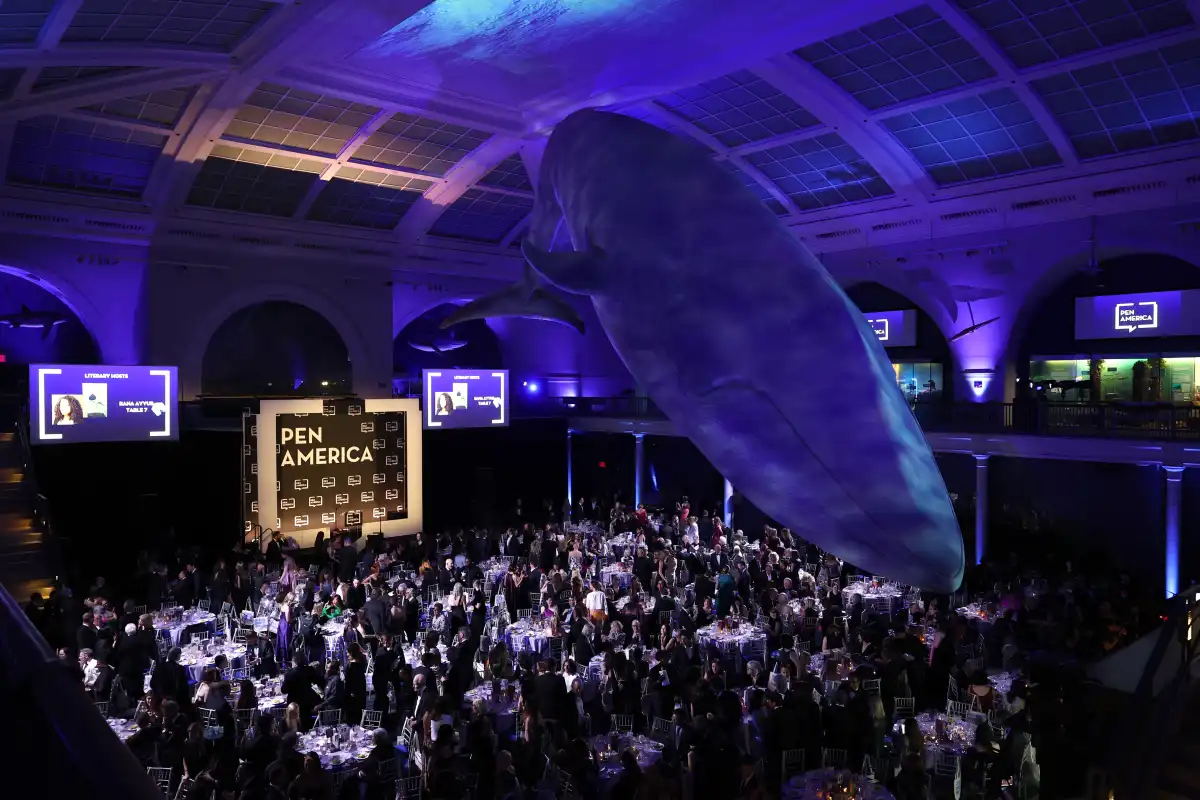
At PEN America’s annual Literary Gala, hosted by B.J. Novak at the American Museum of Natural History, that idea became the evening’s most powerful seduction. Novak, the actor, director, comedian, and bestselling author, did not treat writing as the opposite of glamour. Rather, he treated it as one of glamour’s highest forms. “Writing is glamorous. Reading is glamorous. Freedom of speech is glamorous,” he told the room, placing literature not at the edge of culture, but at its living center.

The gala gathered more than 600 writers, publishers, journalists, artists, and cultural figures for a night devoted to the freedom to read, write, and speak. Honorees included Ann Patchett, Jason Blum, the Rutherford County Library Alliance, and Iranian writers Golrokh Ebrahimi Iraee and Ali Asadollahi, both punished for expression. Iraee remains imprisoned in Tehran, while PEN America’s latest reporting noted more than 400 writers jailed globally. Beneath the evening’s polish sat a brutal truth: literature is not decorative. It is powerful enough to frighten governments, school boards, and systems built on silence.
Novak’s monologue pushed against the anxiety that artificial intelligence could ever replace human creativity. “Real life is making a comeback,” he said. “Real ideas are making a comeback. And books are at the forefront of that.” His call for “the next generation of literary glamour” felt less like a joke than a mandate. With this in mind, young people need something worthy to admire. Let it be the writer. Let it be the reader. Let it be the person brave enough to protect a sentence when the world becomes hostile to nuance.
Luxury, in that context, becomes far more profound than ornament. It is the luxury of an uncensored mind. It is the pleasure of following a thought all the way through. It is the smell of old books, worn sticky at the edges from years of thumbs and index fingers returning to the same pages. It is the hush before a perfect phrase lands. Perhaps most importantly, it is the strange cellular shift that happens when a character teaches us how to feel for someone we thought we could never understand.


Ann Patchett, receiving the PEN/Audible Literary Service Award, gave the evening its grace note. Honored for her humane voice as a novelist and her dedication to independent bookselling through Parnassus Books in Nashville, Patchett reminded the room that literary life is built through community. It lives in bookstores, libraries, classrooms, banned novels, stubborn readers, and the people who keep placing books into other people’s hands. Speaking beneath the museum’s great whale, she moved between beauty and violence, darkness and gratitude, extinction and rebirth. Her wisdom, unsurprisingly, refused despair without pretending the world is gentle.
Jason Blum, honored with the Business Visionary Award, brought the argument into popular culture. Through Blumhouse, horror has become one of contemporary storytelling’s sharpest languages for fear, injustice, class tension, racism, and moral fracture. Maya Hawke described the genre as a place where stories a culture tries to avoid often become the ones most worth telling. Blum, conversely, spoke of fiction as a vehicle for complicated values, especially now, when even the idea of fact has been turned into a battlefield.
The Rutherford County Library Alliance gave the evening its civic spine. Honored for resisting book bans and defending a fired library director who refused to restrict LGBTQ+-themed children’s books, the alliance represented another kind of glamour: moral courage. Libraries belong to everyone. That sentence does not glitter, yet it contains more democratic splendor than any ballroom could manufacture.


By the time PEN America President Dinaw Mengestu introduced the Freedom to Write Award honoring Iraee and Asadollahi, the night’s beauty had acquired its necessary shadow. Glamour without consequence is costume. Glamour attached to language, freedom, danger, and imagination becomes something far closer to the sacred.
The PEN America Literary Gala understood this completely. Beneath the whale, with books serving as centerpieces and writers standing to be recognized, literature was restored to its rightful condition: seductive, volatile, necessary, and enduring. Novak did not simply host the evening. He named the truth at its center. The written word is glamorous because it changes us invisibly first. It enlarges the mind, sharpens the conscience, loosens the heart, and leaves the soul better dressed than it found it. Later, beneath the towering fossil cast that greets visitors at the museum, with books tucked into my bag like contraband treasure, I danced with the particular satisfaction known only to the devoted reader: proof, once again, that a life of the mind can still throw a very good party.
Pen.org


