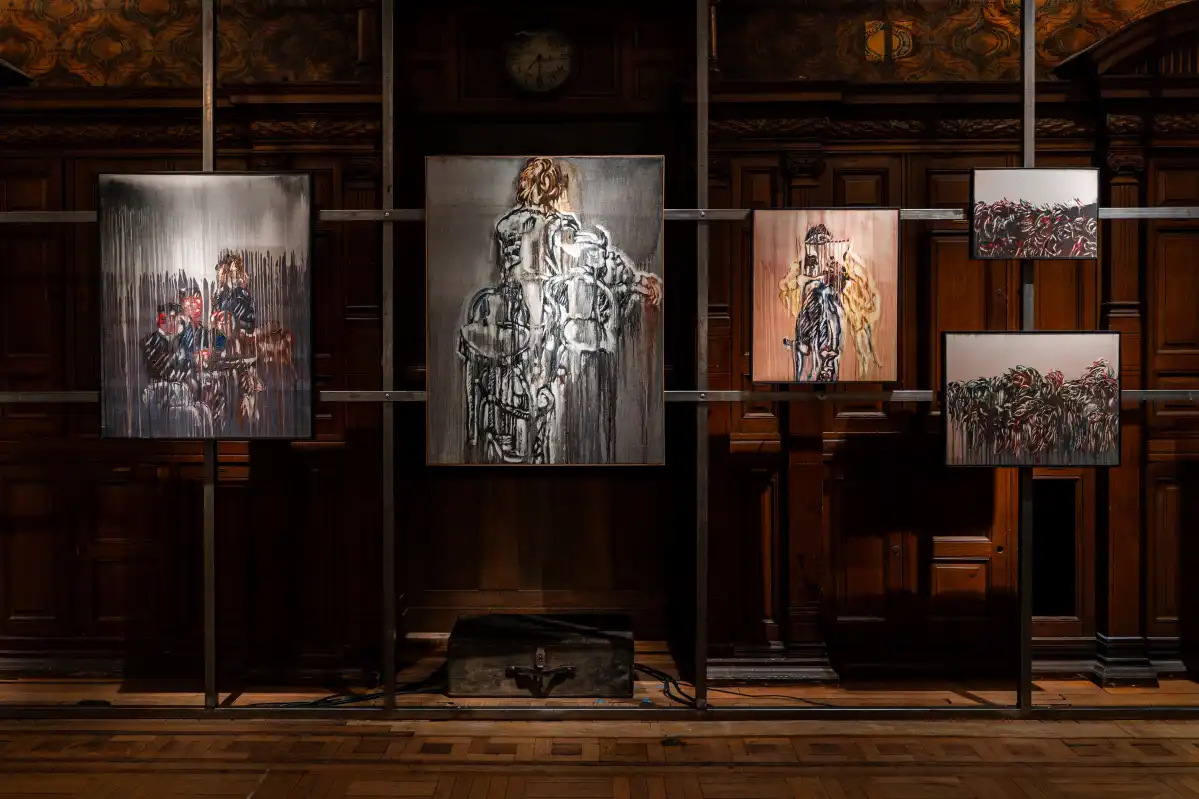
Some will have you believe TEFAF is merely where the wealthy come to be seen, where polished shoes, serious jewelry, museum trustees, and collectors with enviable calendars gather beneath the Park Avenue Armory’s historic bones for another performance of cultural exclusivity. Some will reduce it, perhaps too easily, to an elegant exposition of the one percent, another gilded room where the art world admires itself over champagne. Yet that reading feels not only reductive, but almost willfully joyless. In actuality, TEFAF is where the art world is simply done right.
There is a difference between wealth and taste, between luxury and vulgarity, between access and discernment. TEFAF, at its best, understands that difference with near obsession. It is not simply a fair. It is a standard. It is a reminder that beauty still deserves ceremony, that great objects deserve space, and that connoisseurship is not an outdated affectation but a form of cultural stewardship.
Arguably, this matters even more now. Expertise has been handed out with the vulgar desperation of a dishonest car salesman tossing counterfeit coupons at anyone willing to believe the pitch. Everyone, suddenly, has a take. Everyone has mistaken access for knowledge, opinion for scholarship, and proximity for authority. Somewhere along the way, we were fed the tedious narrative that what was once considered high-end, disciplined, rarefied, and prestigious was somehow pretentious, crude, or morally suspicious. Conversely, we were told that the outsider, the grunge, the undone, and the deliberately imperfect must automatically represent truth, intelligence, and innovation.
Naturally, there is brilliance in the high and the low. There is genius in the gutter and revelation in the palace. Yet it is dangerous, intellectually lazy even, to reduce perfection to vapidity. Perfection takes work. It takes education, stamina, tireless research, historical literacy, a trained eye, white gloves, and, yes, perhaps a little snobbery. Not the cruel kind. The necessary kind. The kind that understands standards exist for a reason, and that cultural authority is not built by shouting louder than the person beside you.
This year, TEFAF New York returned to the Park Avenue Armory with an invite-only preview on May 14, bringing together nearly 90 exhibitors from 14 countries across modern and contemporary art, design, jewelry, and antiquities. That breadth matters. In an art ecosystem increasingly trained to chase novelty, TEFAF still insists on lineage. It places the contemporary in conversation with the historical, the decorative arts beside the intellectual, the jewel beside the painting, the ancient impulse beside the modern hand. Unsurprisingly, the result is not chaos, but choreography.
At every corner, there was evidence of care: breathtaking works, beautifully composed booths, devastatingly chic visitors, champagne held like punctuation, and that particular hush that occurs when people understand they are standing near something exceptional. TEFAF reminds us that art is prestigious, and frankly, that is perfectly all right. Prestige is not the enemy of meaning. Elegance is not the opposite of seriousness. Beauty, when handled with intelligence, can be an argument all its own.
The fair’s closing figures suggest that collectors agreed. Offer Waterman sold a Magdalene Odundo ceramic to a private European collector for above $500,000. White Cube placed all works from its solo presentation of Cai Guo-Qiang by the end of the first day, with works priced up to $700,000. Waddington Custot sold Joan Miró’s Le soleil se retourne vers la fillette pour fêter son allégresse for an asking price of $1.3 million, while Mitterrand saw formidable interest in François-Xavier Lalanne, placing works around the $800,000 to $1.4 million range. Elsewhere, Macklowe Gallery sold Tiffany Studios works, Sheila Hicks continued to command market attention, and Didier Ltd reported six-figure sales of artist-made jewelry by names including Salvador Dalí and Alexander Calder. The message was unmistakable: serious objects, when presented seriously, still move.

Among my own personal favorites were the countless Légers on display, those muscular geometries still somehow able to make modernity feel clean, theatrical, and newly charged; the ballsy Picassos, of course, with all their swaggering nerve and unapologetic command; and, perhaps most powerfully, the nudity. Not nudity as provocation alone, nor as easy sensuality, but nudity as exposure, architecture, vulnerability, and force. Eva Helene Pade’s Opstand (Surge) nearly knocked me over. There are works one admires politely, and then there are works that interrupt the body before the mind has time to organize its response. This was the latter.
The numbers are seductive, of course, yet the true significance lies in what capital can protect, preserve, and propel. At TEFAF, a sale is not merely a transaction; it is an act of stewardship, deciding where an object will live, who will guard its history, and how its aura will move forward.
That institutional gravity was felt throughout the fair. Representatives from more than 260 museums and institutions attended, including leadership from The Metropolitan Museum of Art, MoMA, the Whitney, the Guggenheim, and the National Gallery of Art, among others. With this in mind, the fair becomes harder to dismiss as a playground of privilege alone. It is also a meeting ground for institutions, trustees, curators, collectors, dealers, artists, advisors, historians, and the highly trained eyes who understand that culture does not sustain itself through sentiment. It requires devotion. It requires capital. It requires rooms where beauty is taken seriously enough to be protected.
Put bluntly, to be a true expert in the art world means submitting oneself to rigor. It means looking again, reading more, asking better questions, understanding provenance, condition, medium, market, lineage, restoration, context, and consequence. It means knowing that a work of art is never just an image. It is an object, an argument, a history, a hand, a record, a miracle, and sometimes a very expensive responsibility. It also means accepting that not every door is meant to be entered casually. Sometimes you do need to put on clean, dressy clothing before walking through the threshold. Sometimes you do need to lower your voice, sharpen your eye, and understand that you have entered a room where value is not merely financial, but cultural, intellectual, and historical.

TEFAF, in this sense, is not an apology for elitism. It is a defense of standards. Prestige, when earned, is not vulgar. It is the visible architecture of invisible labor. It is years of study made legible. It is discernment given form.
Certainly, there are outfits. There is champagne. There are diamonds, double kisses, advisors moving with quiet purpose, and collectors pretending not to notice what everyone else is noticing. Thank God. The art world should have glamour. It should have wit, silk, appetite, and drama.
TEFAF understands that the prestige surrounding art is not frivolous when it serves the work. It frames the object. It elevates the encounter. It reminds the visitor that collecting, at its finest, is not consumption but custodianship. In a world increasingly suspicious of refinement, TEFAF New York makes a compelling case for refinement as a cultural virtue. It is where beauty is not apologized for. It is where prestige is not a dirty word.
It is, quite simply, where it is done right.
TEFAF.com
