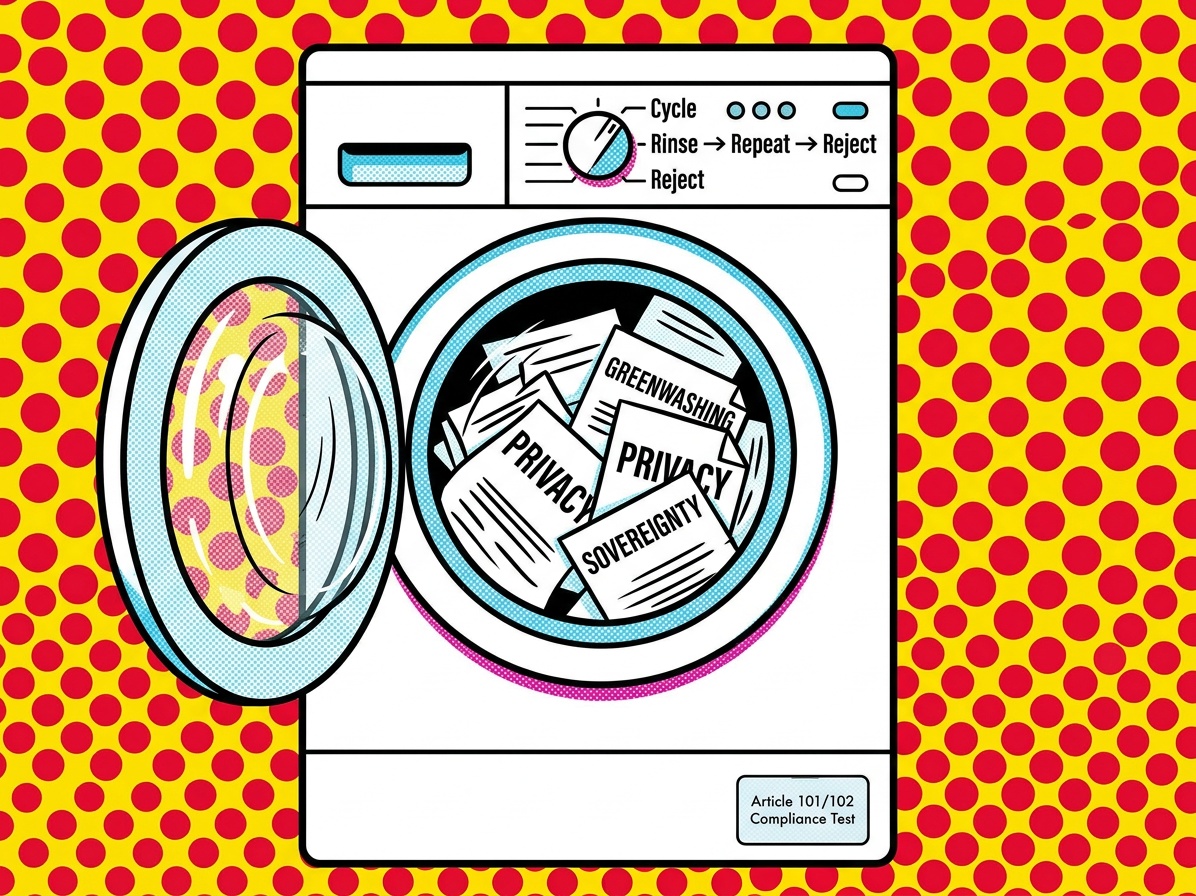
Although not a single, Mitski’s “Washing Machine Heart” ranks among her most popular songs. Its insistent drumbeat echoes the spin cycle of an old washing machine, recalling the singer’s frustration with her romantic life.
Competition policy has its own fixation on “washing.” In this context, “washing” describes efforts by undertakings to invoke public policy goals—such as sustainability, privacy, or sovereignty—to justify anticompetitive conduct. The terminology has proliferated. “Greenwashing” is now standard; “privacy-washing” has gained traction; and “sovereignty-washing” has entered the lexicon. Many commentators now treat these risks as widespread and in need of urgent attention.
That concern is overstated. European Union competition law leaves little room for undertakings to defend otherwise anticompetitive conduct by invoking public policy objectives. The risk of successful “washing” strategies remains low under Article 101 of the Treaty on the Functioning of the European Union (TFEU), and almost nonexistent under Article 102 TFEU.
No Gentle Cycle for Greenwashing Claims
The risk of “washing” appears highest in the context of environmental protection and Article 101 TFEU. Recent scholarship frames sustainability as either a “sword” or a “shield” in antitrust proceedings. It operates as a “sword” when firms engage in conduct that risks environmental harm—for example, an agreement not to develop advanced emissions technology. It operates as a “shield” when otherwise anticompetitive conduct purportedly delivers environmental benefits—for example, an agreement to reduce coal output. The “shield” scenario tends to raise the specter of greenwashing: firms cloaking restrictive agreements in sustainability language to sidestep Article 101 TFEU.
But how realistic is that risk? The European Commission’s Guidelines on Horizontal Cooperation Agreements set out a detailed framework for assessing sustainability agreements. The Guidelines elaborate the four cumulative conditions in Article 101(3) TFEU and require, among other things, that claimed sustainability benefits be substantiated, verifiable, and passed on to consumers in a way that offsets the competitive harm. This is no rubber stamp. A framework this demanding leaves little room for undertakings that aim to engage in greenwashing.
The risk shrinks further outside the sustainability context. Claims that privacy or sovereignty concerns justify an otherwise anticompetitive agreement must clear the same Article 101(3) hurdle. The four cumulative criteria track consumer welfare and competitive effects. They leave little space for creative arguments about broader public policy gains. A firm attempting to “privacy-wash” or “sovereignty-wash” an agreement would face the same evidentiary and analytical burdens. If anything, it would confront an even less hospitable doctrinal landscape than in sustainability, where the European Commission has at least offered tailored guidance. In short, the barriers to a successful “washing” strategy under Article 101(3) remain substantial.
No Detergent Strong Enough: Article 102’s Hard Line
If “washing” risks remain limited under Article 101 TFEU, they are vanishingly small under Article 102 TFEU. The Court of Justice of the European Union’s case law makes the point clear. A dominant undertaking can, in principle, justify anticompetitive unilateral conduct in two ways: efficiency defenses and objective justifications.
In theory, a dominant firm may show that its conduct generates efficiencies that outweigh the competitive harm. In practice, that path is steep. The burdens are not symmetrical. An enforcer may rely on a theory of harm grounded in potential anticompetitive effects, but the firm must prove efficiencies in terms of “their actual existence and extent.” To date, no efficiency defense raised by a dominant undertaking has succeeded under Article 102.
Objective justifications fare no better. The Court of Justice has stressed that safeguarding public policy objectives is not the role of dominant firms—that task belongs to public authorities. In cases such as Tetra Pak II, Romanian Power Exchange/OPCOM, and Baltic Rail, firms invoked justifications based on consumer protection, combating tax evasion, and public safety. None succeeded. As with efficiency defenses, no case has turned on a successful objective justification under Article 102.
For a dominant firm contemplating a “washing” strategy, the doctrine offers no real foothold.
No Spin Cycle: Antitrust Isn’t a Washing Machine
I do not suggest that “washing” strategies will never appear. They can be tempting, and some undertakings will try them. In adjacent domains—such as sustainable finance or corporate social responsibility—they may even be widespread. Even in competition law, a few attempts may succeed in a narrow sense by escaping enforcement through de-prioritization. But that is a far cry from showing that firms routinely pervert public policy objectives to restrict competition. The doctrinal structure of EU competition law stands in the way.
Competition authorities, for their part, remain deeply skeptical of public policy justifications for anticompetitive conduct. One can debate whether that skepticism always strikes the right balance. An overly rigid approach carries risks of its own—I have argued elsewhere that a more open stance may be warranted in some cases. Still, claims of systematic green-, privacy-, sovereignty-, or other forms of “washing” lack doctrinal support.
Antitrust is not about to go on a spin cycle.
