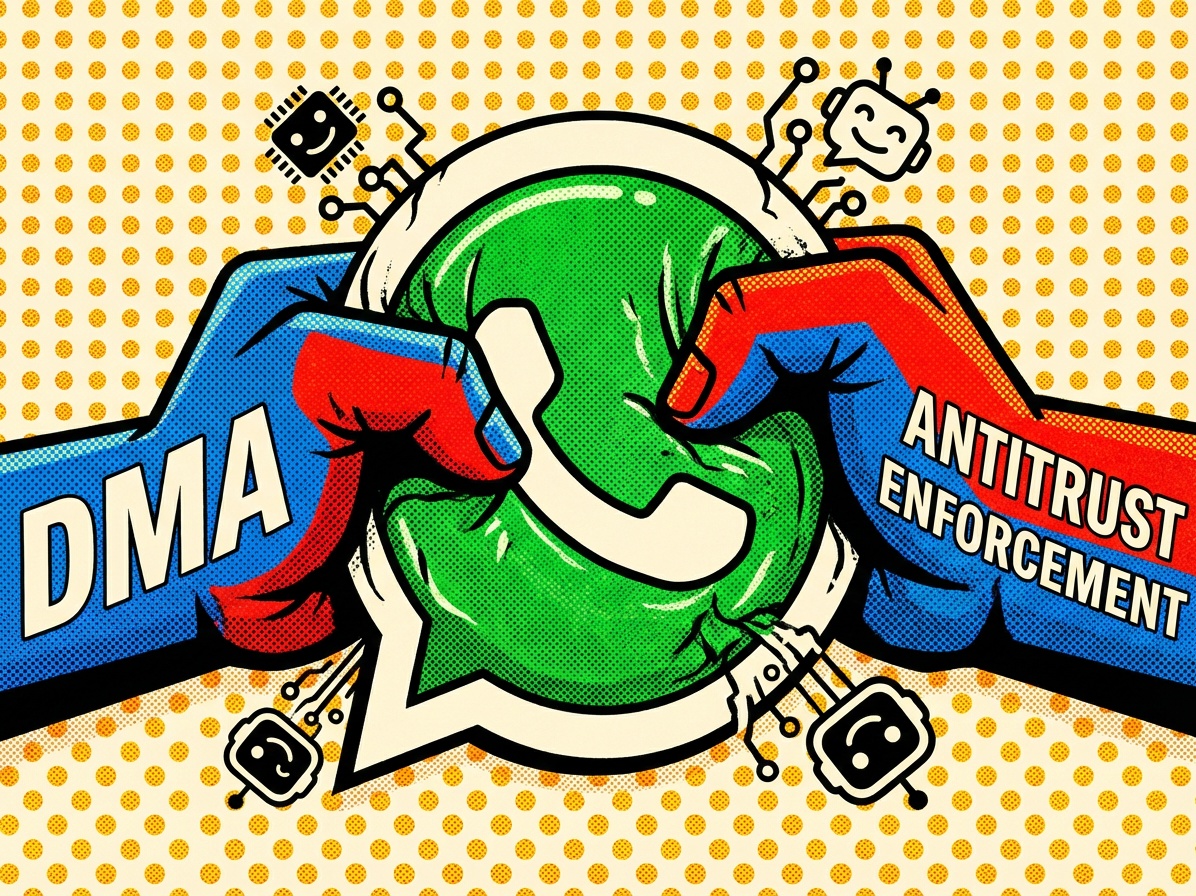
Brussels has boxed itself into a familiar corner: first limit how a platform can make money, then regulate what is left. The European Commission’s case against Meta over WhatsApp is a near-perfect illustration.
On April 15, the European Commission sent Meta a Supplementary Statement of Objections. It signaled its intent to order the company to restore third-party AI assistants’ access to WhatsApp under the terms that applied before Meta’s Oct. 15, 2025 policy change. The move—an interim-measures procedure—marks the latest front in an increasingly strained effort to police competition in generative AI.
The case makes little sense from a consumer-welfare standpoint. It reads less like a coherent theory of harm and more like an attempt to “do something” about generative AI, with the analysis shaped to fit that goal. The Commission proposes to deploy one of its most far-reaching—and rarely used—enforcement tools to protect competitors in a market that, by almost any reasonable metric, remains intensely competitive.
The result is what Robert Bork famously called a “policy at war with itself.”
Squeezing the Balloon: Constrain Monetization, Then Regulate What’s Left
To understand what the European Commission now seeks to unwind, start with the commercial target of its intervention: the WhatsApp Business Platform (formerly the WhatsApp Business API).
WhatsApp has remained free to end users since before Meta acquired it in 2014. Meta has largely honored its commitment not to monetize the consumer-facing app through conventional advertising. That leaves the company to recoup a $19 billion acquisition elsewhere. Historically, it has relied on two channels: cross-service monetization—using WhatsApp data to improve ad targeting on Facebook and Instagram—and the Business Platform, where firms pay a per-conversation fee to communicate with customers at scale.
In Europe, the Digital Markets Act (DMA) has sharply curtailed the first path. Article 5(2) bars a designated gatekeeper from combining personal data across core platform services, or cross-using such data, absent specific user consent. In April 2025, the Commission fined €200 million for noncompliance, finding its “Consent or Pay” model failed to offer a valid free-and-equivalent alternative. The joint-monetization strategy Meta pursued when it integrated WhatsApp into its advertising stack has narrowed dramatically. As a result, the Business Platform now carries more of the burden of monetizing WhatsApp.
Against that backdrop, Meta updated WhatsApp’s terms to exclude third-party general-purpose AI assistants from the Business Platform. That change triggered a regulatory back-and-forth with the Commission. On Feb. 9, the Commission issued a Statement of Objections arguing the amendment constituted an abuse of dominance. Meta responded by reversing course. It brought third-party AI assistants back into the Business Platform under the same paid-access structure that applies to other users. The Commission now contends this revised framework “seems to have the same effect” as the original ban.
The Commission’s theory appears straightforward: WhatsApp functions as a critical distribution channel for general-purpose AI assistants that compete with Meta’s offerings. Meta’s conduct therefore forecloses competition in the adjacent AI-assistant market. Because those markets evolve quickly, the Commission argues interim measures are necessary to prevent “serious and irreparable harm.”
That theory sits uneasily with the underlying business reality. The Commission has singled out one of the few remaining avenues through which Meta can meaningfully monetize WhatsApp. Having constrained cross-service monetization through the DMA, it now seeks to dictate the terms of the paid API that has become Meta’s primary WhatsApp revenue stream. In effect, it would require free—or near-free—access for one category of business user.
Nothing in the DMA required Meta to preserve the pre-October 2025 terms for third-party AI assistants. Extending the same per-conversation pricing that applies to other heavy API users looks like a rational response to the monetization squeeze created by the Commission’s own interventions.
The choice of procedural tool also merits scrutiny. Until recently, the Commission reserved interim measures for manifestly serious cases. Its own procedural manual notes that Broadcom (October 2019) marked the first use of Article 8(1) of Regulation 1/2003 in nearly two decades.
Using this exceptional instrument on a theory that depends on contested market definitions and speculative foreclosure claims in a nascent market should raise eyebrows.
If Everything Is Everywhere, Nothing Is Essential
Public information about the Commission’s analysis remains thin, but its contours are easy enough to sketch. For the theory to hold, the Commission likely needs an unusually narrow relevant market—something like “general-purpose AI assistants distributed through consumer messaging apps.” Broaden the lens to “general-purpose AI assistants,” which better reflects how users actually switch between services, and the theory of harm starts to unravel.
The wider generative-AI space ranks among the most hotly contested in recent memory. Since ChatGPT’s public launch, AI firms have attracted enormous venture capital inflows. The result: a crowded field of serious players—Anthropic, Google, Microsoft, Meta, Mistral, Perplexity, xAI, DeepSeek, and others—whose relative positions shift constantly. Recent Similarweb data, for example, show ChatGPT’s chatbot-traffic share falling from about 87% at the start of 2025 to roughly 64% a year later, as Google’s Gemini nearly quadrupled. That is not what an entrenched bottleneck looks like.
A narrow market definition also clashes with observable competitive behavior. Generative-AI firms aggressively expand across distribution channels. Anthropic has rolled out Claude Cowork and Office integrations. Perplexity distributes through WhatsApp, Telegram, and X via dedicated numbers. Google has embedded Gemini across Search, Android, Gmail, and Workspace. Microsoft has integrated Copilot into Windows, Office, and GitHub. OpenAI, for its part, made ChatGPT available inside WhatsApp by publishing a phone number.
In a market where firms pursue multi-channel distribution as a matter of course, it is hard to treat any single entry point—here, a messaging app—as an indispensable “essential facility” for AI assistants.
Needing the Platform Is Not Being Entitled to It
Even if WhatsApp access matters, it is hard to see who suffers foreclosure in any meaningful competitive sense. The major AI labs already reach users through their own apps, websites, browsers, smartphone operating systems, productivity software, and APIs that power thousands of third-party services.
ChatGPT counts hundreds of millions of weekly users and installs easily across platforms. Claude runs across the web, apps, and a growing set of enterprise integrations. Google’s preinstalled distribution on some Android devices dwarfs anything WhatsApp could offer. Against that backdrop, the claim that losing one distribution channel would “seriously and irreparably” harm competition in AI assistants stretches credulity.
The more plausible losers are smaller firms that rely heavily on messaging-app distribution—companies like Luzia, which targets Spanish- and Portuguese-speaking users primarily through WhatsApp. That is a real business risk for those firms. It is not, however, a sound basis for European competition policy, much less for invoking interim measures.
In a fast-moving industry, freezing today’s market structure can do more harm than good. Platform success often reflects adaptation to user demand, not exclusionary gatekeeping. Efforts to “open up” platforms by fiat risk short-circuiting the experimentation that drives progress.
The Foundem saga offers a cautionary tale. Foundem, a small UK search site, saw its rankings decline and spent years blaming Google’s algorithm—a narrative the Commission ultimately endorsed in its 2017 Google Shopping decision. A simpler explanation is that Foundem mistook needing a platform for being entitled to placement on it. It confused its own needs with consumer preferences. The Meta-WhatsApp theory repeats that mistake, treating firms that benefit from WhatsApp access as entitled to it on their own terms.
Compete—Just Not Too Effectively
Beyond the immediate effects, the deeper problem lies in the signal this case—and others like it—sends. Firms compete in AI in part by finding new ways to deliver functionality, often through deep integration into widely used products. Think of Anthropic’s Claude launching Cowork and building an Excel plugin. Current EU competition policy discourages that kind of integration.
Under the DMA, Google has effectively pulled back from embedding AI-generated answers into Search in ways that would most clearly benefit European users, because such moves risk being labeled self-preferencing under Article 6(5). The Meta case sends the same message from the opposite direction: integrate your own AI into your own distribution channels—even ones third parties have used—and you may face interim measures. The practical effect is to force Web-2.0 incumbents to compete in AI with one arm tied behind their backs.
That is an odd stance for competition policy. Meta Platforms Inc. is among the firms best positioned to challenge OpenAI, Anthropic, and Google in generative AI. Its open-weight Llama models and its recent acquisition of Manus underscore that potential. Penalizing Meta for integrating its own assistant into WhatsApp—while also constraining Google’s integration of Gemini into Search—reduces, rather than increases, competitive pressure on current AI leaders.
The intervention also rests on a broader assumption: that incumbents will inevitably dominate AI absent regulatory constraints. The evidence cuts the other way. Despite their Web-2.0 scale, Google, Meta, and Microsoft have yet to convert that advantage into dominant AI positions. Instead, startups—OpenAI in consumer use and Anthropic in enterprise—currently lead.
A Policy at War With Itself—Now With AI
Robert Bork’s 1978 diagnosis of American antitrust was that it had become “a policy at war with itself”—a body of doctrine that undermined the consumer-welfare goals it claimed to serve. The same critique now fits competition policy in AI.
In the name of addressing speculative and unlikely foreclosure risks, policymakers are creating concrete harms. They deter integration that would benefit consumers, blunt the competitive pressure Web-2.0 incumbents could bring to bear on AI leaders, and replace market evolution with regulatory micromanagement.
It is especially troubling that the European Commission has chosen this case to normalize interim measures as a routine enforcement tool. Those measures should remain reserved for clear-cut, urgent harms—not used to lock in the design of an emerging market on the basis of a novel and contested theory.
Sound competition policy protects the competitive process, not particular competitors. It centers consumer welfare, relies on evidence, and respects the limits of regulatory foresight in fast-moving markets. The Commission’s Meta-WhatsApp case misses on all three.
Bork saw the danger clearly. Europe is now proving him right.
