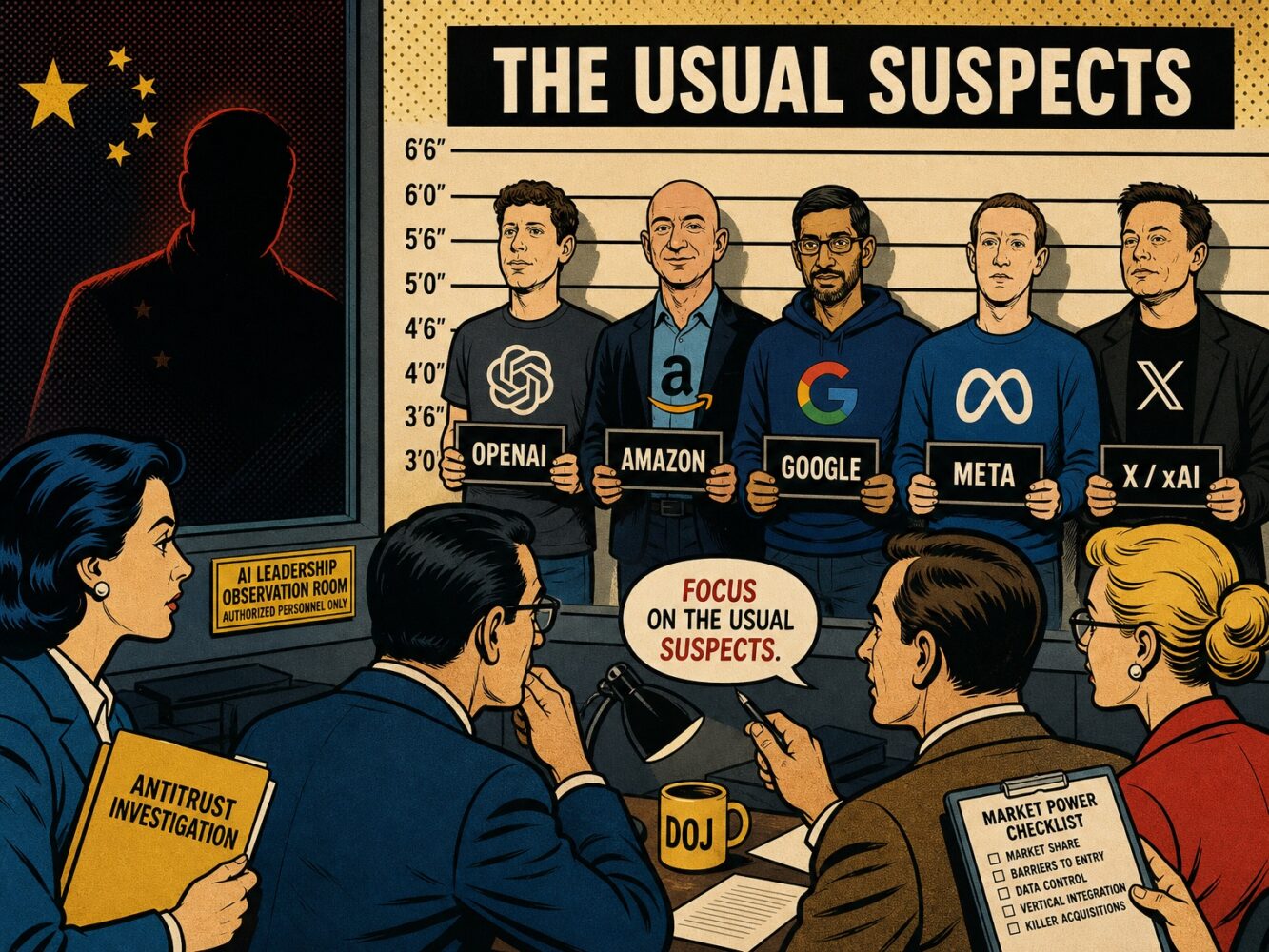
The standard AI competition story has plenty of supposed villains. It just keeps leaving out one of the biggest.
Regulators and academics warn that a small group of firms—including Amazon, Anthropic, Google, and OpenAI, with Microsoft and Meta sometimes added—will dominate generative artificial intelligence. Their advantages in computing power, capital, data, and distribution will harden into market power, shut out challengers, and concentrate control over a technology reshaping the economy.
Public agencies have embraced this account. The U.S. Federal Trade Commission (FTC), U.S. Department of Justice (DOJ), U.K. Competition and Markets Authority (DMA), and European Commission advanced it in their Joint Statement on Competition in Generative AI, which I have discussed before.
Academics have raised similar concerns, even as the sector continues to grow quickly. Much of their attention centers on “GAMMA”—Google, Amazon, Microsoft, Meta, and Apple—and those firms’ control over critical inputs such as data and computing capacity. The fear is that these advantages could produce an “AI oligopoly.”
That theory has given regulators a reason to act early. In the European Union, it has shaped Digital Markets Act (DMA) specification proceedings, Article 102 investigations, and emergency interim measures. In Brazil, it has pushed merger review beyond mandatory notification thresholds to reach AI partnerships. In Italy, it has prompted proceedings over Meta’s integration of AI into WhatsApp before regulators established any consumer harm.
As I argued in an earlier post, these interventions follow the same logic. Regulators treat a plausible theory of harm as enough to justify immediate action, while giving limited weight to the safeguards that ordinarily discipline competition enforcement. That approach risks suppressing the very practices through which AI firms compete, including integration, partnerships, and the use of existing distribution networks.
Yet the larger flaw appears even earlier in the analysis. The story remains almost entirely Western. Regulators cast GAMMA, OpenAI, and Anthropic as the firms to contain, then focus on their relationships with one another and with U.S. and European complementors, meaning companies whose products or services increase the value of another firm’s offering.
Meanwhile, one of the fastest-growing sources of competitive pressure in global AI barely appears in market-definition exercises, foreclosure theories, or claims that power in older markets will carry over into AI.
China is missing from the case file.
The Competitor Regulators Forgot
Chinese models accounted for roughly 1% of the global generative AI market in late 2024. By the end of 2025, their share had climbed to about 15%, according to data reported by Nikkei.
The Chinese market has coalesced around about 10 serious providers, each offering frontier-class models. DeepSeek and Alibaba’s Qwen are the best known abroad, but the field also includes Zhipu’s GLM-5, Moonshot AI’s Kimi, MiniMax’s M-series, ByteDance’s Doubao and Seed models, Baidu’s ERNIE, Tencent’s Hunyuan, StepFun’s Step series, and Xiaomi’s MiMo. Kimi’s latest version reportedly beats Fable 5 on some benchmarks, while MiMo has emerged as a surprise volume leader on global developer platforms.
Several of these models remain primarily domestic. Baidu’s ERNIE, Tencent’s Hunyuan, and ByteDance’s Doubao are closely integrated into Chinese search, messaging, and device products, and remain difficult to access abroad.
Others follow a very different model. DeepSeek, Qwen, GLM-5, and Kimi K2.5 distribute their model weights under permissive licenses, including MIT- and Apache-style terms. “Open weights” means developers can download the underlying model parameters, adapt them, and deploy the resulting systems on their own infrastructure. A developer in Europe, the United States, or Latin America can use these models without opening an account, obtaining a Chinese phone number, or relying on a Chinese server.
Qwen alone has surpassed 700 million downloads on Hugging Face, overtaking Meta’s Llama as the world’s most downloaded AI-model family. Developers have built more than 113,000 derivative models from its checkpoints, or saved versions of the model used as starting points for further training. These products do not need to find Western distribution. They already have it.
The performance gap has narrowed just as quickly. Stanford University’s 2026 AI Index Report estimates that the gap between the best U.S. and Chinese models has fallen to 2.7 percentage points, compared with 17.5 to 31.6 points in May 2023. U.S. firms attract 23 times as much private AI investment as Chinese firms, yet lead in model performance by less than 3 percentage points. Among leading open-source models, U.S. and Chinese systems have repeatedly traded the top spot on major benchmarks since early 2025.
None of this appears in the public record of the European Commission’s proceedings against Meta; the Brazilian Administrative Council for Economic Defense’s (CADE) referrals involving Amazon, Microsoft, and Google AI partnerships; or the DMA specification proceedings concerning Alphabet.
The usual caveat applies. Market definitions depend on the facts of each case, and regulators tailor theories of harm to particular conduct. Some proceedings may have sound reasons to exclude Chinese models.
The broader pattern is harder to defend. No major AI enforcement action in Europe, the United States, or Latin America has publicly confronted the possibility that some of the strongest competitive pressure in global AI comes from firms beyond those regulators’ reach. Academic debate often makes the same omission. Chinese AI scarcely exists in either account.
That omission looks stranger against the growing concern in trade policy. Chinese firms aim to export lower-cost alternatives to Western graphics-processing units (GPUs), the chips used to train and run AI models, while spreading open-source models abroad to build long-term dependence on Chinese technology. Chinese models have already gained users among some of the largest U.S. companies.
Competing Outside the Antitrust Playbook
Chinese AI firms are pursuing a competitive strategy that differs sharply from the proprietary, vertically integrated model favored by leading U.S. companies—and from the market structure most antitrust tools assume.
OpenAI, Anthropic, and Google DeepMind develop frontier models, control access through application programming interfaces (APIs), and build applications, distribution deals, and enterprise services around them. They generally treat scale, computing power, and proprietary training data as core competitive advantages. Much Western antitrust enforcement in AI rests on the premise that regulators must police those advantages, especially when they combine with the distribution networks of established platforms.
Many Chinese firms compete differently. They rely more heavily on open weights, inexpensive fine-tuning, and state-supported distribution. DeepSeek releases V3.2 and V4 under the MIT license, with model weights available for commercial use. Alibaba’s Qwen family uses a hybrid approach. Its midrange models, up to 35 billion parameters, remain available under the Apache 2.0 license, while its most capable models have moved toward proprietary access. That shift resembles, with some delay, the drift toward closed systems among U.S. frontier labs.
For the open tier, ubiquity is the competitive weapon. A model that is free to download and cheap to run can spread through adoption rather than through controlled access.
That difference creates two problems for current enforcement.
First, diffusion through open-source models does not fit neatly within the remedies regulators now favor. Behavioral restrictions, data-sharing mandates, and interoperability rules assume identifiable firms, proprietary products, and gatekeeping intermediaries. Those tools have little purchase on a model family downloaded 700 million times and embedded in derivative applications across multiple jurisdictions.
Second, open models weaken some of the market-power theories behind current cases. Consider the European Commission’s DMA proceeding extending search-data-sharing obligations to AI chatbots. The concern is that Google could use its dominance in search to secure dominance in AI assistants.
That theory depends on Google controlling an input that rivals cannot obtain elsewhere. Yet Qwen, DeepSeek, and, more recently, Kimi have gained users worldwide without access to Google’s search data. They did so by offering capable models at low cost. Their growth complicates the Commission’s foreclosure theory.
Different business models do not place Chinese firms in a separate market or make them relevant to every antitrust dispute. Open-source models can still discipline leading providers, even when their licensing, distribution, and revenue models differ.
The competitive pressure also extends beyond open source. Chinese firms offer leading models through inference APIs, which allow developers to send requests to remote models without operating the underlying infrastructure. Those services remain accessible worldwide, though they carry the security and privacy risks associated with Chinese-operated systems.
Some technically open models still require enormous computing resources. Zhipu’s GLM-5, for example, uses a 744-billion-parameter mixture-of-experts architecture and is available under the MIT license. Few developers can run it themselves. Most reach it through third-party inference services such as OpenRouter.
That still counts as competition. A model need not run on a laptop to pressure incumbent providers. If developers can reach it through the same services they already use, it competes on price, capability, and availability with leading U.S. models.
Competition also will not always pit one frontier model against another. Many production systems use several models for different tasks. A larger controller model may handle open-ended reasoning, while smaller, specialized models parse inputs, format outputs, and route tool calls.
Those routine tasks rarely require frontier-level performance. Firms can assign them to fine-tuned small language models at far lower cost. Recent analysis suggests that using a frontier model for the roughly 30% of tasks requiring advanced reasoning and a smaller model for the remaining 70% can cost about one-tenth as much as sending every task to a large model.
Smaller models are not perfect substitutes for frontier systems. They still create meaningful competitive pressure. Developers and enterprises seeking to control costs can reduce their dependence on any single frontier-model provider by combining larger systems with smaller Chinese or non-Chinese alternatives.
The Market Has Noticed, Even If Regulators Haven’t
At least one major generative AI company has noticed the competition from China. In a May 14 blog post, Anthropic described two possible paths through 2028. Under the first, the United States and allied democracies retain a 12- to 24-month lead in frontier AI. Under the second, China closes the gap and reaches parity.
Anthropic’s analysis reflects its assessment of current competitive trends. Without changes to export controls, computing policy, and investment priorities, the company believes China could erase the remaining gap within two years. Dario Amodei made a similar argument in his earlier essay, “On DeepSeek and Export Controls.” He described DeepSeek as a genuine competitive challenge, though one that some observers had overstated, and argued that stricter export-control enforcement was necessary to preserve the U.S. lead.
Microsoft’s conduct offers an even clearer test. According to Axios, the company is considering a fine-tuned version of DeepSeek V4, hosted on Azure, as a cheaper alternative to the OpenAI and Anthropic models that power Copilot Cowork. Charles Lamanna, Microsoft’s executive vice president for Copilot, gave a simple reason. Some enterprise users perform hundreds of tasks each week, and “the costs can go very high.”
The price advantage of Chinese open-source models is large enough that Microsoft, an OpenAI investor and close commercial partner, may route enterprise workloads through a Chinese-origin model. Other companies have already made that choice:
Lindy, a San Francisco-based company that builds AI work assistants, recently made a switch from Anthropic models to DeepSeek, according to its founder Flo Crivello, who announced the move on X in June. Crivello said the switch saved the firm millions of dollars. “You don’t need God to write your email,” he said on tech news show MTS. “If you can get those lower tiers of intelligence for a tenth of the price, it would be foolish not to do it.”
All three major U.S. cloud providers now offer Chinese open-source models through managed application programming interfaces. Amazon Bedrock hosts DeepSeek, Qwen, Kimi, MiniMax, and GLM. Google Cloud Vertex AI offers DeepSeek and Kimi through fully managed serverless interfaces. Azure AI Foundry includes DeepSeek and Kimi in its model catalog.
The competitive pressure is already reaching the enterprise market. Proprietary U.S. companies must now compete with cheaper Chinese models distributed through their own cloud services. Antitrust analysis that ignores those models is describing a market that its largest participants no longer recognize.
Investors appear to recognize the threat as well. DeepSeek raised more than $7 billion last month, the largest financing round in Chinese AI history, at a valuation above $50 billion. The terms were unusual. Investors accepted a five-year lockup and no voting rights, while only China’s National Artificial Intelligence Industry Investment Fund invested directly. Even on those terms, investors committed capital on a scale that suggests they expect DeepSeek to remain a serious global competitor.
Regulating One Side of the Race
Western antitrust enforcement imposes compliance costs, procedural burdens, product-design limits, and uncertainty on AI companies operating in the European Union and the United States. Chinese AI firms face few comparable constraints when competing in those same markets.
That asymmetry does more than burden a particular group of companies. It can distort competition and leave consumers worse off.
Judge Frank Easterbrook’s error-cost framework warns that false positives—mistakenly condemning conduct that helps competition—can be especially costly in young markets. Competitive conditions remain unsettled, and markets may correct themselves faster than regulators can. Premature intervention becomes even riskier when foreign rivals are ready to capture the business lost by firms constrained through antitrust remedies.
The short-term effects may look attractive. Smaller firms may enter and gain market share. The harder-to-see costs may include weaker integration, less innovation, and lower investment in computing capacity, data, and other critical inputs.
Consider the DMA requirement that Google share search data on fair, reasonable, and nondiscriminatory (FRAND) terms. The European Commission expects that access to help rival search engines and AI services enter the market.
That theory assumes a contest between a dominant U.S. incumbent and smaller American or European challengers. The market now looks different. Chinese open-source models have accumulated hundreds of millions of downloads, and Microsoft is considering them for enterprise use. Mandated access to Google’s search data may benefit firms far beyond the European rivals the Commission had in mind.
More broadly, Western incumbents bear growing regulatory costs while Chinese competitors operate beyond the reach of those rules. Most competition theory pays little attention to that imbalance.
Restrictions that weaken the product quality or integration advantages of Google, Meta, or Anthropic may do little for consumers. They may instead shift market share toward firms outside the regulatory perimeter while leaving users with worse products.
The Market Is Bigger Than the Case File
None of this means Chinese AI competition is uniformly benign, that Western regulators should abandon enforcement, or that current antitrust concerns are imaginary. Competition policy still has a role in policing genuine foreclosure, preventing exclusionary access terms, and blocking mergers that harm competition.
Enforcement should rest on evidence, sound economic theory, and a complete account of the market. If Chinese open-source models are growing quickly enough that leading U.S. firms treat them as a serious strategic threat, regulators cannot analyze AI competition as a contest among Western incumbents alone.
Theories that assume dominance in search, cloud computing, or social media will automatically translate into AI dominance must account for adoption data showing Chinese models gaining global users at extraordinary speed. Claims that AI chatbots risk being shut out of distribution must confront the fact that some of the world’s most downloaded models are available free to developers almost anywhere.
Two caveats temper the argument. First, Chinese adoption data are often difficult to verify independently. Qwen’s reported 700 million Hugging Face downloads, for example, comes largely from company announcements and cannot be easily audited. Regulators should consider such figures without treating them as gospel.
Second, geopolitics may divide the global AI market. U.S. semiconductor export controls, data-localization rules, and enterprise security policies already discourage Chinese software in some regulated industries. Chinese and Western systems may increasingly serve separate markets rather than compete directly. If that division deepens, some of today’s open-weight competition may become geographically limited.
Neither caveat resolves the central problem. Even heavily discounted, the available figures point to Chinese competition growing at a pace and scale that current enforcement has barely addressed. Market separation would also reflect choices made by governments, firms, and regulators. It does not justify defining today’s market as though Chinese providers were absent.
Antitrust authorities are right to scrutinize AI markets. They should start by looking at the whole market.