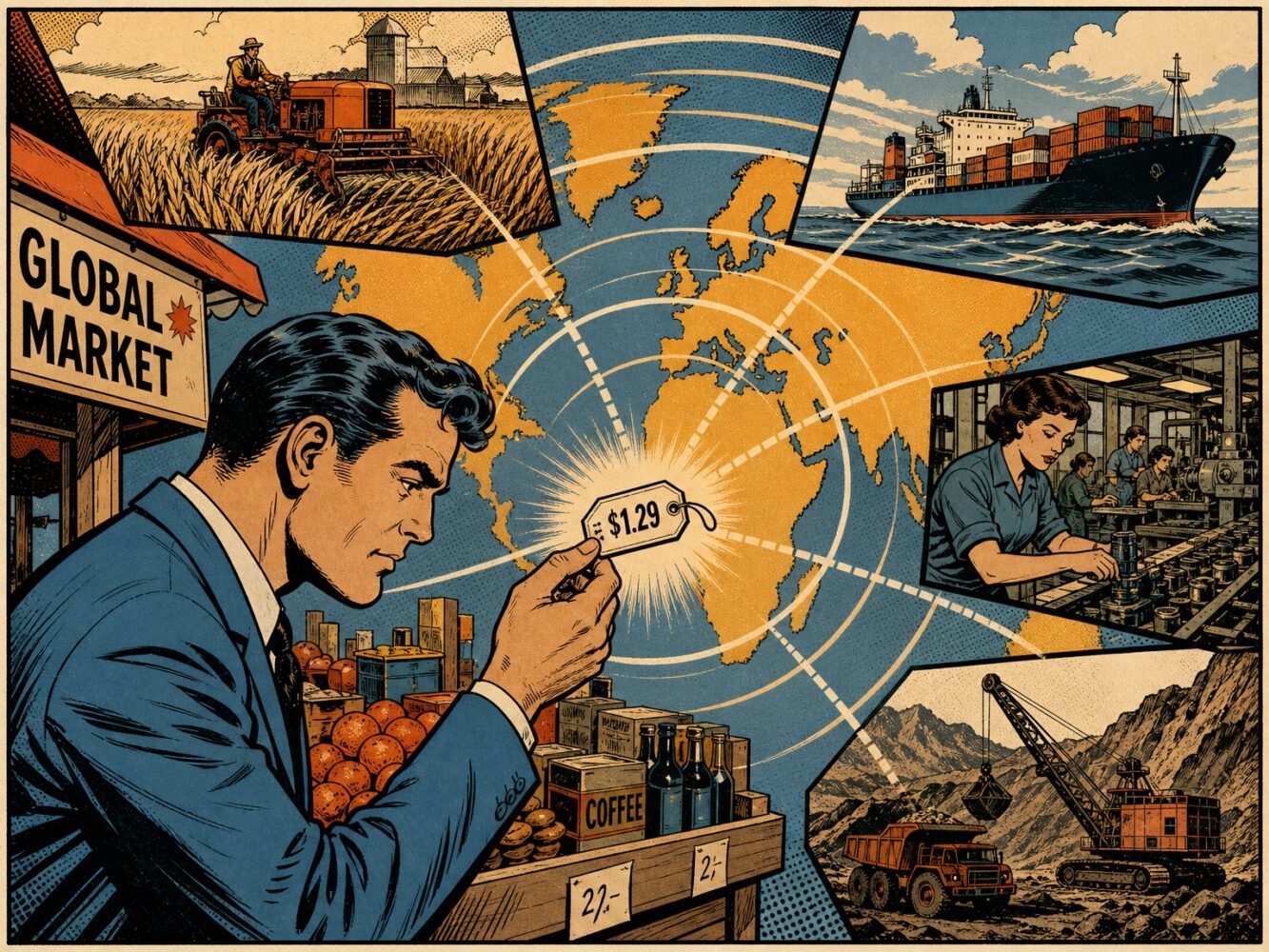
The wealth and technological sophistication of modern society are readily apparent. Less visible, but no less remarkable, is its ability to coordinate the actions of billions of people who know almost nothing about one another’s circumstances.
Every day we make decisions without possessing most of the information on which those decisions ultimately depend. We purchase products whose origins we cannot trace, rely on medicines we did not test, respond to prices shaped by events occurring thousands of miles away, and invest retirement savings in companies whose operations we will never observe firsthand. Somehow, despite possessing only fragments of the relevant information, billions of independent decisions become coordinated without anyone directing the whole.
How is that possible?
Nobody Knows Everything. Everyone Knows Something.
In his 1945 essay “The Use of Knowledge in Society,” Friedrich Hayek offered one of the most influential answers in economics. Hayek begins with a deceptively simple observation:
The economic problem of society is … not merely a problem of how to allocate ‘given’ resources ….
As he explains in one of the essay’s most famous passages:
The peculiar character of the problem of a rational economic order is determined precisely by the fact that the knowledge of the circumstances of which we must make use never exists in concentrated or integrated form, but solely as the dispersed bits of incomplete and frequently contradictory knowledge which all the separate individuals possess.
Hayek’s contribution lay not in offering a new solution, but in redefining the problem itself. Earlier debates often assumed that the relevant information about an economy could, at least in principle, be assembled by a single decision-maker—and that the challenge was then deciding how to allocate resources. Hayek argued that assumption was fundamentally mistaken. The most valuable knowledge in an economy, he contended, never exists in one place. Instead, it takes the form of what he famously called “the knowledge of the particular circumstances of time and place.”
Hayek used “knowledge” in a broader sense than economists often do today—referring not to scientific discoveries or official statistics, but to countless observations people acquire through everyday experience. A farmer notices that unusually dry weather has changed this year’s harvest. A factory manager knows a machine has become unreliable. A shopkeeper recognizes that customers have begun asking for a product few competitors yet carry.
Individually, these observations seem insignificant. Collectively, they determine what should be produced, where resources should flow, and how an economy adapts to changing conditions. Because this knowledge is practical, local, and constantly changing, it cannot easily be collected in reports or stored in databases without losing the context that gives it value.
The Most Efficient Gossip Network Ever Built
Recognizing the problem, however, is only half the story. If knowledge is irreducibly dispersed, how can millions of people coordinate their decisions without assembling all the relevant facts? (Coordination here means individuals adjusting their own plans in ways that become mutually compatible without anyone directing the process.) The mechanism itself was familiar; Hayek’s insight was that individuals do not need the complete picture.
Prices do far more than determine what goods cost. They communicate only the information necessary for individuals to revise their own plans in light of changing economic conditions—without requiring them to understand the countless events that produced those changes. A changing price reflects the cumulative effect of countless individual judgments about scarcity, demand, opportunity costs, and alternative uses. Rather than communicating each of those judgments separately, the price system compresses them into a single signal that others can act upon.
In this way, the price system economizes on information, enabling decentralized coordination without centralized direction or comprehensive knowledge. Individuals need not know why copper has become scarce or wheat abundant. They need only observe the changing price.
Hayek illustrated this with the example of a shortage of a single raw material. Most people would never learn whether it resulted from a mine closure, increased military demand, or a natural disaster. They would not need to. As prices rose, manufacturers would conserve the material, consumers would seek substitutes, and entrepreneurs would search for new sources of supply. As Hayek famously observed:
Without an order being issued, without more than perhaps a handful of people knowing the cause, tens of thousands of people whose identity could not be ascertained by months of investigation are made to use the material or its products more sparingly….
No planner needs to issue commands. No one needs to understand the entire economy. The genius of the market is not that everyone becomes fully informed—it is that coordinated action emerges because prices allow individuals to respond intelligently to information they never directly possess.
Hayek regarded this as one of civilization’s greatest achievements. As he memorably wrote:
I have deliberately used the word “marvel” to shock the reader out of the complacency with which we often take the working of this mechanism for granted.
More than 80 years later, “The Use of Knowledge in Society” remains one of the foundational essays in law & economics precisely because it explains why decentralized institutions can often outperform centralized planning in a world of dispersed information.
Hayek Stopped Too Soon
Hayek’s framework reflects the particular question he set out to answer. His concern was not how knowledge comes into existence but how societies make use of knowledge that already exists. Individuals possess knowledge of their land, their machines, their preferences, and the opportunities they encounter. Hayek explained how these dispersed fragments could be coordinated without centralized direction. But his account largely assumes that the knowledge itself already exists—leaving open a different question: Who creates the knowledge that markets later coordinate?
The distinction becomes clearer when Hayek is placed alongside two related traditions. Ludwig von Mises’s calculation problem asked whether central planners could allocate resources rationally without the market prices generated through exchange. Hayek reframed that problem by emphasizing that the difficulty was not simply calculation but knowledge itself—much of it dispersed among individuals and impossible to assemble centrally. Ronald Coase, meanwhile, showed that using markets is itself costly and that firms may arise when organizing transactions internally is cheaper.
The problem of knowledge production is related to each of these insights but distinct from them. Before information can be communicated through prices or coordinated within firms, institutions may first have to invest resources in making it sufficiently reliable to be used at all.
Some forms of knowledge emerge naturally through decentralized interaction. Consumer preferences, for example, reveal themselves through countless individual choices. Other forms do not. They must be produced through deliberate investments in measurement, investigation, verification, and disclosure. A pharmaceutical risk cannot influence consumer behavior until someone detects it. Corporate fraud cannot affect investors until someone uncovers it. A defective product cannot alter purchasing decisions until someone tests it, documents the results, and makes those findings public.
Markets can coordinate only the knowledge that becomes available to them. The production of knowledge is therefore just as important to the functioning of markets as its coordination.
The institutions that produce this knowledge rarely occupy center stage in economic theory. Yet modern societies devote enormous resources to creating reliable information before it can ever circulate through markets. Scientists conduct experiments. Firms maintain records. Auditors verify accounts. Journalists investigate misconduct. Courts establish facts through litigation. Administrative agencies inspect facilities, collect data, and evaluate evidence. Universities train experts. Professional organizations establish standards.
Each institution employs different methods, but all perform a common function: transforming uncertainty into knowledge that others can trust. None simply discovers facts lying dormant in the world. Each invests labor, expertise, and judgment to measure, verify, and authenticate observations before they become sufficiently reliable for others to act upon. Only then can markets, consumers, regulators, and investors incorporate that knowledge into their decisions.
Hayek’s account brilliantly explains how society coordinates dispersed knowledge once it exists. But the knowledge that makes coordination possible is itself the product of institutions.
Economists have not entirely ignored the problem of knowledge production. Kenneth Arrow famously observed that information is costly to produce but inexpensive to reproduce, creating incentives to underinvest in its creation. Elinor Ostrom showed how communities develop institutional arrangements that draw upon local knowledge to govern common resources. Both contributions draw attention to the institutions and incentives that shape how economically valuable knowledge becomes available.
Legal scholarship has begun to explore pieces of this puzzle as well. Administrative law scholars increasingly recognize that agencies do more than enforce legal rules—they inspect facilities, collect evidence, evaluate technical claims, and produce authoritative factual determinations on which private actors depend. Corporate law scholars have examined the informational role of disclosure regimes, auditors, and gatekeepers. Scholars of science and technology studies have emphasized the institutional work required to transform raw data into reliable public knowledge.
Yet these literatures often proceed independently. What remains underdeveloped is a broader account of how agencies, courts, firms, and private intermediaries produce the reliable knowledge on which markets, regulators, and private ordering all depend.
Hayek taught economists that the central challenge of modern society is coordinating knowledge that no single person possesses. Eighty years later, technological change might seem to have weakened the force of that insight. Digital platforms collect information from millions of transactions in real time, governments and firms maintain vast datasets, and artificial intelligence can identify patterns across quantities of information no human could process. Some knowledge that once could not feasibly be centralized now can be.
Yet these technologies do not eliminate the problem of knowledge production. More data is not necessarily better knowledge. Before information can be aggregated or analyzed, someone must decide what to measure, collect and classify observations, verify their accuracy, and determine whether it can be trusted. Artificial intelligence can dramatically reduce the costs of processing existing information, but its outputs remain only as good as the data and institutions that produce them.
The 21st-century challenge, then, is not simply how to coordinate dispersed knowledge. It is how that knowledge is produced, who bears the costs of producing it, and which institutions deserve our trust—questions that sit at the intersection of economics, law, and institutional design. Hayek gave us the map of how knowledge travels. We still need a theory of who builds the roads.
Further Reading
- Friedrich A. Hayek, “The Use of Knowledge in Society,” The American Economic Review, Vol. 35, No. 4 (1945).
- Kenneth J. Arrow, “Economic Welfare and the Allocation of Resources for Invention,” in “The Rate and Direction of Inventive Activity: Economic and Social Factors,” Princeton University Press (1962).
- Ronald H. Coase, “The Nature of the Firm,” Economica, Vol. 4, No. 16 (1937).
- Haiyun Damon-Feng, “Agency Fact-Making,” Yale Law Journal, Vol. 135 (2026).
