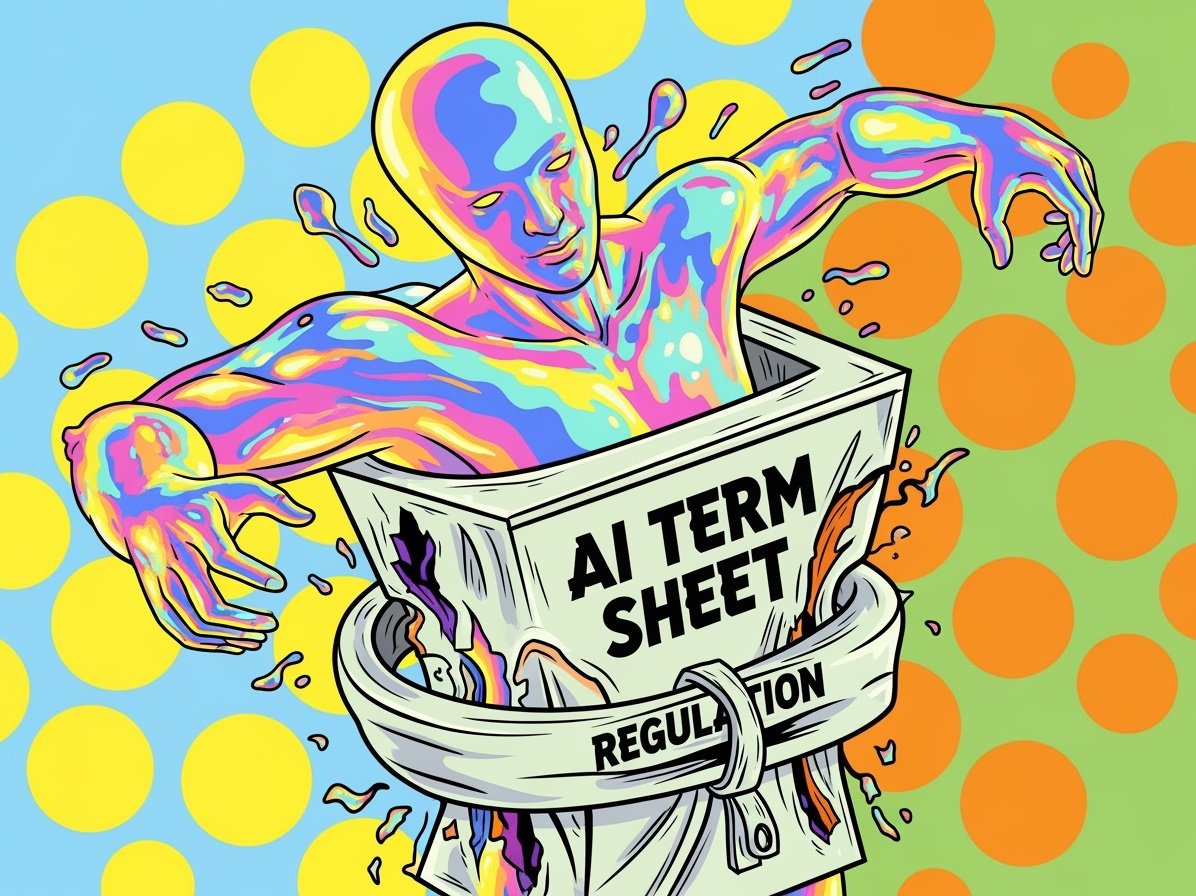
Washington may be closing in on an AI “term sheet.” The industry, meanwhile, is already writing its own rules.
Recent commentary suggests U.S. artificial intelligence (AI) policy may be coalescing around a federal framework. A widely discussed Tech Policy Press piece argues that a short “term sheet” emerging from negotiations between the White House and industry could reshape American AI policy. An Axios report, meanwhile, highlights how Anthropic imposed constraints on its latest model before release. Taken together, these developments point to two distinct—and too often conflated—mechanisms of governance: political coordination and market discipline. Washington policy debates fixate on the former. The latter already shapes behavior across the industry.
That distinction matters. A political “term sheet” can influence expectations, shape investment decisions, spur compliance planning, and create focal points for firms trying to anticipate the regulatory landscape. It can affect how boards, general counsel, venture investors, enterprise customers, and journalists define “responsible AI.” In that limited sense, the strongest version of the term-sheet argument holds: nonbinding political coordination can produce real economic effects before Congress enacts a statute or an agency promulgates a rule.
But that concession does not answer the harder question—whether those effects are beneficial. The issue is not whether a term sheet shapes expectations. It is how it shapes them, and whether it improves or distorts the market process through which information about AI safety, reliability, and value emerges. Skepticism is warranted. In a fast-moving industry defined by dispersed knowledge, entrepreneurial experimentation, and radical uncertainty, a politically generated focal point can do more than reduce uncertainty at the margin. It can create the wrong kind of certainty—and in the AI context, that may prove worse than having less of it.
Term Sheets Don’t Scale to Washington
Anyone who has negotiated a complex commercial deal knows a term sheet is not a solution. It is, at best, a preliminary framework—one that sketches broad principles while deferring the hardest questions. That is not a criticism. In private bargaining, term sheets serve a useful role because the parties engage directly in a process of discovery and adjustment. They test proposed terms against cost, risk, information asymmetry, financing constraints, and incentives. The final agreement emerges through feedback-rich iteration, with each party bearing the consequences of its own errors.
That analogy weakens when it moves from private ordering to political governance. In that setting, the “term sheet” no longer marks a step in reciprocal adjustment among parties disciplined by profit and loss. It becomes a signal from a political actor with different incentives—one insulated from ordinary mechanisms of correction. In game-theoretic terms, this signaling often resembles cheap talk, rather than credible commitment. That risk increases in an election year, under divided government, amid federal-state conflict, and in a technological domain evolving faster than the political process can track.
None of this denies that such signaling affects expectations. The problem is directional. It can move expectations the wrong way. Roger Koppl’s “Big Player” theory helps explain why. When a powerful actor enters a market and can shift outcomes without profit-and-loss discipline, participants reorient. They look less to consumer preferences and more to the anticipated actions of the powerful actor. That shift matters. It changes what firms try to learn from—and what they try to optimize against. In this context, the White House becomes not just another source of information, but a privileged source of noise.
The issue runs deeper than incomplete guidance. Political signaling can generate artificial herding, rather than genuine coordination. In a market process, coordination emerges from decentralized experimentation—firms test plans, correct errors, and respond to price signals, customer demand, and competitive pressure. What looks like coordination is the emergent product of adaptation. A politically salient term sheet does something different. It encourages firms to cluster around what is legible to Washington. It pushes them to align with politically visible definitions of “safety,” “accountability,” or “responsible deployment”—not because those standards have proven superior, but because they have become focal in a political game.
That distinction matters even more in AI, where no one yet knows the optimal mix of safety constraints, openness, auditability, latency, accuracy, model autonomy, or domain-specific risk controls. In a functioning market, firms can experiment with different combinations, and customers can reward or reject them. But when a Big Player supplies a politically privileged focal point, the ecology of plans shifts. Firms invest less in discovering what users value or which safety practices work best, and more in anticipating what regulators, staffers, and aligned commentators will bless. That is not discovery. It is mimicry under political uncertainty.
Pointing the Market the Wrong Way
That problem intensifies given AI’s underlying characteristics. The relevant knowledge is not centralized, stable, or even fully articulable. It is dispersed across model developers, downstream integrators, enterprise customers, open-source communities, safety researchers, and users. Much of it remains tacit. Much of it emerges only through deployment and use. AI is not a static object that policymakers can govern from a fixed blueprint. It more closely resembles what Ludwig Lachmann described as a kaleidic world—defined by constant change, shifting expectations, and a future that resists any stationary forecast.
That distinction matters. Political coordination invites observers to mistake temporary conceptual order for durable institutional knowledge. A federal term sheet may project stability, and firms and investors may welcome it. But in a kaleidic environment, that stability often proves illusory. It channels capital toward structures optimized for today’s political vocabulary—even as the technological frontier moves on. In Austrian terms, that dynamic points toward malinvestment.
Capital is not homogeneous. It is time-structured, complementary, and oriented toward expected future states of the world. When political signaling distorts expectations, it distorts investment. Firms build compliance systems, safety teams, documentation regimes, and product architectures around what appears politically prudent. Some of that investment may prove useful. Some will not. More important, it can reallocate resources away from entrepreneurial experimentation and toward politically induced conformity. The cost is not just wasted compliance spending. It is a market process that drifts away from discovering superior alternatives.
Israel Kirzner’s work sharpens the point. The entrepreneurial market process depends on alertness to previously unseen opportunities. Competition does not simply select among known options; it discovers what the options are. Regulation—or even preliminary quasi-regulation—can narrow that discovery process by constraining entrepreneurial vision. Once a politically endorsed conception of “safe AI” becomes focal, it reduces incentives to search for better or different approaches. The result is not just compliance. It is the foreclosure of imagination.
This is why the “term sheet” framing understates the risk. It treats the problem as one of incomplete follow-through—as if a preliminary framework simply points in a useful direction. In AI, pointing in a politically approved direction may itself distort the process. It encourages firms to build toward current consensus, rather than test competing approaches that users, enterprises, or downstream markets might validate. In a domain where discovery drives progress, central focal points can obstruct, rather than assist.
Compliance as a Competitive Weapon
Public choice theory sharpens the concern. Political coordination in high-value sectors rarely amounts to neutral problem-solving. It creates opportunities for incumbents to shape rules in ways that entrench their position. Gordon Tullock’s work on rent seeking remains essential here. Once regulatory standards carry economic weight, firms have incentives to compete over their design. That competition may be rational for individual firms, but it can impose real social costs.
This does not require bad faith. The problem is structural. Once “safety” language becomes a vehicle for barrier creation, the institutional environment shifts. Terms like “responsible deployment,” “model evaluation,” “frontier capabilities,” “compute thresholds,” and “red-team requirements” can be framed as public-interest measures while aligning more closely with the internal capacities of established firms than with those of smaller rivals. That is classic public-choice dynamics: private advantage pursued through public-facing justification.
AI amplifies the risk. Many proposed standards are complex, resource-intensive, and legible primarily to insiders. That makes them well suited to raising rivals’ costs. Large firms can absorb compliance staff, documentation burdens, staged evaluation protocols, and structured reporting. Smaller firms, open-source communities, and new entrants often cannot. A politically salient term sheet may do more than coordinate expectations—it can tilt the competitive landscape toward those best positioned to translate political language into operational compliance.
None of this implies that term-sheet proponents consciously seek rents. But it does counsel caution. Analysts should resist treating preliminary political alignment as a neutral public good. Once a political focal point emerges, it shifts the margin of competition. Firms no longer compete only on product quality, customer trust, model performance, and contractual reliability. They also compete on their ability to shape—or adapt to—the emerging regulatory vocabulary. That is a different game, and often a negative-sum one.
The Governance Washington Keeps Overlooking
If political coordination carries more risk than its defenders suggest, what is the alternative? Not a romantic claim that markets are perfect or that harms internalize automatically. The better answer is more grounded: market discipline already operates through institutional mechanisms that are more adaptive, information-rich, and corrigible than political precoordination.
Anthropic’s decision to impose constraints on its model before release offers a concrete example. No statute required it. No regulator ordered it. The company appears to have acted based on expectations about customers, reputational risk, and the long-term consequences of deploying capabilities likely to trigger backlash. That is not law. But it is governance—rooted in anticipated responses from users, enterprise customers, partners, investors, employees, and the broader market.
To make that claim persuasive, the mechanisms matter.
Reputational Capital
In AI markets, trust is not ornamental; it is an input into adoption. Firms perceived as reckless, unreliable, or cavalier about model risk can lose customer confidence, enterprise contracts, developer integrations, and talent. Reputation functions as a bond posted to the market. Firms protect it because it conditions future revenue.
Enterprise Procurement
Many of the most economically significant uses of AI occur through integration into enterprise workflows, software stacks, and decision-support systems—not casual consumer use. Enterprise customers care about hallucination rates, privacy protections, audit trails, uptime, support, indemnification, and predictable performance. They do not need Congress to tell them to care. They already do. Providers face pressure to self-regulate to win and retain those customers.
Contractual Governance
Downstream deployers increasingly allocate risk through contracts, service-level agreements, and integration requirements. AI firms must negotiate around these constraints to embed their products in production systems. In Coasean terms, transaction costs remain, but bargaining, reputation, and repeat dealings can partially internalize relevant externalities. This is not the frictionless Coase theorem of textbooks. It is a practical point: when parties can identify, price, and allocate risk, decentralized governance can emerge without prior regulatory design.
Switching Behavior
In many AI applications, switching costs—while real—are lower than in legacy industries marked by deep consumer lock-in. Users can compare outputs across models. Enterprises can multi-home. Developers can benchmark APIs. The market is not frictionless, but providers face a credible threat of substitution. If a model behaves in ways customers find unsafe, biased, unstable, or unusable, alternatives exist. That creates pressure to improve.
Capital-Market Discipline
Investors care about regulatory risk, but they also watch for reputational failures, botched launches, litigation exposure, product withdrawals, and fragile business models. A firm that deploys irresponsibly may lose customers and face tighter access to capital. Market governance operates not just at the point of sale, but across the financing ecosystem.
Evolution Beats Edict
Market signals are noisy. Users do not perceive risk perfectly. Some harms emerge only over time or remain diffuse. Information asymmetries persist. Feedback loops can lag, and fads can skew judgment. Those concerns are real, and any serious defense of market discipline should acknowledge them. But that concession does not resolve the issue in favor of political direction. The relevant comparison is not imperfect markets versus perfect regulation. It is imperfect markets versus imperfect politics.
Steven Horwitz’s work clarifies the point. From an Austrian perspective, noisy price signals do not refute the market process—they are integral to it. Disequilibrium signals do not provide omniscience. They highlight where knowledge is missing and where entrepreneurial correction can occur. In AI, the same logic applies. Public criticism, customer hesitation, developer complaints, benchmark failures, enterprise demands, and product defections do not pinpoint the ideal safety frontier. But they generate information and incentives to improve.
This is why the market account is better understood as evolutionary, rather than static. Richard Nelson and Sidney Winter’s framework is instructive. Firms operate through routines, experiment under uncertainty, and face selection pressures. In AI, firms try different combinations of safety and capability. Some impose tighter guardrails; others emphasize transparency, enterprise trust, or openness. Some overreach and pull back. These variations are tested against market responses. Firms whose governance choices diverge from user and customer demands face reputational and financial consequences. Firms that better match the evolving environment survive and scale.
The process is not instantaneous. It involves trial, error, and loss. That is precisely what makes it adaptive. A politically coordinated framework, by contrast, tends to convert provisional judgment into uniform standard. It suppresses variation before selection can do its work. The result is often slower learning, not better governance.
Friedrich Hayek’s insight into competition as a discovery procedure ties this together. We do not know ex ante the optimal balance between openness and safety, speed and interpretability, or general-purpose deployment and domain-specific constraint. Those margins must be discovered. Competition allows firms to test different combinations, and allows customers, developers, and enterprises to sort among them. What appears from Washington as a need for ex ante alignment may, from within the market, amount to premature foreclosure of discovery.
Better Late Corrections Than Early Mistakes
A brief Coasean clarification helps frame the issue. Critics often assume that any defense of markets rests on the fiction of zero transaction costs and fully internalized externalities. That is not the claim. The question is not whether transaction costs exist. It is whether AI governance problems are more likely to be addressed through decentralized adaptation or centralized precommitment.
In many AI settings, transaction costs for decentralized governance are falling. APIs make benchmarking and substitution easier. Enterprise contracting creates repeat relationships and structured risk allocation. Public visibility accelerates reputational sanctions. Open technical communities surface flaws quickly. None of this eliminates harm. But it does show that the market’s capacity to generate governance is not fixed—it improves as the technology diffuses.
Political governance carries its own transaction costs: legislative delay, bureaucratic rigidity, information bottlenecks, path dependence, and capture. These costs often draw less attention than product failures or public controversies, but they matter. In AI, they may matter more. A system that corrects late but can correct continuously may outperform one that coordinates early but locks in error.
Too Much Order, Too Soon
The strongest defense of the “term sheet” view is straightforward: even incomplete political coordination can shape expectations, encourage caution, and nudge markets toward socially desirable norms. That argument is not frivolous. But it is incomplete. It treats coordination as the central institutional problem. In AI, the deeper problem is discovery.
Political term sheets can influence investment, compliance, and norms. The question is whether that influence improves discovery or distorts it. Framed that way, the risks come into focus. Big Player signaling can induce herding rather than experimentation. In a kaleidic industry, it can drive malinvestment by projecting false stability. Through public-choice dynamics, it can invite rent seeking and raise barriers to entry. And by making current political understandings focal, it can dampen incentives to discover better approaches to safety, trust, and governance.
Market discipline, by contrast, is neither utopian nor passive. It operates through reputation, procurement, contract, switching, financing, and evolutionary selection. Its signals are noisy, but that is how adaptation works under uncertainty. It allows firms to test competing governance models and lets users, enterprises, and downstream markets sort among them. In Hayekian terms, it is a discovery process. In Coasean terms, it enables decentralized governance where transaction costs permit. In Kirznerian terms, it preserves the entrepreneurial alertness through which better solutions emerge. And in public-choice terms, it avoids mistaking political focal points for neutral reflections of social knowledge.
The danger in the current policy debate is not just that Washington may act too slowly or too clumsily. It is that observers may mistake politically induced alignment for genuine order. A term sheet may shape American AI policy. The harder question is whether it should. In a sector defined by uncertainty, experimentation, and rapid adaptation, the real risk is not too little coordination—but too much, too soon.