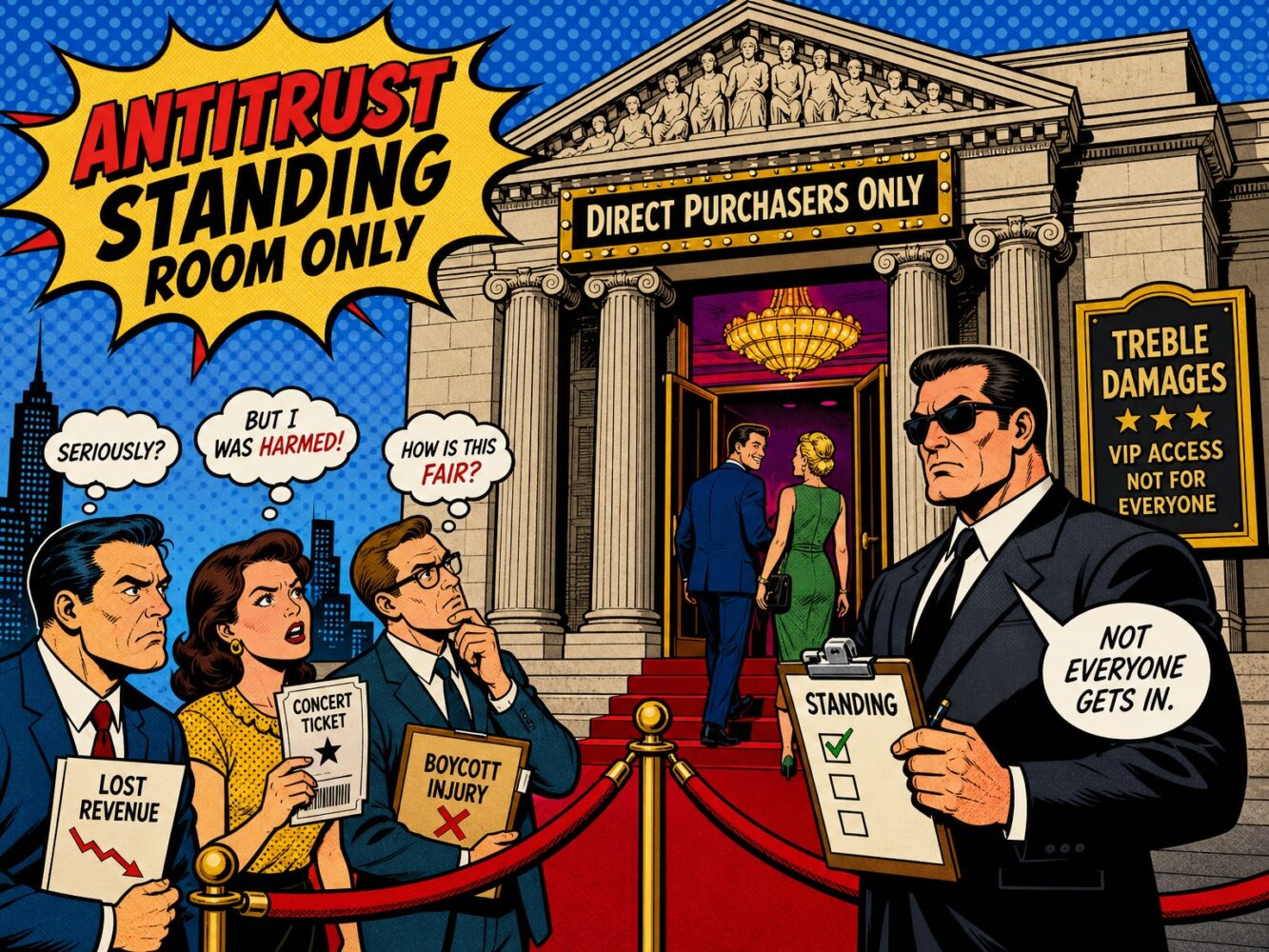
Antitrust law does not hand out damages just because someone got hurt in the general vicinity of an antitrust violation. A plaintiff must show more than bad conduct, more than lost money, and more than a plausible violation of the Sherman Act. The loss must come from the thing antitrust law exists to protect: competition.
That is where antitrust standing does its work. In ordinary litigation, standing asks whether a plaintiff has enough of a stake in the dispute to be in court at all. Antitrust standing asks a more pointed question: Is this the kind of plaintiff, and the kind of injury, the antitrust laws allow to recover damages?
That inquiry often gets treated as a threshold pleading hurdle—a box plaintiffs satisfy almost automatically once they allege anticompetitive conduct and economic harm. But modern antitrust doctrine demands more. The question is not merely whether a plaintiff lost money. It is whether that loss reflects diminished competition in the allegedly restrained market.
Section 4 of the Clayton Act provides that any person injured in their business or property “by reason of anything forbidden in the antitrust laws” may sue and recover treble damages—three times the damages proved. Read literally, that language sounds expansive. Courts have never read it that way.
Instead, plaintiffs must show, as the Supreme Court put it in Brunswick Corp. v. Pueblo Bowl-O-Mat (1977), that their injury is “of the type the antitrust laws were intended to prevent and that flows from that which makes defendants’ acts unlawful.”
The reason is straightforward: antitrust law protects competition, not competitors. A business harmed by rivals acting badly has not necessarily suffered an antitrust injury. The harm must reflect damage to the competitive process in a relevant market. Antitrust standing also serves a practical purpose: limiting exposure to treble damages in private enforcement actions before liability sprawls beyond any administrable boundary.
Two recent proceedings show how much work this doctrine still does. The first is X Corp. v. World Federation of Advertisers, in which Judge Jane Boyle dismissed Elon Musk’s lawsuit against an advertising-industry coalition, holding that X Corp. failed to plead antitrust injury despite extensive allegations of coordinated advertiser boycotts. The second is the Live Nation-Ticketmaster litigation, where a federal jury found Live Nation and Ticketmaster liable for antitrust violations in a venue-facing ticketing market. That verdict raises a harder follow-on question: Can downstream consumers—and states suing on their behalf—recover federal damages for harm that began upstream?
The cases arise in very different settings. But they expose the same doctrinal tension: antitrust liability and antitrust recovery are not the same thing. Conduct may violate the Sherman Act while a particular plaintiff’s injury remains too remote to support damages under Section 4 of the Clayton Act. In both X Corp. and Live Nation, the central question became whether the plaintiffs’ losses flowed from harm to competition, or merely from conduct alleged to be anticompetitive.
Not Every Wound Is an Antitrust Injury
In X Corp., X—formerly Twitter—alleged that a coalition of major advertisers, coordinated through the Global Alliance for Responsible Media (GARM), an initiative of the World Federation of Advertisers (WFA), orchestrated a group boycott of the platform after Elon Musk acquired Twitter in 2022. X claimed that GARM members, including Mars, CVS, Colgate, Nestlé, Abbott, and others, agreed collectively to withhold advertising unless X complied with brand-safety standards developed by GARM. According to X, the resulting advertising withdrawal cost the company hundreds of millions of dollars in revenue.
The district court nevertheless dismissed the case with prejudice, meaning X could not simply refile the same claims. The court did not dispute that X had suffered economic loss sufficient to establish injury in fact—the basic injury needed for constitutional standing. Instead, it held that X had not alleged the type of injury the antitrust laws are designed to remedy.
According to the court, X alleged lost advertising revenue and reduced fees for advertising placements. Those are real business harms. But citing the 5th U.S. Circuit Court of Appeals’ decision in Rx Solutions v. Caremark, the court noted that classic antitrust injuries typically involve higher prices, reduced output, diminished quality, or some other harm to the competitive process.
X argued that it need not satisfy the antitrust-injury requirement because the alleged boycott was a per se antitrust violation. A per se violation is conduct deemed so likely to harm competition that courts condemn it without the usual detailed market analysis. The court disagreed. Even per se violations require plaintiffs to show antitrust injury before they may recover damages.
Illegal Doesn’t Mean You Can Sue
Assume, for the sake of argument, that the WFA-GARM boycott satisfied the threshold conditions for per se condemnation. That is far from certain. Under Northwest Wholesale Stationers (1985), not all group boycotts are per se Sherman Act violations. But even if X cleared that hurdle, its claims faced a separate and fatal defect: X failed to allege antitrust injury.
That distinction matters. Per se treatment is a rule of liability. It shortcuts the market analysis ordinarily needed to prove that the defendant’s conduct harmed competition. It does not decide whether a particular plaintiff has standing to seek private damages.
As the Supreme Court held in Atlantic Richfield v. USA Petroleum (1990):
A loss flowing from a per se violation of § 1 does not automatically satisfy the antitrust injury requirement, which is a distinct matter that must be shown independently. The purpose of per se analysis is to determine whether a particular restraint is unreasonable. Actions per se unlawful may nonetheless have some procompetitive effects, and private parties might suffer losses therefrom. The antitrust injury requirement, however, ensures that a plaintiff can recover only if the loss stems from a competition-reducing aspect or effect of the defendant’s behavior.
In other words, conduct may be per se unlawful while a particular plaintiff’s losses still fall outside antitrust injury. The plaintiff’s harm must flow from the anticompetitive mechanism that makes the conduct illegal.
Consider a simple example. Suppose several major steel manufacturers enter a per se unlawful price-fixing conspiracy, agreeing to raise the price of industrial steel sold to automakers. The cartel is plainly illegal under Section 1 of the Sherman Act because horizontal price fixing—competitors agreeing on price—is presumed to harm competition in the steel market.
Now suppose higher steel prices lead automakers to reduce production and buy fewer trucking services to transport finished vehicles. A trucking company loses substantial business and suffers serious economic harm.
The trucking company’s losses are real, and they are causally connected to the unlawful cartel. But the company has not suffered antitrust injury. Its harm does not flow from the anticompetitive mechanism that makes the cartel unlawful: the suppression of price competition in the steel market.
As the Supreme Court observed in 1982’s Blue Shield of Virginia v. McCready, an antitrust violation may send ripples of harm through the economy. But liability cannot extend forever. At some point, the chain becomes too attenuated.
The Court permitted standing in McCready because the plaintiff’s injury—Blue Shield’s refusal to reimburse her for psychotherapy sessions with a psychologist rather than a psychiatrist—was not merely a side effect of the alleged conspiracy. It was the very instrument through which Blue Shield allegedly sought to achieve its anticompetitive ends.
The trucking company stands in a materially different position. Its injury is remote and consequential. That is not enough to establish antitrust standing under Associated General Contractors v. Carpenters (1983).
Other factors point the same way. The trucking company is neither a consumer nor a competitor in the restrained market—the two categories antitrust-standing doctrine most readily recognizes. Allowing recovery also would risk duplicative damages or force courts to apportion damages across multiple layers of claimants. More direct victims exist: the automakers who bought steel at cartel-inflated prices. Their claims would more cleanly serve the deterrent goals of private antitrust enforcement.
The steel cartel may be per se unlawful. The trucking company still lacks antitrust injury.
Standing Takes Center Stage
Antitrust injury also played a central role in the Live Nation-Ticketmaster litigation. In 2024, the U.S. Justice Department (DOJ) and 33 state attorneys general sued Live Nation and Ticketmaster under Sections 1 and 2 of the Sherman Act, alleging unlawful agreements and monopolization. The DOJ proceeded under Section 4 of the Sherman Act, while the states also invoked Section 4C of the Clayton Act and various state antitrust statutes.
By summary judgment—the stage at which a court decides whether claims can proceed to trial—the district court had substantially narrowed the case. Among other claims, it dismissed allegations involving fan-facing ticketing markets. Two theories survived: claims involving the venue-facing primary-ticketing market, in which venues purchase ticketing services directly from Ticketmaster; and claims that Live Nation unlawfully tied concert-promotion services to access to its amphitheaters.
After the DOJ settled midway through trial, several states continued the case and secured a jury verdict finding Live Nation liable on all remaining claims. The jury awarded damages based on an estimated average overcharge of $1.72 per ticket across 22 states.
Live Nation then renewed its motion for judgment as a matter of law, asking the court to set aside the verdict. Among other arguments, Live Nation contended that the states lacked a cognizable antitrust injury and were not proper—or at least efficient—enforcers under federal antitrust-standing doctrine.
Standing in the Cheap Seats
Section 4 of the Clayton Act raises two distinct questions the Supreme Court highlighted in Illinois Brick v. Illinois (1977). First, which plaintiffs have suffered injuries too remote to recover damages? Second, which plaintiffs paid the unlawful overcharge in the legally relevant transaction?
To answer the first question, the district court relied heavily on McCready. There, the Supreme Court held that a plaintiff may suffer antitrust injury even without directly participating in the restrained market, so long as she falls within “that area of the economy endangered by the breakdown of competitive conditions.” The district court concluded that Live Nation was on all fours with McCready. That conclusion is difficult to sustain.
In McCready, the alleged conspiracy involved a concerted refusal to reimburse patients who sought psychotherapy from psychologists rather than psychiatrists. The Court found that the refusal was the mechanism through which Blue Shield allegedly implemented the conspiracy. McCready’s injury was therefore inextricably linked to the harm the conspirators sought to inflict on psychologists and the psychotherapy market. Her injury was not merely foreseeable. It was “integral” to the scheme.
The fans’ position is materially different. Their alleged injury is not the instrument through which Live Nation purportedly advanced its anticompetitive objectives. Nor is it an integral feature of the alleged scheme. It is downstream harm.
The distinction becomes clearer when viewed through the structure of the relevant market. Unlike McCready, ticket-buying fans are neither consumers nor competitors in the market allegedly restrained by the conspiracy. The direct purchasers of venue-ticketing services are venues. The relevant competitors are firms such as SeatGeek and AXS. Fans sit one step further away. They are end users of a product whose upstream supply conditions are the subject of the alleged restraint.
At most, fans can show consequential harm flowing from conduct directed at others. That is a much weaker basis for antitrust standing.
The Supreme Court emphasized this point in Associated General Contractors. The case for extending standing to a more remote plaintiff weakens substantially when there exists “an identifiable class of persons whose self-interest would normally motivate them to vindicate the public interest in antitrust enforcement.” Such a class is readily identifiable here. Venues, along with Live Nation’s and Ticketmaster’s direct competitors, suffered the alleged harm more directly and have both the injury and the incentive to litigate. Fans occupy a derivative position.
The existence of more direct victims also highlights the practical dangers of extending standing further down the chain. When plaintiffs closer to the alleged violation can enforce the antitrust laws, allowing more remote parties to recover creates a substantial risk of duplicative damages and the complex apportionment problems that Illinois Brick and Associated General Contractors sought to avoid.
Taken together, the remoteness of the fans’ alleged injury, the availability of more suitable plaintiffs, and the risk of duplicative recovery all weigh against recognizing standing for the states’ federal claims.
The Illinois Brick Wall
A plaintiff may satisfy McCready and still be barred by Illinois Brick because it was not the direct purchaser in the market where the anticompetitive conduct occurred. Thus, the district court’s reliance on McCready resolves only the first question: whether concertgoers suffered an injury sufficiently connected to the alleged violation to satisfy antitrust-injury principles. The second question—who was injured by the alleged overcharge for purposes of Section 4 standing—is governed by Illinois Brick and Kansas v. UtiliCorp United (1990). Live Nation and Ticketmaster arguably should have pressed that question more aggressively.
In Illinois Brick, the Supreme Court held that only direct purchasers may recover federal antitrust damages. Indirect purchasers—those who bear overcharges passed through an intermediary—cannot recover under federal law.
The Court reaffirmed that principle in UtiliCorp, holding that Section 4C did not alter the Illinois Brick rule for parens patriae actions. A parens patriae action allows a state to sue on behalf of its residents. Section 4C, the Court explained, “did not establish any new substantive liability, but simply created a new procedural device to enforce existing rights of recovery under Section 4.” States therefore could not recover on behalf of residential utility customers who merely absorbed overcharges passed through from upstream transactions.
The Live Nation ticketing structure bears a strong resemblance to the arrangement at issue in UtiliCorp. The face value of a ticket is set by the event organizer. The facility charge is set by the venue, and Ticketmaster retains none of it. The service fee is negotiated between Ticketmaster and the venue and then divided between them.
In other words, the all-in ticket price reflects several upstream pricing decisions. Any supracompetitive overcharge attributable to Ticketmaster would therefore appear to pass through the venue before reaching the fan.
Milton Handler and Michael Blechman warned of precisely this problem in their influential critique of parens patriae actions, which the Supreme Court cited approvingly in Illinois Brick. They observed that many antitrust violations occur at levels of the distribution chain “so remote from consumers as to make it virtually impossible . . . to prove that they suffered any compensable injury at all.”
Once multiple intermediaries and independent pricing decisions separate the alleged restraint from the consumer transaction, determining whether—and to what extent—an overcharge reached consumers becomes less a matter of proof than of speculation.
As Handler and Blechman explained, establishing consumer injury in such settings requires tracing how an alleged overcharge moved “from one level to another in the chain of distribution” through a series of independent economic decisions that courts are poorly equipped to reconstruct after the fact.
The Live Nation ticketing system presents many of the same difficulties. Even assuming anticompetitive conduct in the venue-facing ticketing market, the states’ damages theory requires a court to determine how much of any allegedly supracompetitive fee negotiated between Ticketmaster and venues ultimately reached consumers through a pricing structure shaped by promoters, venues, facility charges, dynamic-pricing practices, and revenue-sharing arrangements.
That is exactly the sort of speculative pass-through inquiry that Illinois Brick and UtiliCorp sought to avoid by limiting federal antitrust-damages recovery to direct purchasers.
Direct Purchasers of What, Exactly?
A possible response is that Apple v. Pepper (2018) points in the opposite direction. There, the Supreme Court held that consumers who purchased apps through Apple’s App Store were direct purchasers for purposes of Illinois Brick.
The Court emphasized the direct transactional relationship between Apple and iPhone users. Consumers bought apps directly from Apple, paid Apple directly, and Apple collected the allegedly monopolistic commission directly through those transactions. The Court expressly rejected the argument that Illinois Brick turns on who sets the retail price. Although app developers set app prices, consumers were still direct purchasers.
Instead, the Court treated Illinois Brick as a bright-line rule that asks a simple question: from whom did the plaintiff purchase the product or service? Because iPhone users purchased apps directly from Apple, with no intermediary between buyer and seller, they had standing to sue.
That reasoning does not necessarily rescue the states’ claims against Live Nation and Ticketmaster. The question is not whether fans transact with Ticketmaster at checkout. They do. The question is whether fans purchased the product sold in the market allegedly restrained by the anticompetitive conduct.
The alleged restraint occurred in the venue-facing primary-ticketing market. Fans do not participate in that market. Venues purchase ticketing services from Ticketmaster. Fans purchase admission to live events. Those are distinct products sold in distinct markets.
Viewed this way, the Illinois Brick problem is not that venues stand between Ticketmaster and fans as traditional reseller intermediaries. It is that fans never purchased the allegedly restrained product in the first place. Their injury, while potentially sufficient under an expansive reading of McCready, flows downstream from a market in which they were never buyers.
Accordingly, fans fall outside the class of direct purchasers that Illinois Brick and UtiliCorp require for federal damages recovery under Section 4 of the Clayton Act. If that analysis is correct, states likewise cannot maintain a parens patriae action on their behalf under Section 4C.
The practical answer is that the states did not rely solely on federal law. They also asserted claims under state antitrust statutes, several of which contain Illinois Brick repealer provisions that permit indirect purchasers to recover damages under state law. The jury’s $1.72-per-ticket damages award therefore likely rests on those state-law theories rather than on federal Section 4C claims, which UtiliCorp appears to foreclose.
Liability Is Not Standing
Both cases turn on the same question: Can the plaintiff’s loss be tied directly to a competitive mechanism the antitrust laws protect?
In X Corp., that connection was missing from the pleadings. WFA and GARM allegedly coordinated buyers, but they did not control a supply-side chokepoint, and X’s lost revenue did not flow from a restraint on the competitive structure of any market. Antitrust-injury doctrine therefore ended the case at the pleading stage.
In Live Nation, the competitive mechanism exists in the venue-facing ticketing market. But the path from that upstream restraint to downstream consumer damages runs through antitrust-standing doctrine—specifically, whether fans who did not purchase in the restrained market may recover federal damages through the states’ parens patriae claims.
The lesson is the same in both cases: antitrust liability and antitrust recovery ask different questions. A plaintiff can identify real harm, describe anticompetitive conduct, and still fail. Harm to a competitor is not necessarily harm to competition. Downstream injury is not direct-purchaser standing.
Antitrust law does not compensate every casualty of bad conduct. It compensates injuries to competition—and only the plaintiffs close enough to prove them.