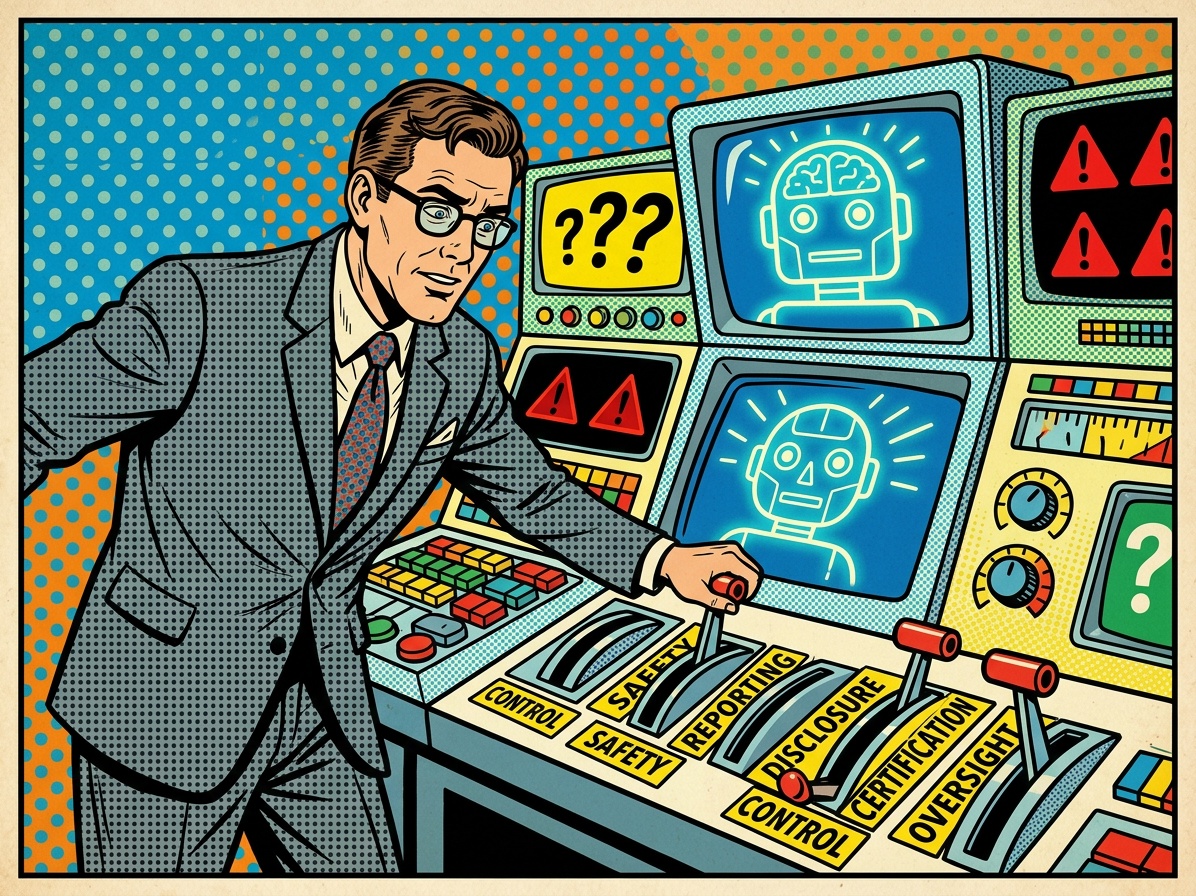
Everyone in Washington seems to agree that artificial intelligence must be governed. The only real dispute is who gets the steering wheel. Congress? Federal agencies? State legislatures? Some newly minted task force with a long acronym and a taste for reporting requirements?
That debate is already too narrow.
President Donald Trump’s recent executive order on “Promoting Advanced Artificial Intelligence Innovation and Security” reflects the tension. The order emphasizes maintaining American leadership in artificial intelligence while directing federal agencies to develop voluntary frameworks, reporting standards, and oversight mechanisms for advanced models. Its stated objective is laudable: encourage innovation without imposing unnecessary burdens on one of the most important technologies of the 21st century.
Yet the executive order also highlights a deeper problem in the current debate. Both sides assume the central question is who should regulate AI. Should authority reside in Washington or in the states? Should Congress act, or should state legislatures lead?
That is the wrong question.
The more fundamental question is whether either level of government possesses the knowledge, incentives, or institutional capacity to regulate a technology evolving at extraordinary speed. Before deciding who should regulate AI, we should first ask whether government can regulate it effectively at all.
The answer is no.
Critics of AI regulation often focus on innovation, competitiveness, or economic growth. Those concerns matter. But they are secondary to a more fundamental insight developed by economists associated with the Austrian and Virginia schools of political economy. The problem is not simply that regulation may slow innovation. It is that neither federal nor state regulators possess the knowledge necessary to determine what AI should become. And even if they did, the political process would steadily transform limited oversight into expansive control.
The result is a regulatory project almost certain to fail on its own terms.
The Federalism Distraction
The executive order has reignited a debate that has been simmering for months: Should AI be regulated by the federal government or by the states?
Both sides raise legitimate concerns. Advocates of federal regulation worry that a patchwork of state laws will fragment national markets, raise compliance costs, and weaken America’s ability to compete with China. Supporters of state authority respond that federal regulation could entrench incumbent firms, suppress experimentation, and impose a one-size-fits-all framework on a technology still taking shape.
Both positions have merit. But both share the same mistaken premise: that the central question is which government should regulate AI.
From an Austrian perspective, the more important question is whether any political institution has the knowledge needed to regulate a technology whose most important applications, risks, and governance mechanisms are still being discovered. Put differently, the choice between federal and state regulation assumes the relevant knowledge already exists and merely needs to be assigned to the right regulator.
But much of that knowledge does not yet exist at all.
That is why the debate is ultimately not about federalism. It is about knowledge. Whether authority sits in Washington or 50 state capitals, regulators face the same basic problem: They must make decisions today about technologies whose future uses, risks, and opportunities remain largely unknown.
Federal regulation may reduce jurisdictional variation, but it cannot solve the knowledge problem. State regulation may allow experimentation among jurisdictions, but it remains constrained by the same informational limits. Either way, policymakers are trying to govern a discovery process before the relevant discoveries have been made.
A National Center of Ignorance
More than 80 years ago, F.A. Hayek articulated one of the most important insights in economics: the knowledge needed to coordinate a complex economy is dispersed among millions of individuals. It exists in fragments. It is local, often tacit, and constantly changing. No central authority possesses all of it. Markets coordinate this dispersed knowledge through the price system.
The same insight applies with even greater force to artificial intelligence. The challenge facing policymakers is not simply that AI is evolving rapidly. It is that nobody knows what AI ultimately will become. The technology’s most valuable uses may not yet have been discovered. The most important safety mechanisms may not yet exist. The most effective governance structures may emerge years from now through experimentation and competition.
In other words, AI is not merely a product. It is a discovery process.
That distinction matters. Unlike a traditional product, whose characteristics are largely known before it reaches consumers, AI’s capabilities, limitations, and most valuable applications are being discovered through use. Every interaction between users and AI systems generates information about what works, what fails, what creates value, and what risks warrant attention. That information emerges through experimentation and experience, not centralized planning.
Governments routinely regulate products. Automobiles, pharmaceuticals, and household appliances have relatively stable characteristics. Regulators can inspect them, test them, and develop standards around known risks.
AI is different. Every day, millions of people interact with large language models, coding assistants, image generators, scientific research tools, and enterprise software. Through those interactions, users discover new applications, identify flaws, develop workarounds, and reveal preferences. The technology evolves in response.
The relevant knowledge therefore does not reside in Washington, Sacramento, Austin, or Albany. It resides with the millions of users, developers, entrepreneurs, and businesses experimenting with AI in real time.
Centralizing regulatory authority does not solve this problem. It merely moves decision-making farther away from the people who possess the relevant information.
The current debate often assumes that federal regulation is preferable because it avoids a patchwork of state rules. But a single national standard cannot overcome the knowledge problem. It simply creates a single national center of ignorance.
Replacing 50 imperfect regulators with one imperfect regulator does not eliminate the underlying difficulty.
It magnifies it.
Freezing the Future
Israel Kirzner extended Hayek’s insight by emphasizing entrepreneurial discovery. Markets are not static systems moving neatly toward equilibrium. They are dynamic processes through which entrepreneurs discover opportunities others have missed. Competition matters not because it produces a predetermined outcome, but because it reveals information nobody previously recognized.
AI development exemplifies this process. No regulator predicted the explosive growth of prompt engineering—the practice of shaping inputs to get better outputs from AI systems. Few anticipated the rapid rise of AI coding assistants. Fewer still foresaw how quickly businesses would integrate generative AI into legal services, drug discovery, customer support, software development, and scientific research. Those discoveries emerged through experimentation.
That poses a serious problem for regulators. Any reporting requirement, disclosure standard, certification process, or safety framework necessarily reflects current knowledge. It embodies policymakers’ best understanding of responsible AI development at a particular moment.
But what if that understanding is wrong? More realistically, what if it is incomplete? The danger is not merely that regulators may make mistakes. It is that regulation freezes today’s assumptions into tomorrow’s rules.
A reporting framework developed in 2026 reflects what policymakers believe AI risks and opportunities look like in 2026. Yet the market’s understanding of those risks and opportunities may look entirely different in 2028 or 2030.
The more detailed the framework becomes, the greater the risk that it will block the discovery of better alternatives. Innovation frequently comes from directions experts fail to anticipate. The history of technology is filled with entrepreneurs discovering opportunities that established firms, government agencies, and academic specialists overlooked.
That is precisely why regulatory efforts to direct innovation so often disappoint. They attempt to manage a process whose most important outcomes have not yet been discovered.
The Machinery Matters More Than the Mission
Suppose regulators somehow overcome the knowledge problem. Suppose they develop a genuinely modest framework, act with the best intentions, and remain committed to encouraging innovation.
The problem still remains.
The Virginia School of political economy teaches us to abandon what James Buchanan famously called the “romantic” view of politics. Government officials are not omniscient guardians of the public interest. They are human beings responding to incentives, just like everyone else.
That insight has profound implications for the executive order. The administration deserves credit for recognizing AI’s importance to American prosperity, innovation, and national security. The order repeatedly emphasizes the need to maintain U.S. leadership in AI and says America should not “stifle this innovation with overly burdensome regulation.” Taken at face value, those aspirations are entirely sensible.
The difficulty is that institutions often matter more than intentions. The order directs federal agencies to develop a voluntary framework for advanced AI models, establishes reporting and disclosure mechanisms, and contemplates a federal role in evaluating frontier systems—the most advanced AI models at the cutting edge of development.
Many observers view these structures as limited and reasonable. Perhaps they are. The more important question is whether they will remain limited and reasonable.
Public-choice theory suggests otherwise.
Bureaucracies have incentives to expand their authority. Agencies benefit from larger budgets, larger staffs, and broader mandates. Politicians benefit from claiming credit for solving perceived problems. Interest groups benefit from influencing rules that affect their competitors.
Reporting and disclosure requirements often represent the first stage of a broader regulatory architecture. Before government can certify, license, restrict, or otherwise supervise an activity, it must first gather information about it. Supporters understandably view these provisions as modest transparency measures designed to improve visibility into frontier AI development. Yet from a public-choice perspective, information collection is rarely the endpoint. Once reporting mechanisms exist, they create both the capacity and the temptation for future policymakers to convert information gathering into more active oversight.
The executive order should therefore be evaluated not only by what it does today, but by the machinery it creates for tomorrow.
The history of regulation is instructive. Most regulatory regimes begin modestly. They aim to address specific concerns, often with assurances that they will remain narrowly tailored. Yet American regulation is full of agencies and programs that expanded far beyond their original scope.
New reporting requirements lead to new oversight responsibilities. New oversight responsibilities justify new staff and budgets. New bureaucratic capacities create pressure to identify additional problems requiring additional intervention.
That result does not require corruption or bad faith. It is simply what happens when ordinary incentives operate inside political institutions.
Why Big AI Loves Regulation
The greatest threat posed by AI regulation may not come from government officials themselves. It may come from the firms invited to help write the rules.
Gordon Tullock’s theory of rent-seeking explains that whenever government acquires the power to distribute benefits or impose burdens, individuals and firms devote resources to influencing those decisions. Rather than competing solely in markets, they compete for political advantage.
AI regulation creates precisely these incentives. Large AI companies have compliance departments, legal teams, lobbying operations, and deep financial resources. Small firms and open-source developers often do not. As a result, incumbent firms may welcome regulatory frameworks that appear neutral while imposing costs their smaller rivals struggle to bear.
The language of safety, transparency, accountability, and security can therefore become a mechanism for raising rivals’ costs.
A federal reporting standard may sound modest. Yet every reporting requirement requires personnel, documentation, legal review, and administrative infrastructure. For a trillion-dollar technology company, those costs are manageable. For a startup operating out of a garage, they may be prohibitive.
The result is a familiar pattern: regulation that ostensibly protects the public often ends up protecting incumbents.
Milton Friedman observed this dynamic repeatedly throughout the 20th century. Regulatory agencies established to protect consumers, he argued, frequently evolved into institutions that protected established firms from competition.
There is little reason to believe AI regulation will be different. If anything, the incentives may be even stronger. The stakes are enormous, the potential rewards are vast, and the firms involved have every reason to shape the rules governing the market they already dominate.
The Interventionist Ratchet
Proponents of federal AI regulation often emphasize that current proposals are limited. That misses the point.
The central lesson of Ludwig von Mises’ analysis of interventionism is that government interventions frequently produce consequences policymakers neither anticipate nor desire. Those unintended consequences then become the justification for additional interventions. The process feeds on itself, generating ever-larger and more complex regulatory regimes.
Consider AI safety. No regulatory framework will eliminate all risks associated with AI systems. Hallucinations will occur. Security incidents are inevitable. Misuse is unavoidable.
When those events happen, policymakers will face pressure to respond. Will they conclude that regulation has failed and should be scaled back?
History suggests otherwise.
The more likely response is that the existing framework did not go far enough. Additional reporting requirements will be proposed. Expanded disclosure obligations will be considered. New certification standards will be developed. Additional oversight bodies will be created.
Each intervention generates new perceived shortcomings. Each shortcoming becomes the rationale for another intervention.
This dynamic does not require bad intentions. It emerges from the incentives embedded in political institutions. Once a regulatory system is in place, the pressure almost always runs in one direction: toward expansion.
What begins as a voluntary framework may become an expected industry practice. What begins as a disclosure requirement may evolve into a certification requirement. What begins as a reporting standard may become a licensing regime.
None of this is inevitable. But all of it becomes possible once the institutional foundation has been laid.
That is the interventionist ratchet. It turns temporary solutions into permanent structures and modest frameworks into increasingly comprehensive systems of control.
Too Big to Discipline?
Advocates of federal regulation often dismiss market discipline as inadequate because the largest AI companies are supposedly too powerful. On this view, firms such as Microsoft, Amazon, Google, Meta, OpenAI, and Anthropic have resources so vast that meaningful accountability requires government intervention.
But that argument overlooks an important reality: Even the largest firms in the AI ecosystem face intense competitive pressure.
The current AI race illustrates the point. Hyperscalers—large cloud-computing providers such as Amazon, Microsoft, and Google—and frontier-model developers are investing hundreds of billions of dollars in new infrastructure. They are not doing so because regulators require it. They are doing so because customers demand better performance, lower latency, greater reliability, and more sophisticated capabilities.
Data-center construction has accelerated because users want more computing power. Companies are pursuing nuclear-power agreements, natural gas generation, and other energy solutions because reliable, always-on electricity has become a competitive necessity. These firms are not dictating market outcomes. They are responding to them.
The same pattern appears in AI safety. Long before governments developed comprehensive regulatory frameworks, leading firms were already investing heavily in alignment research, red-teaming, model evaluations, and safety testing. Alignment research aims to make AI systems behave consistently with human goals. Red-teaming means stress-testing systems to find vulnerabilities before bad actors do.
Cynics may dismiss these efforts as public relations exercises. Some undoubtedly are. But that misses the larger point: Firms devote resources to these activities because customers, enterprise clients, investors, and the public increasingly demand them.
Enterprise customers do not want unreliable systems generating inaccurate outputs. Businesses integrating AI into critical operations care deeply about security, transparency, and predictability. Investors worry about reputational risk. Users abandon products that consistently fail to meet expectations. When allowed to function, these market pressures create powerful incentives for self-correction.
Thomas Sowell’s distinction between market participants and surrogate decision-makers is useful here. Firms and customers bear the consequences of their decisions. When an AI model fails, developers lose revenue, customers lose productivity, and investors lose capital. The costs are immediate and tangible.
Regulators, by contrast, typically bear little personal cost when their decisions prove mistaken. Their feedback mechanisms are weaker, slower, and more indirect.
This does not mean markets are perfect. Market signals can be noisy. Firms make mistakes. Consumers misjudge risks. But those imperfections are not an argument for replacing markets with political control. They are precisely why competition matters. As Hayek observed, competition serves as a discovery procedure: Different firms pursue different approaches, and the market reveals which ones work.
Government standards tend to homogenize behavior. Markets encourage variation. In a technology as uncertain as AI, that variation is essential.
The hyperscalers’ enormous investments in infrastructure, energy, and safety are not evidence that markets have failed.
They are evidence that markets are working.
The Real Regulators
If neither the states nor the federal government can effectively regulate AI, who can?
The answer is surprisingly simple: the people who use it.
Mises described this idea as consumer sovereignty. His central insight was that markets are governed not by bureaucrats, but by consumers. Producers succeed only by satisfying the preferences of the people they serve. In “Human Action,” Mises likened the consumer to the captain of a ship:
The captain is the consumer. Neither the entrepreneurs nor the farmers nor the capitalists determine what has to be produced. The consumers do that.
AI is no exception.
Every day, users evaluate AI systems based on accuracy, reliability, bias, speed, privacy, security, and usefulness. When systems perform well, users reward them with greater adoption. When they do not, users leave—or worse, switch to a competitor.
When companies fail to address legitimate concerns, they lose customers, revenue, and reputation. These feedback mechanisms operate continuously and at extraordinary scale.
Unlike government regulators, users possess direct knowledge of their own needs. Unlike bureaucratic oversight, consumer feedback generates immediate consequences. Unlike regulatory mandates, consumer preferences evolve as circumstances change.
Most importantly, consumer choice encourages experimentation. Different users value different things. Some prioritize safety. Others prioritize creativity. Others care most about speed, privacy, transparency, or cost.
Markets accommodate those differences. Regulatory frameworks often suppress them.
Put differently, consumer sovereignty allows millions of individuals to make decisions for themselves. Government regulation substitutes the judgment of a relatively small number of officials for the judgment of everyone else.
Who Do You Trust?
The debate over AI regulation ultimately reflects a deeper disagreement about how knowledge is generated and how social order emerges. The prevailing view assumes wise policymakers can identify the right balance between innovation and safety, codify that balance into rules, and steer society toward the desired outcome.
The Austrian tradition suggests something very different. Knowledge emerges through discovery. Order emerges through interaction. The future cannot be designed in advance because the most important information about that future does not yet exist.
Hayek explained why no central authority can possess the knowledge needed to direct a complex economy. Kirzner showed that entrepreneurial discovery is how new knowledge gets generated. Buchanan and Tullock reminded us that political institutions respond to incentives no less than markets do. Mises showed how interventions tend to expand over time and why consumers—not bureaucrats—ultimately determine economic outcomes.
That final point is especially important. In “Human Action,” Mises argued that the apparent captains of industry are not the true sovereigns of the market. Business leaders hold their positions only so long as they satisfy consumers. The ultimate authority rests not with producers, but with the individuals who choose what to buy, what to use, and what to reject.
The same principle applies to artificial intelligence. The future of AI will not ultimately be determined by task forces, reporting standards, advisory committees, or federal frameworks. It will be shaped by millions of users deciding which systems they trust, which capabilities they value, and which firms deserve their business. Those choices generate the feedback that guides investment, rewards innovation, punishes failure, and encourages continuous improvement.
Put simply, the debate is not really about whether AI will be regulated. It already is. Every day, users regulate AI through their choices in the marketplace. They reward firms that provide value and abandon those that do not. They encourage useful applications and reject those that fail to meet their needs. They do so continuously, dynamically, and at a scale no government institution could replicate.
The question, then, is not whether we should have regulation. It is whether we trust the decentralized judgments of millions of users or the centralized judgments of a comparatively small number of policymakers. The executive order reflects faith in the latter. The Austrian tradition counsels faith in the former.
If the goal is to promote both innovation and security, policymakers should remember a lesson economists from Hayek to Mises emphasized again and again: The knowledge needed to govern society is not concentrated in Washington. It is dispersed throughout society itself.
The challenge is not to replace that discovery process with regulation.
It is to get out of its way.