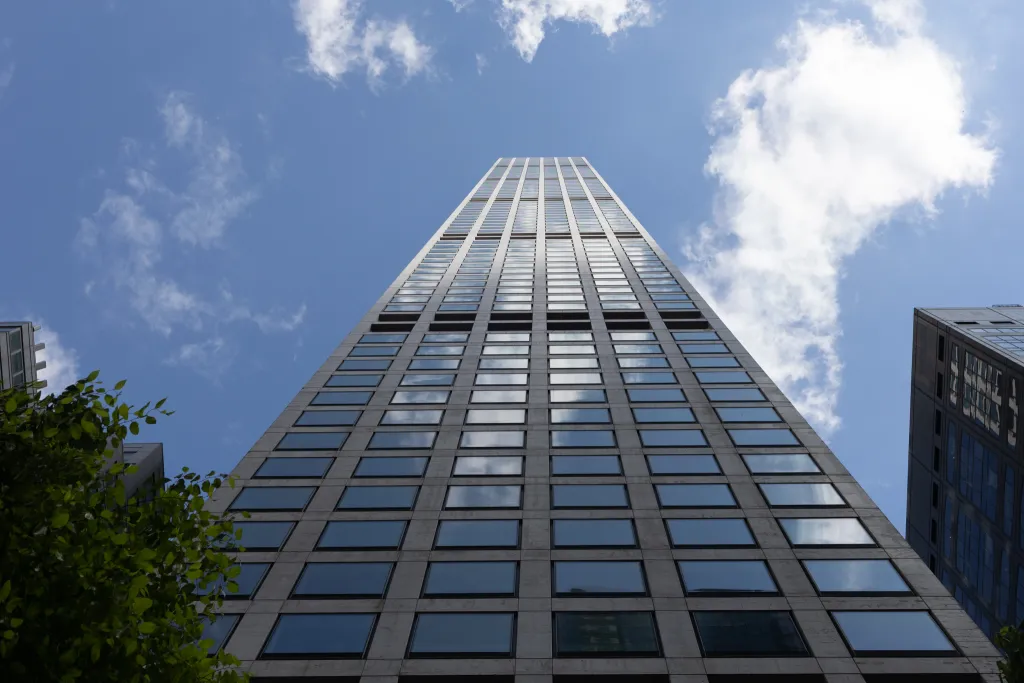
A Billionaires’ Row penthouse that sold for $87.7 million. Sting’s pad overlooking Central Park, bought for $65.7 million. A Trump Tower apartment owned by Donald himself.
These properties might seem like exactly the type of real estate that stands to be hit with a newly proposed “pied-à-terre” tax, which takes aim at high-priced homes that aren’t people’s primary residences. Mayor Zohran Mamdani and Gov. Kathy Hochul announced last week that the tax would apply to units worth $5 million or more and would raise an estimated $500 million a year to throw at the city’s gaping budget hole.
But if that $5 million worth is defined by the city’s tax valuations, condos that sell for 10 times that amount and more could avoid the tax, according to experts and city Department of Finance data. To capture pied-à-terre tax revenue from them, the government would need to use a different threshold.
The finance department’s “market values” and “assessed values” for condos and co-ops are notoriously low, calculated based on rents in the area rather than actual sales prices.
A condo at supertall 432 Park Ave. that sold for $26 million in 2021, for example, has an “assessed value” of just $785,477. And the condo’s “market value,” as calculated by the DOF, is just under $1.9 million, a fraction of its actual worth.
The governor and state lawmakers are hammering out the details of the pied-à-terre tax proposal, so how the city might assess the tax is still unclear.
Hochul has said about 13,000 New York City properties would be subject to the tax. In response to an inquiry for this story, Hochul’s office told THE CITY Tuesday that they’d make sure the tax would apply to superluxury properties like those found on Billionaires’ Row but declined to share further details.
But whatever the state lands on, it would need to account for the city’s loopy property tax system in order to include many owners’ glitzy second (or third, or fourth) homes.
Take 432 Park Ave.’s 96th floor penthouse, which sold for $87.7 million in 2016. Its “market value,” based on DOF’s math, is $3.8 million, according to city tax records. Its “assessed value” is $1.6 million.
A CITY review of property records at that supertall luxury tower did not find a single residential unit that would qualify for the pied-à-terre tax under its “assessed value,” and only one — bought for $91 million in 2017 — that would count as a $5 million condo under its official “market value.”
Even radically lowering the pied-à-terre threshold would leave some luxury crash pads free and clear.
A 2019 state bill that never became law proposed using a $300,000 assessed value threshold for a pied-à-terre tax. Under that measure, about 20% of the condos at 432 Park Ave. would still avoid being hit by the tax, according to a review of DOF data by THE CITY.
Prelude to Property Tax Reform?
Hochul and Mamdani announced the new “pied-à-terre” tax on April 15, an apparent détente in their “tax the rich” tug-of-war. Soon after, President Donald Trump took to his Truth Social platform to attack Mamdani, saying “the TAX, TAX, TAX Policies are So Wrong.”
Trump, who made Palm Beach, Florida, his official primary home in 2019, would in theory be the kind of non-resident targeted by the tax. But according to the DOF, his unit No. 66N at Trump Tower is assessed at only $2.6 million.
The condos’ distorted valuations — and the question of how to implement the new tax around them — are extensions of the much-discussed inequities of the city’s property tax system, long the focus of calls for reform, including by Mamdani.
“I think the pied-à-terre tax is the canary in the coal mine for property tax reform,” said Manhattan Borough President Brad Hoylman-Sigal, who introduced the version of the tax in 2019 when he served in the legislature. “The owners of these trophy properties are paying a lower effective tax rate than single-family homeowners.”
The gap between posh co-op and condos’ real-world and taxable values is a vestige of the 1980s, when apartment ownership was rare. Rental buildings were converting to ownership via co-op apartments, but those buildings still kept some rental apartments, many of which were rent-regulated. That history is why state law directed DOF to consider theoretical, would-be rental income for many buildings that now have few or zero rental apartments.
But decades later, as superluxury supertalls came to dominate the Manhattan skyline, such condos can effectively function as overseas bank accounts for housing vast wealth. Many are held by limited liability corporations, which mask owners’ identities.
Because of their low valuations, fancy condos pay lower effective tax rates than rental buildings by a large margin; rates for big rental buildings are nearly five times higher, according to an estimate from the Citizens Budget Commission, a watchdog group. In general, lower-valued homes face a substantially higher effective tax rate than more expensive ones, a city tax commission report found.
The musician Sting bought an apartment at 220 Central Park South for $65.7 million in 2019. Its current assessed value is just $1.89 million, records show.
That’s because its valuation, and thus its property taxes, is based on nearby aging rental buildings that house rent-stabilized apartments.
A City Hall spokesperson said conversations about the pied-à-terre tax are ongoing.
Our nonprofit newsroom relies on donations from readers to sustain our local reporting and keep it free for all New Yorkers. Donate to THE CITY today.
The post A Superluxury Condo Sold for $87.7 Million. Will NYC’s New Pied-à-Terre Tax Apply? appeared first on THE CITY – NYC News.
