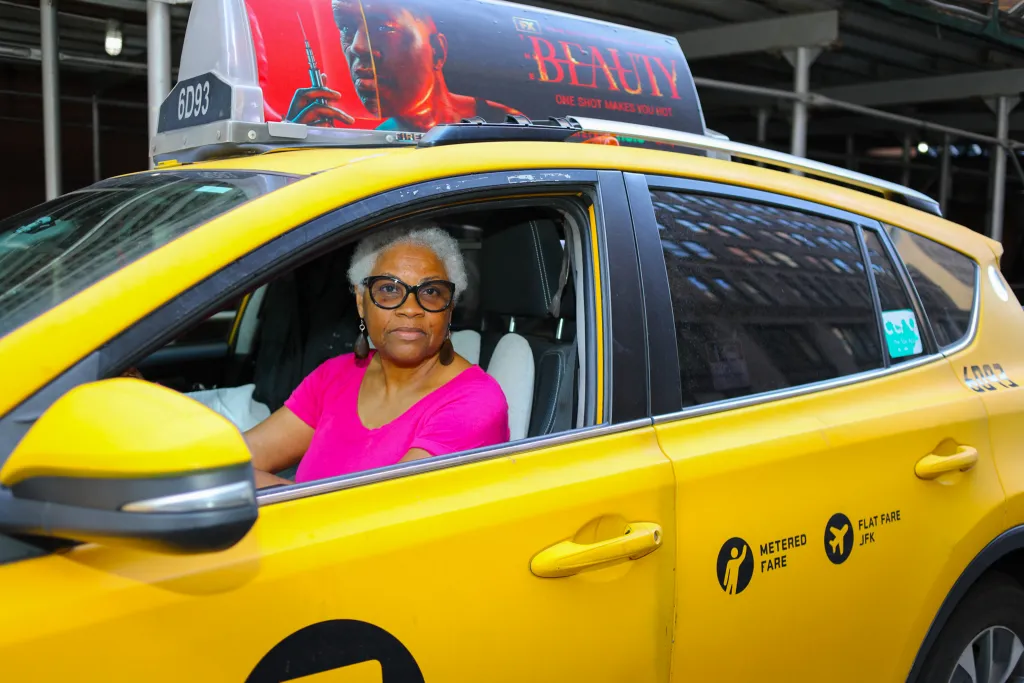
As Midori Valdivia takes the wheel of the New York City Taxi & Limousine Commission, she is encountering an industry with other women in key leadership roles — and where the number of trips with females in the driver’s seat is growing.
Valdivia is the fourth woman to serve as commissioner and chair in the 55-year history of the TLC and her arrival comes as agency data shows that female operators complete 6% of all monthly trips by the more than 178,000 TLC-licensed drivers who ferry passengers for livery bases, yellow taxis, green cabs and app-centered ride-hailing services such as Lyft and Uber.
That is a marked increase from just over a decade ago, when there were more than 140,000 TLC-licensed operators across the various for-hire vehicle classes as app-based services were in their infancy.
“The hours are so long and the conditions can be dangerous and risky,” said Bhairavi Desai, executive director of the New York Taxi Worker Alliance. “All of that makes it more difficult for women.”
According to the 2016 TLC Factbook, agency-licensed female operators completed 4% of trips by for-hire vehicles, which offer pre-arranged services through licensed bases, with 3% completed by women driving for the apps. For yellow taxis, female drivers completed not even 1% of all trips, a number that, a decade later, stubbornly remains in the same range.

“Everybody was like, ‘Oh my god, a woman cab driver!’” recalled Dorothy Leconte, who has been a yellow taxi driver since 1987. “Until today, I still hear that.”
“But years ago, it was more often like people were surprised that they had been living in New York for 20 years and this was the first time they had ever had a woman cab driver.”
Industry leaders said the changes to the industry are striking as female drivers account for a higher share of all rides, while also acknowledging that their numbers are still dwarfed by those of their male counterparts.

“It shows how much we have moved forward — that would have been impossible 20 years ago,” said Cira Angeles of the Livery Base Owners, an association that represents more than 300 bases and close to 20,000 affiliated drivers. “It was a man’s industry and it really still is.”
Women in Driver’s Seats
As Valdivia settles into her second week as head of the agency that regulates New York City’s taxi and for-hire vehicles, the new TLC head said she admires the “hard work and strength” of women who succeed in the industry.

“You can see that intrepid and independent spirit in many of our female licensees,” said Valdivia, who served as TLC deputy commissioner of finance and administration under Meera Joshi, who led the agency during Bill De Blasio’s two terms as mayor. “They make up some of the safest drivers and most conscientious base operators out there, a mighty force who deserve our respect and support.”
Women are already in leadership and advocacy roles at several industry groups in the city.
Since the 1998 founding of the New York Taxi Workers Alliance, Desai has been a labor leader in the group representing more than 20,000 yellow taxi, green cab, app-based, livery and corporate black car drivers. Angeles is the spokesperson for the Livery Base Owners group and the co-founder and chief executive of L.A. Riverside Brokerage, a taxi and livery insurance broker.
Then there is Diana Clemente, president of the Black Car Assistance Corp., which represents drivers of those cars. She also serves on the board of the Black Car Fund, which provides workers’ compensation coverage and other benefits.
Clemente entered the business in the 1980s while she was in college studying to be a certified public accountant.
“I am a CPA, I never really expected to go to a car company,” said Clemente, the chief executive of Big Apple Car, a base in Brooklyn. “But sometimes a door opens in life and you walk through it.”
Clemente recalled how her parents made what she described as a “small investment” in Big Apple Taxi, the yellow cab company that preceded Big Apple Car — and which introduced her to the business.
“My mom was despondent over the fact that they had made an investment with their savings — which was quite minimal, but all they had — and she begged me to come on board with the company,” she said. “I resisted because I went to school for public accounting.”

Decades later, Clemente is still there as the industry grapples with competition from new app-based rivals such as Empower and the prospect of autonomous vehicles potentially entering the fray in New York City among for-hire vehicles, as they have in other cities.
“It’s been a pretty amazing journey,” Clemente said. “It’s had its ups and downs, but I wouldn’t change it.”
Former factory worker Carmen Cruz shifted to driving for Uber several years ago after she began working in 2001 for a black car base in Brooklyn. To this day, a higher proportion of women drive for livery bases than the other vehicle classes.

As of February, female drivers completed 5.9% of monthly trips for the bases, TLC data shows, compared with 3.6% for Uber and Lyft. Uber last month expanded its “Women Preferences” program to New York City and across the country, giving female drivers and passengers the option to request trips with others from their gender.
“I’m happy that I came through all of this with my three kids,” said Cruz, 53. “I got to see them grow up and they know everything I have gone through in this business.”
She acknowledged the difficulty of being a single mother, noting how she regularly drives seven days a week to make ends meet.
Cruz said she supports Valdivia, expressing hope that having a female TLC commissioner and chair will be beneficial for women drivers whose on-the-job barriers include access to parking spaces for bathroom breaks and personal safety.
“For me, it was so strange when I went to work as a driver — and it scared me, too,” Cruz said. “But you know that necessity only makes you stronger.”
Our nonprofit newsroom relies on donations from readers to sustain our local reporting and keep it free for all New Yorkers. Donate to THE CITY today.
The post Women Take the Wheel in NYC’s For-Hire Vehicles, Even as Male Drivers Predominate appeared first on THE CITY – NYC News.
