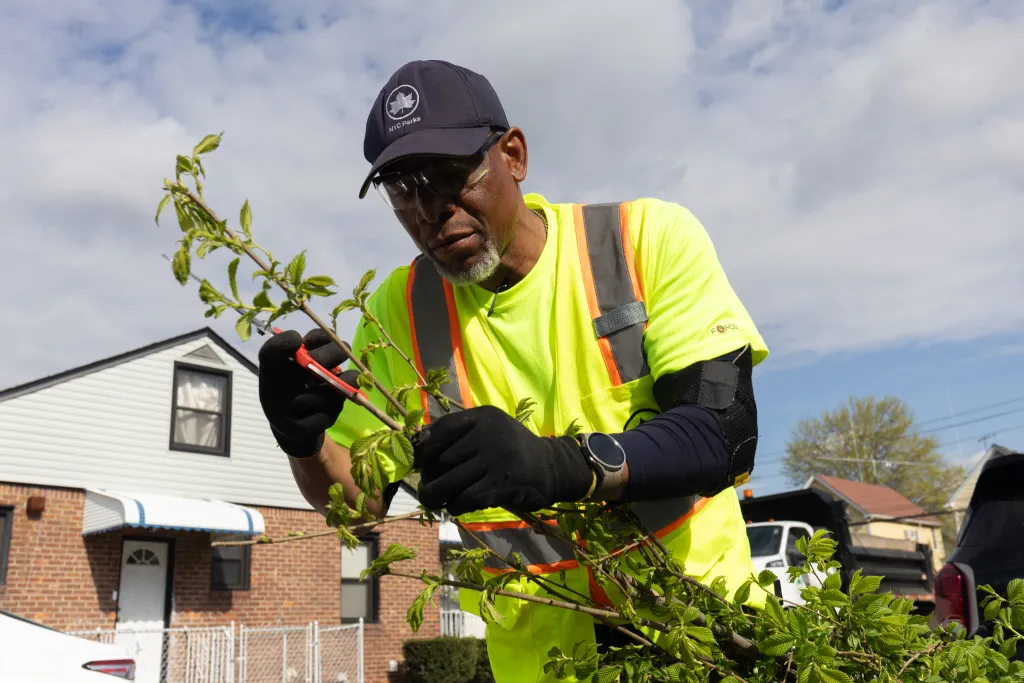
On a breezy Monday morning on a quiet corner of Queens, 11 leafy new neighbors arrived on a truck, fresh from a nursery in Kansas City.
Elm, red maple and cherry trees — some with pink blossoms — would be planted next to the sidewalks across a few blocks of Cambria Heights, a suburban-style neighborhood of homes with grassy front lawns.
As workers hoisted a tree out of a bag surrounding its roots, a woman with a phone to her ear leaving a nearby house called out to ask what kind of tree the workers were planting: an elm that would grow to be up to 70 feet tall over the next three to four decades.
“Adding to the family!” she exclaimed, grinning, before getting into a car.
Cambria Heights is among the neighborhoods with the highest risks of extreme heat, where temperatures are hotter than the city’s average and where some blocks lack any trees.
Monday’s tree-planting session came as part of a strategy in its second year that prioritizes putting new trees in the neighborhoods most vulnerable to extreme heat, rather than in response to ad hoc 311 requests, as had been done in years past.
And planting those trees took on a particular significance as the Mamdani administration on Tuesday released a plan to expand the tree canopy to cover 30% of the city by 2040.
“To reach this 30% goal, it’s going to take work from every actor in the entire city,” said Jessica Einhorn, chief of forestry programs at the Department of Parks and Recreation. “This program planting trees, especially in the high [heat vulnerable] neighborhoods, is really critical towards that equity angle.”
In those riskier areas, the tree canopy — or the area of the city currently covered by trees and their leaves — currently stands at 19%, compared to about 26% in others, city Chief Climate Officer Louise Yeung told the City Council in March. (Overall, tree canopy covers just over 23% of the boroughs according to the last count in 2021. That was after a net increase of 1.2% since 2017.)
Trees across the city serve more than an aesthetic purpose — they add to the health and resiliency of a neighborhood. Areas with a robust tree canopy and vegetation have shown to be slightly to significantly cooler compared to places where green space is scarce and pavement is plentiful. Trees also help to purify air and can reduce water runoff to mitigate flooding.
And their value as heat-regulators will only increase in the near future.
By the 2040s — the due date for the 30% canopy goal — New York City’s temperatures could be between nearly 3 and 6 degrees hotter due to the effects of climate change, according to the New York City Panel on Climate Change. Heat is dangerous: it contributes to the deaths of over 500 New Yorkers on average each year, with Black New Yorkers twice as likely to die compared to whites.

The city already experiences the urban heat island effect, meaning it’s hotter because of the density, pavement and tall buildings than elsewhere. But some areas are significantly greener and cooler than others, while other neighborhoods are more vulnerable to heat based on a combination of physical factors — like existing trees — and social considerations, like residents’ income and access to air conditioning.
The Parks Department’s tree-planting strategy, announced in 2024, does away with the system where anyone can call 311 to ask for a new tree — except for the loophole New Yorkers can make a $1,800 donation to do so, as previously reported by THE CITY.
The new system instead divides the city into more than 400 zones, planting trees in every viable place within a zone while removing stumps and dying trees.
Each community board district will have a zone serviced every three years, and Parks plans to hit all zones every nine years. (Here’s a tentative schedule of tree-planting locations.) The most heat-vulnerable neighborhoods are on track to be completed by the end of 2027, Yeung said.
Money Grows Trees
Mamdani’s plan is the first time the city has set a target date for the goal of a 30% canopy. But critically, the money to pay for it has not been committed.
“Many of the actions in the plan rely on existing program budgets and aim to ensure that we are spending smarter,” City Hall spokesperson Jessica Woolford said in a statement. “We are creatively leveraging funds from government and private sources to advance our shared goals.”
City Hall did not offer its own estimate for the cost. But according to a 2022 estimate from a local environmental advocacy group, it would cost about $500 million to plant a million trees and achieve its canopy goal.
“The plan is great, but what comes after is the most critical part,” said Shravanthi Kanekal, a resiliency planner at the New York City Environmental Justice Alliance. “It’s going to signal a whole lot to see how much they dedicate funding to the plan.”
Though as a candidate, Mamdani promised to dedicate 1% of the budget to the Department of Parks and Recreation, his preliminary budget this year proposed spending just half of that — cutting nearly $34 million from the department’s budget in the current fiscal year.
“I’m really glad to see the city set a goal of 2040, and I think what we’ve been looking to is how to further accelerate achieving that goal,” said Tami Lin-Moges, director of the cities program at the Nature Conservancy. “But obviously that really relies on increased investments. … Investing in parks and the urban forest is an investment in livability in New York City.”

Greening the city so almost a third of it has tree canopy will require money, manpower and shoring up interest from New Yorkers, said Simon Skinner, chief of programs and operations at the New York Restoration Project.
He pointed to the successful initiative to plant a million trees that the Bloomberg administration launched in 2007. It took eight years, short of the decade expected.
“It shows it’s possible,” Skinner said. “Everyone was pulling in the same direction because it was such a big initiative coming from City Hall.”
Skinner said several agencies coordinated to prioritize the goal as private landowners got involved, and the government and its partners educated kids and adults on tree planting and stewardship.
In Cambria Heights on Monday, interactions with neighbors showed some of the challenges the city may face as it reaches for the goal; not everyone was happy about the newly rooted neighbors.
Derrick Simmons, a long-time resident of a nearby block, stopped by to talk to the Parks workers about the problems he’s had with trees.
“The trees have fallen on different people’s cars. They broke up the sidewalks,” he said. “I know they said that this is supposed to make the neighborhood more beautiful, and I get that. But of course we got 26 trees. We don’t need any more trees.”
A bit later, another neighbor walked by and said the tree roots were messing with his home’s sewer pipes: “I live on the next block. We got tree-lined streets. It sucks!”

Navé Strauss, Parks’ director of tree planting, said, “Our mandate is to plant every available location.”
Einhorn said Simmons and his neighbor’s complaints indicated there was a lot that could be done to “increase the connection between people and their trees.”
“We do as much as we can to care for the trees, but really it’s those blocks where like a property owner or a neighbor will come out and water the tree or maybe plant flowers around that the data shows that those trees are better off than the others,” she said.
To reach the 30% canopy goal, trees will need to be planted on privately owned property, not just in public parks and on streets, Einhorn said — “and more than anything else is preserving our existing tree canopy.”
That maintenance — pruning, watering, cleaning tree beds and removing invasive vines — is important for trees to thrive and for the canopy to expand. All of those tasks require people to do them, which costs money.
“Obviously it’s sexy and nice to plant a bunch of new trees, but we have to also look after what we already have,” Skinner said. “They have an outsized effect on things like reducing heat and absorbing pollution.”
Our nonprofit newsroom relies on donations from readers to sustain our local reporting and keep it free for all New Yorkers. Donate to THE CITY today.
The post To Fight Heat, NYC Sets 2040 Tree Canopy Deadline, With Riskiest Areas First appeared first on THE CITY – NYC News.
