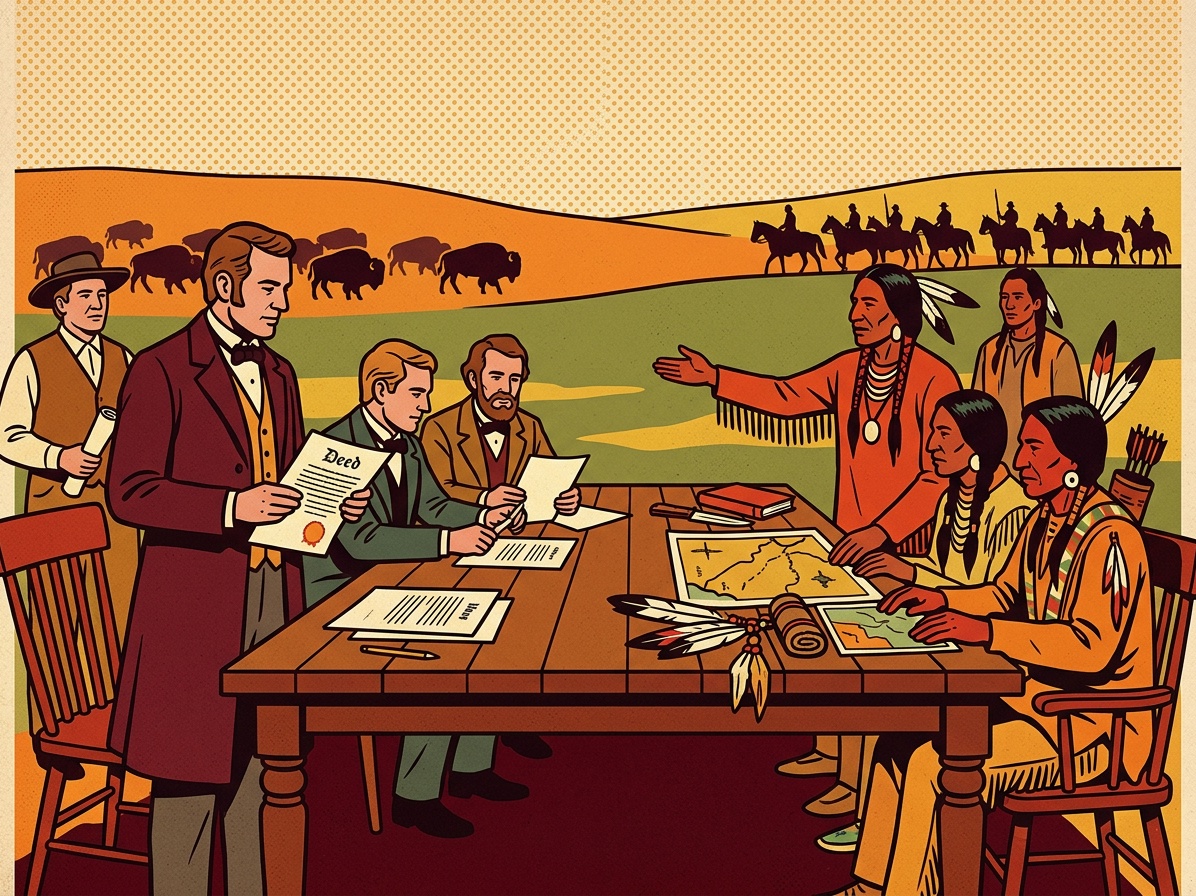
The traditional domain of law & economics is the courtroom, the legislature, and the administrative agency. But in their 1994 article, “Raid or Trade? An Economic Model of Indian-White Relations,” Terry Anderson and Fred McChesney took the theoretical tools developed to explain modern legal disputes and set out to settle a wider continent.
When European settlers arrived in North America, they brought royal charters granting them ownership of vast tracts of land. Almost immediately, they encountered numerous Indian tribes that could credibly claim control over those same lands. Faced with these conflicting claims, both parties had to decide whether to press their claims or abandon them. If they pressed, they then had to decide whether to exchange the land peacefully or fight it out.
Contrary to the popular narrative, Indian-white relations were not violent from first contact. History is complex, but the general pattern is that Indian-white relations began fairly peacefully and worsened over time. At first, Indian tribes often appeared inclined to drop ownership claims in the face of settler intrusion. When Indians did press a claim, the typical result was peaceful negotiation and exchange. Anderson and McChesney show that, from the Founding era to about 1830, treaties between Indians and whites were frequent, while battles were few and far between. As the American frontier moved farther west, the dominant mode of settling disputes shifted to warfare.
Why did Indian-white relations move from the peaceful interactions symbolized by the first Thanksgiving to the Massacre at Wounded Knee? Or, as Anderson and McChesney put it: “If both sides prefer settlements to violence, what caused the increasing resort to warfare between Indians and whites?” More broadly, under what conditions might Europeans have settled North America more peacefully?
From Courtroom to Continent
Like early land disputes between Indians and whites, most modern legal disputes settle long before they reach court. William Landes, in his 1971 article, “An Economic Analysis of the Courts,” developed a formal model to explain why. In Landes’ model, the decision to settle or litigate turns on the stakes of the dispute, the relative costs of settlement and litigation, and each party’s estimate of its odds of winning. Landes, Richard Posner, and others used the model to explore how settlement rates might be affected by the bail system, court delay, prejudgment interest, pretrial discovery, and rules governing who pays trial costs.
Anderson and McChesney’s key insight is that the decision to trade or raid mirrors the modern decision to settle or go to trial. The Landes model, in other words, is a general model of dispute resolution. All disputes—not just modern legal ones—are resolved according to the relative costs and benefits of each available method.
Where Peace Has a Price
When European settlers occupied Indian territory, the tribe had to decide whether to assert its claim to the land and its resources. An Indian tribe would assert its claim if the marginal benefit of the land—the value of one additional unit—exceeded the marginal cost of asserting that claim. That might mean making a credible commitment to retake the land by force, if necessary.
On first contact with European settlers, Indian-held land was abundant and the marginal value of land to Indians was relatively low. We should therefore expect Indians to allow whites to settle fairly unimpeded. Indians would assert a claim only when the marginal benefit of the land exceeded the marginal cost of asserting and enforcing it.
The logic worked symmetrically. Whites would expand their territorial control only so long as the marginal benefit of acquiring an additional strip of land exceeded the marginal cost of claiming and controlling it. Between those two points lies what Anderson and McChesney call the “zone of controversy.” That is where all disputes between Indians and whites occur.
Within the zone of controversy, Indians and whites had to decide how to resolve individual disputes. A peaceful settlement required both parties to walk away with a surplus they would not have gained from fighting. Indians would choose peaceful negotiation if the costs of fighting, plus the value of reclaimed land, exceeded the costs of negotiation. Whites would go to the negotiating table if the costs of negotiation were lower than the costs of fighting, plus the losses they expected from fighting.
Thus, all else equal, as the cost of negotiation rises, so does the likelihood of violence. And as the cost of violence falls, violence becomes more likely.
When the Frontier Moved, So Did the Math
Uncertainty about the outcome of conflict adds another wrinkle. If one party is substantially more optimistic than the other about its chances of victory, fighting becomes more likely—even when the expected costs of fighting exceed the costs of negotiation.
This point is about information asymmetry, not merely imperfect information. If faulty information about military capacity causes whites and Indians to hold incorrect but identical expectations about their chances in battle, peace can still prevail if fighting costs more than negotiation.
As white settlers moved farther west, the costs of negotiation rose, the costs of fighting fell, and information asymmetries widened. All of this meant more warfare.
Unlike the sedentary agricultural tribes in the east, Indian tribes west of the Mississippi were nomadic, like the buffalo they hunted. On the vast commons of the Great Plains, Indian tribes did not have neatly defined territorial ownership claims. The ownership rights they did have came from capture and possession.
The nomadic western tribes also lacked the more centralized political structures common among eastern tribes. Western tribal leaders did not fully control their members, and individuals routinely ignored treaties signed by their chiefs. Negotiation is difficult when both the party across the table and the object of negotiation are unclear. The western Indians’ nomadic lifestyle also made it harder to communicate with the tribe and “size up” its strength.
Over time, the party we have simply been calling “whites” was no longer an individual settlement community or local militia, but the growing federal government and the U.S. Army. Treaties signed by politicians in Washington were difficult to enforce locally when a citizen or rogue government employee violated their terms. The existence of a standing army—staffed by officers and bureaucrats whose careers benefited from fighting—also lowered the cost of violence.
It should not be too surprising, then, that whites shifted toward taking what they wanted by force.
Better Lawyers Than Molotovs
Stepping back, Anderson and McChesney implicitly teach us a valuable lesson about the importance of well-functioning legal institutions. Like it or not, violence is part of the human condition. If I find myself in a legal dispute with my neighbor, I must decide whether to negotiate and settle, go to trial and litigate, or throw a Molotov cocktail through his window.
Litigation might sometimes feel like combat. But compared with the alternatives, it is another way to resolve disputes peacefully. A capable legal system—one that upholds the rule of law and delivers fairly predictable judgments—lowers the costs of negotiation and raises the costs of fighting. That, in turn, reduces violence.
Further Reading
- Terry L. Anderson & Fred S. McChesney, “Raid or Trade? An Economic Model of Indian-White Relations,” The Journal of Law and Economics, Vol. 37, No. 1 (April 1994)
- William Landes, “An Economic Analysis of the Courts,” The Journal of Law and Economics, Vol. 14, No. 1 (April 1971)
- Robert D. Cooter & Daniel L. Rubinfeld, “Economic Analysis of Legal Disputes and Their Resolution,” Journal of Economic Literature, Vol. 27, No. 3 (September 1989)
- John Umbeck, “Might Makes Rights: A Theory of the Formation and Initial Distribution of Property Rights,” Economic Inquiry, Vol. 19, No. 1 (January 1981)
- Richard Posner, “An Economic Approach to Legal Procedure and Judicial Administration,” The Journal of Legal Studies, Vol. 2, No. 2 (June 1973)
- George L. Priest & Benjamin Klein, “The Selection of Disputes for Litigation,” The Journal of Legal Studies, Vol. 13, No. 1 (January 1984)