There is something quietly radical about an art fair that still knows how to feel alive.
At NADA, amid the expected velocity of booths, glances, introductions, acquisitions, and discoveries, what emerged most powerfully was not a single aesthetic thesis, but a sense of artistic permission. Expression, textiles, sculpture, figuration, abstraction, and photorealism moved through the fair with unusual vitality, each offering a different argument for why material intelligence still matters in an increasingly flattened world.
The fair’s range felt especially important. Representation from the Virgin Islands to Tokyo, Philadelphia to Miami, gave the presentation a global pulse without dissolving into sameness. One could feel the value of access, not as institutional language, but as lived encounter. Different geographies carried different pressures. Different artists proposed distinct vocabularies for memory, desire, place, resistance, and transformation.
This is why art fairs still matter when they are alive to discovery rather than hierarchy. They interrupt the arrogance of the already known. They place the viewer in direct proximity to unfamiliar gestures, cultural lineages, and psychological climates. At their best, fairs do not merely sell art. They expand the civic imagination. They remind us that culture is not a sealed room for the already initiated, but a living organism strengthened by friction, visibility, and surprise.
Certainly, the figure has returned with force across contemporary art, though at NADA it was only one part of a broader visual conversation. After decades in which abstraction, conceptual practice, and digital mediation often promised escape from the body, the human form now appears again as evidence, pressure, and refusal. In a world that often wants us apart, categorized, optimized, and estranged from one another, a body rendered with conviction can feel quietly revolutionary. Yet the fair’s intelligence came from the fact that figuration did not dominate alone. It existed alongside works where gesture, textile, texture, objecthood, and illusion carried equal authority.
Oil on canvas
80 × 68 inchesPhoto courtesy of NADA/Molly Lowe
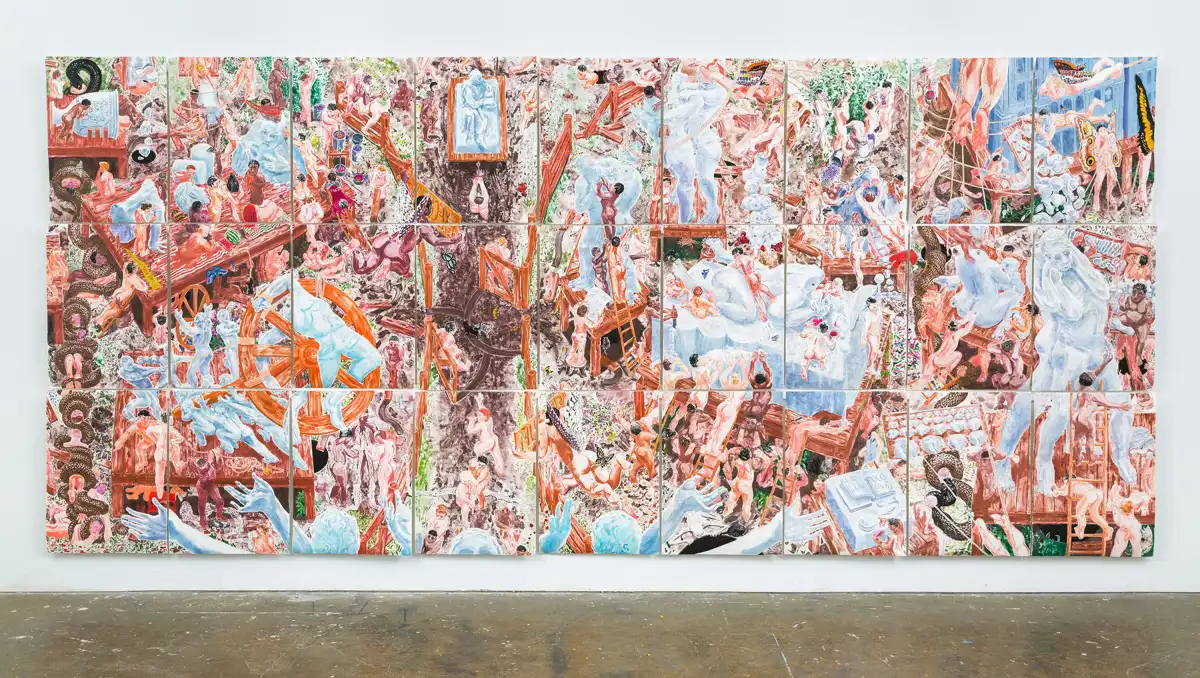
Todd Strong’s mural work, presented by Big Stamp Gallery out of Philadelphia, held me immediately. His figures pulse with liberated unrest: nude, winged, writhing, some bearing butterfly-like appendages, all charged by a physicality that feels both erotic and emancipatory. The bodies do not perform shame. They arrive as living forces, caught between metamorphosis and release. There is something almost Dionysian in their rhythm, as though flesh has escaped etiquette and returned to instinct, heat, and transformation.
One thinks, perhaps, of the long art-historical tension between the nude as possession and the nude as power. Strong’s bodies do not feel arranged for passive consumption. They feel self-propelled, volatile, and insistently alive. Their nakedness is not vulnerability alone. It becomes motion, appetite, psychic weather, and a declaration that the human form still carries spiritual voltage when handled without fear.
Molly Lowe’s Wrestle in the Grass from 2023, an oil on canvas, operated from another register entirely. The work is abstract, yet not evasive. Its painterly brushstrokes carry a muscular sense of movement, as if the surface itself were caught in a private struggle between density and release. There is an atmosphere of contact without literal explanation, a sense of something turning, pressing, slipping, and reconstituting itself through paint. The title offers a clue, though the canvas wisely resists illustration. Wrestling becomes less a depicted act than a condition of making: pigment against ground, gesture against control, motion against containment.

Oil on canvas
30 × 40 inchesPhoto courtesy of NADA/Esaí Alfredo
That is the seduction of abstraction when it is handled with conviction. It does not refuse meaning. It refuses the tyranny of immediate legibility. Lowe’s painting invites the viewer to feel before naming, to follow pressure, rhythm, and painterly weather before the mind insists upon possession. In that way, the work becomes deeply bodily without needing to show a body at all.
Esaí Alfredo’s The Necklace from 2026, presented by Spinello Projects out of Miami, moved in yet another direction, with photorealism carrying an almost devotional charge. The work’s majestic, ethereal color application gave realism a strange luminosity, reminding us that technical mastery need not be cold when animated by atmosphere and psychological depth. Photorealism, at its strongest, is not merely a demonstration of skill. It becomes a philosophical trapdoor. The viewer enters through recognition and then finds something more elusive waiting beneath the surface.
In Alfredo’s hands, reality appears heightened, almost consecrated. The image does not simply reproduce the visible world. It intensifies it. There is a hush in that kind of looking, a sense that the ordinary has been slowed down enough to become ceremonial. The necklace becomes more than adornment. It becomes a point of focus, a charged emblem of intimacy, identity, and attention.
Unsurprisingly, textiles and sculpture deepened the fair’s broader material conversation. Textile, historically dismissed as domestic, feminine, craft-adjacent, or secondary, has become one of the most intellectually potent materials in contemporary practice. Cloth carries labor. Fiber remembers touch. Weaving, stitching, binding, knotting, and draping all suggest the hand, the wound, the garment, the shelter, the inheritance. Sculpture, conversely, insists upon presence. It occupies the same room as the viewer and asks the body to negotiate space, weight, proximity, and scale.

yarn, fabric, wire, gold mica flecks, chain, corset, used clothes, safety pins, IV pole
75 × 30 × 30 inchesPhoto courtesy of NADA/Angela Rogers
Together, these works made NADA feel less like a parade of objects and more like a gathering of visual arguments. The emphasis on expression was not loose emotionalism. It was a serious claim that feeling, when disciplined by form, becomes thought. The best works did not shout. They unsettled, seduced, clarified, and complicated.
That challenge feels urgent now. So much of contemporary life is designed to flatten perception. We are encouraged to scroll rather than look, brand rather than become, perform rather than feel, optimize rather than inhabit. Against that machinery, NADA offered something more generous and more alive: a renewed faith in surface, hand, texture, image, object, and encounter.
NADA is worth checking out this weekend precisely for that reason. The fair offers more than an afternoon of looking. It offers a necessary reentry into the charged terrain of material, imagination, and human presence. At its strongest, the work on view reminds us that art does not simply reflect culture. Art agitates it, repairs it, seduces it, and sometimes, mercifully, returns us to ourselves.
Newdealers.org
