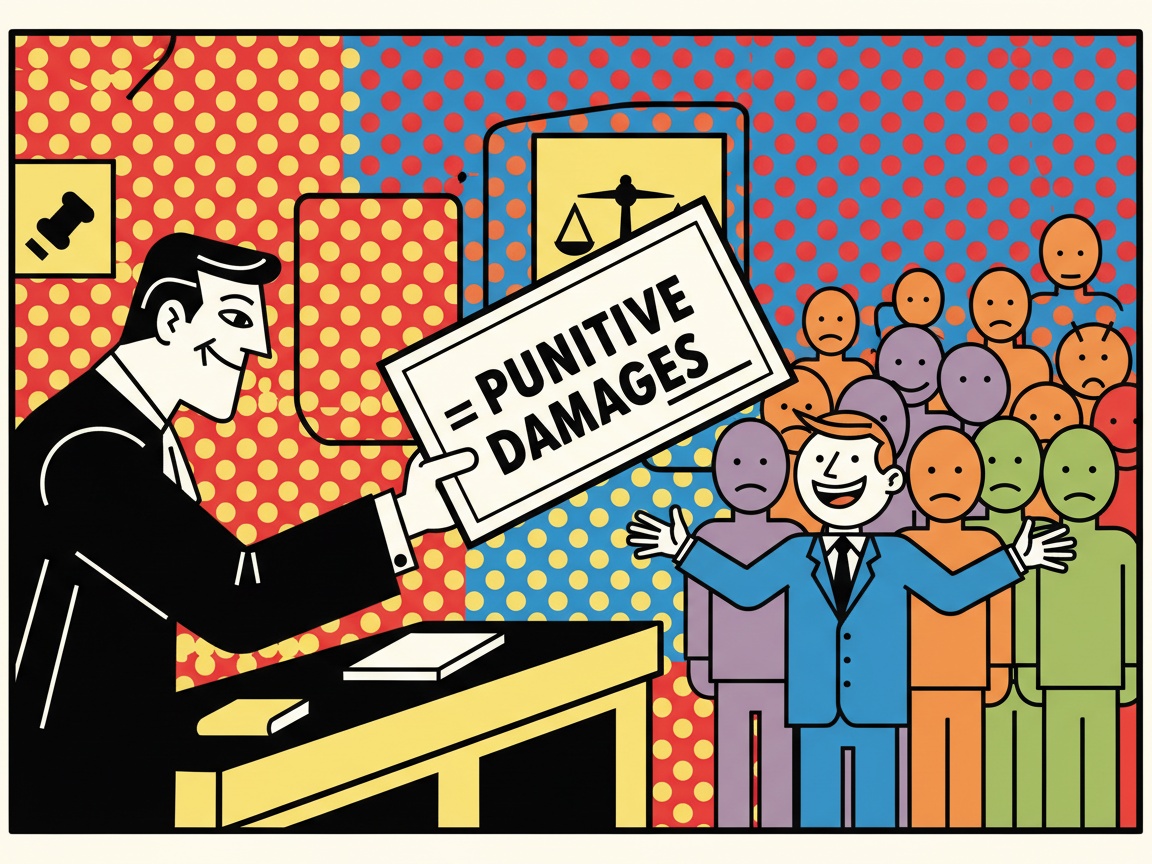
Catherine Sharkey’s “Punitive Damages as Societal Damages” addresses a tension that has been obvious for decades, but usually treated as an annoyance: punitive damages are justified in public-regarding terms—punishment, deterrence, and condemnation—yet delivered through private litigation and typically paid to a single plaintiff. The doctrinal rhetoric often tracks conduct broad in scope, such as systematic fraud, organizational bad faith, or product defects affecting many victims. The remedial structure, by contrast, remains stubbornly bilateral.
Sharkey treats that mismatch as a design problem, not a terminological one. Her proposal separates two functions long bundled together under the “punitive” label: (i) punishment, which she calls “anti-social penalties,” and (ii) compensation for social harms that ordinary compensatory damages do not reach, which she terms “societal damages.”
The point is not to deny punitive damages’ deterrent role. Rather, Sharkey argues that once we concede punitive awards often respond to harms beyond those suffered by the named plaintiff, courts should stop laundering that broader social objective through a plaintiff windfall.
Methodologically, the paper is both doctrinal and institutional. It reads constitutional punitive-damages doctrine as a constraint and then asks what remedial architectures—split recovery, compensation funds, or aggregation substitutes—might better align punitive damages with their asserted social function.
Everybody’s Harm, One Plaintiff’s Check
The paper’s organizing claim is that legal actors already behave as if punitive damages incorporate a social-harm component. Sharkey opens with State Farm v. Campbell, where plaintiffs’ counsel urged jurors to punish a nationwide course of conduct, and the Utah Supreme Court defended a large punitive award by invoking harms to other insureds and to “society in general.” The system plainly reaches for a justification broader than the individual plaintiff.
Yet the system then does something inconsistent with that logic: it pays the money to the plaintiff. Sharkey’s move is to argue that courts and legislatures should make explicit what the doctrine already assumes implicitly—that part of the award serves a compensatory function for harms extending beyond the named plaintiff.
Once that premise becomes explicit, the next question becomes unavoidable: where should the “societal” portion of the award go?
Deterrence Is Only Half the Design Problem
The standard law & economics defense of punitive damages is the under-detection multiplier: when wrongdoing is difficult to detect or prove, compensatory damages alone will underdeter, so the remedy should be scaled up to bring expected liability closer to expected harm. Sharkey engages this view sympathetically, but presses on what it abstracts away: distribution.
The law & economics approach starts from the under-detection and under-deterrence problem and treats remedy design—especially who receives the money—as an input into deterrence, not merely a distributional afterthought. If the “extra” dollars exist to internalize social costs, paying them to a randomly positioned plaintiff may seem like a crude but tolerable shortcut.
Sharkey argues that shortcut carries consequences economic models often treat as secondary, but institutional design cannot. Recipient choice affects legitimacy, settlement leverage, litigation incentives, and the relationship between private enforcement and public objectives. Her societal-damages framing makes those consequences central, rather than incidental.
Iowa: Keep the Plaintiff, Split the Windfall
Iowa’s split-recovery approach requires a special finding about whether the defendant’s conduct was “directed specifically” at the claimant. If it was not, then—after specified costs and fees—no more than 25% of punitive damages may go to the claimant, with the remainder paid into a civil reparations trust fund. (Iowa Code § 668A.1).
The rule matters because it operationalizes the moral and economic intuition Sharkey wants doctrine to acknowledge. When the wrong is not specifically targeted—when it instead appears part of a broader pattern affecting others—the argument that the plaintiff should capture the entire punitive award becomes less persuasive. Iowa makes that intuition concrete through a binary interrogatory and a simple routing rule.
The predictable objection is incentive-based: reducing the plaintiff’s upside may weaken private enforcement. Sharkey’s response is not that incentives are irrelevant, but that they are variables to be engineered. The institutional challenge is to balance deterrence, administrability, and legitimacy.
The Ohio Supreme Court Creates a Public Fund
Sharkey also emphasizes that some courts have improvised “societal” routing even without statutory authorization. In Dardinger v. Anthem, the Ohio Supreme Court stated: “The plaintiff remains a party, but the de facto party is our society …” (Dardinger, 98 Ohio St. 3d 77 (2002)). The court then tried to implement that logic by remitting the punitive award and directing a substantial portion—after attorneys’ fees—to a court-created cancer-research fund.
One can object to the specifics. Courts are not natural fund administrators, and ad hoc earmarks invite arbitrariness. Even so, the episode is instructive for Sharkey’s purposes: once courts explicitly frame the wrong as social, they become pulled toward social distribution. The doctrinal vocabulary is already doing the work; the remedial architecture simply lags behind.
Catastrophic AI Risk Is Not Built for One-Plaintiff Remedies
Advanced artificial-intelligence risk—especially catastrophic misuse or large-scale misalignment, where an AI system pursues goals in ways its designers did not intend—creates a familiar enforcement problem for tort law. The harms that matter most may be practically noncompensable because they exceed feasible insurance limits, overwhelm defendant solvency, or occur in states of the world where adjudication is unavailable.
If expected social harm is driven by low-probability but catastrophic “tail” outcomes, insurance markets often fail to internalize those risks reliably. Diversification breaks down when risks are highly correlated; model uncertainty makes pricing difficult; and coverage is capped, excluded, or implicitly dependent on public backstops.
In that setting, two failures compound. First, relying on private insurance to price externalities becomes structurally unreliable. Second, relying on a plaintiff-windfall model to finance deterrence and redress becomes unstable. It routes public-harm money through sporadic, high-variance litigation outcomes while creating no durable institutional capacity for monitoring, remediation, or compensation in diffuse-harm cases.
Sharkey’s split also sharpens how punitive damages should be used—if at all—in frontier AI cases. If part of an award is meant to function as a deterrent sanction, it cannot be structured in a way that predictably allows the defendant to neutralize it through indemnification or contractual pass-through. A “punitive” price signal that can be shifted is not, in any robust sense, punitive.
By contrast, the portion of an award better understood as “societal damages” should be treated as a routing problem. If the justification is harm to nonparties or diffuse social costs, the remedy should not be delivered as a plaintiff windfall. Instead, it should go to institutions capable of converting those funds into public goods that reduce under-detection and manage diffuse harms, such as risk measurement, independent auditing capacity, and incident-response infrastructure.
The point is not that such institutions solve AI-governance problems. It is that once punitive damages are justified in social-cost terms, allocation becomes part of the mechanism, rather than an afterthought.
Conclusion
Sharkey’s contribution is to treat remedies as governance instruments with institutional form. Punitive damages are often defended as tools for internalizing externalities when compensatory damages underdeter. The societal-damages reframing asks a further question: if the function is partly social, why should the form remain purely private?
For correlated, partially uninsurable AI risk, that question is not academic. If courts continue to describe society as the relevant beneficiary of punitive awards, Sharkey’s framework forces a follow-on demand: build a remedial architecture that reflects that claim, and then defend it—doctrinally, constitutionally, and institutionally—on its own terms.
Further Reading
- Catherine M. Sharkey, “Punitive Damages as Societal Damages,” Yale Law Journal, Vol. 113 (November 2003).
- Catherine M. Sharkey, “The Future of Classwide Punitive Damages,” University of Michigan Journal of Law Reform, Vol. 46 (2013).
- A. Mitchell Polinsky & Steven Shavell, “Punitive Damages: An Economic Analysis,” Harvard Law Review, Vol. 111, No. 4 (February 1998).
- Gabriel Weil, “Closing the AI Accountability Gap: Strict Liability and Punitive Damages for Advanced Artificial Intelligence,” Oregon Law Review (forthcoming 2027)
- Gabriel Weil, “Overcoming Judgement-Proofness: The Law & Economics of Insuring and Mitigating AI Risk” (working paper, February 2026)
