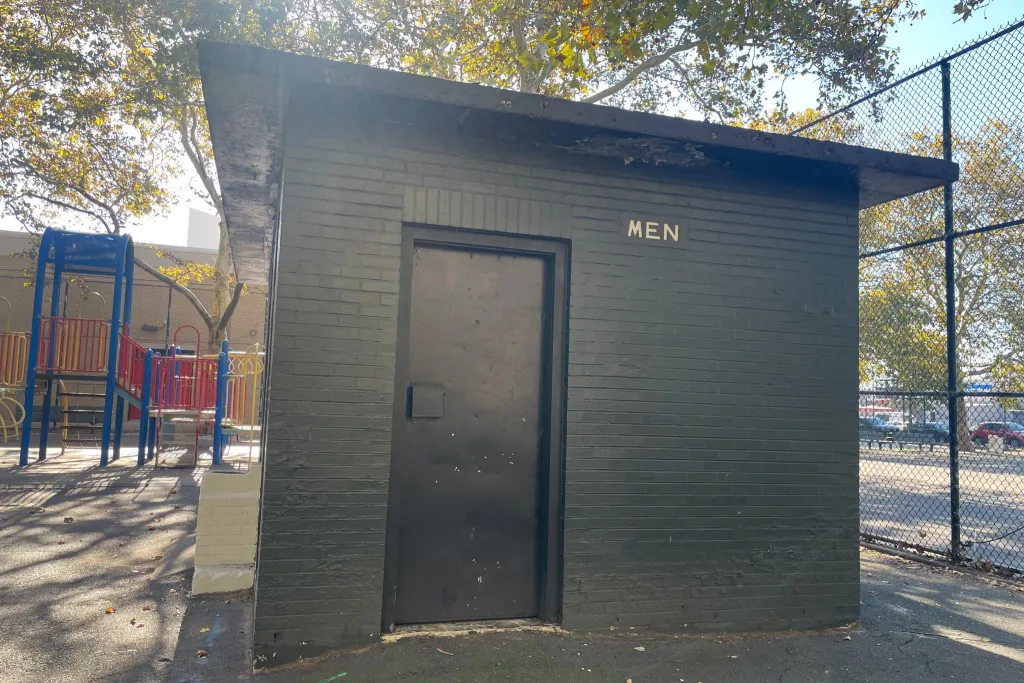
A few blocks off the Belt Parkway in Gravesend, Brooklyn, a playground bathroom has been closed so long its doors no longer have handles.
A rusted latch box is bolted to the graffiti-tagged doors of the cube-like structure, which city records show has been shut since at least 2018 — three mayors ago. One local says she hasn’t seen it open in roughly 15 years.
“I come here often. I’ve never seen this bathroom open,” said Magdalena Maxine, who works at the Shoreview nursing home next to the playground.
The Gravesend bathroom is one of 68 Parks Department facilities currently closed, according to records obtained through a Freedom of Information Law request. Nine have been closed for at least nine years, the records show, and only three of those have a capital repair project scheduled, the data reveal.
Parks advocates and experts point to a combination of factors behind the city’s shuttered bathrooms, including chronic underfunding, state contracting laws that can complicate repairs and a lack of urgency from City Hall.

City Councilmember Ty Hankerson (D-Queens), who chairs the Council’s Committee on Parks and Recreation, said the closures are a serious inconvenience for parkgoers, particularly parents with young children.
“Bathrooms being closed during that time is not only a big inconvenience, but it forces people many times to unfortunately go outside,” Hankerson told The City Reporter.
A Parks Department spokesperson said Tuesday they needed more time to comment on repair plans for the long-shuttered washrooms.
The Cost of Comfort
Restoring just one of the city’s aging park bathrooms, known as comfort stations, can cost between $5 million and $7 million, a hefty price tag that could potentially consume an entire year’s $5 million capital allocation for an individual Council member.
In an effort to address the lack of public bathrooms, the administration of Mayor Zohran Mamdani in September began installing 17 modular public bathrooms across the five boroughs as part of a $4 million pilot aimed at expanding access to free facilities in busy public areas.
The units, selected through the city’s Economic Development Corporation, are open daily from 7 a.m. to 10 p.m. and include accessible entrances, running-water sinks, flushing toilets, climate control and baby-changing stations. The company operating them, Throne Labs, handles cleaning and maintenance.
Unlike traditional park comfort stations, the self-contained units do not require connections to water, sewer or power infrastructure, allowing them to be installed more quickly and relocated as needed.
The rollout comes as the Mamdani administration also has struggled to develop a broader strategy for expanding public bathroom access.
The One Percent Solution
A citywide plan to build 2,120 public bathrooms by 2035 — doubling the existing network under legislation known as the Bathroom Bill — has been delayed, The City Reporter detailed in August.
At the time, Deputy Mayor Julia Kerson told City Council Speaker Julie Menin that she hopes to submit the plan by Nov. 1.
Parks advocates are eagerly awaiting that report and want the mayor to do more.
As a mayoral candidate, Mamdani promised to dedicate 1% of the city budget to the Parks Department. His initial proposed budget actually set aside just half of that.
The final budget allocated roughly $709 million to Parks, restoring some of the proposed cuts, but still several hundred million dollars short of the 1% target.
“For many, many years, parks have not been a priority for previous administrations,” Adam Ganser, executive director of New Yorkers for Parks, told The City Reporter.
A Parks Department spokesperson said the agency operates more than 700 restroom buildings containing over 1,400 individual restrooms, nearly all of which are open seven days a week, year-round, and free to the public.
A Parks Department spokesperson, Gregg McQueen, said the agency operates more than 700 restroom buildings, nearly all of which are open daily year-round, and that its in-house trades staff makes repairs when facilities go offline.
“Building and improving bathrooms is one of our priorities,” McQueen said, adding that the agency is on target to complete renovations or new construction at 14 restroom facilities this year.
The department is also working with the city’s Department of Design and Construction on a faster design-build process for new restrooms and participating in the administration’s modular bathroom pilot, he said.
But Parks does not have a dedicated budget for restroom repairs, according to the department. Instead, its in-house trades staff handles bathroom fixes as part of its broader building maintenance responsibilities.
Why So Expensive?
Meanwhile, the price tag for park bathroom construction has been climbing for years.
A 2019 investigation by THE CITY found that the typical Parks Department restroom — a no-frills rectangular structure with four walls, several toilets and a handful of sinks — cost taxpayers just under $3.6 million on average. That was nearly triple the $1.3 million average the agency spent in 2011.
It’s not just a money issue.
Adrian Benepe, the parks commissioner during the Bloomberg administration, said an antiquated state law has created a major obstacle for new construction.
Under New York’s Wicks Law, certain projects above specified cost thresholds must use separate contractors for plumbing, electrical, heating and general construction work. The law prohibits the use of a single general contractor.
Why hasn’t the law been adjusted? The city’s trade unions — who benefit from the bifurcated projects — have lobbied for years to keep it in place.
Park bathrooms face other hurdles.
Even relatively small bathroom renovations require reviews by community boards, the city’s Design Commission, lawyers, the comptroller’s office and budget officials.
“There are at least a dozen bureaucratic steps even a simple project has to go through,” Benepe said.

The city’s problems go beyond red tape.
Many of the park buildings housing public bathrooms date back nearly a century, to the Works Progress Administration era. They have aging plumbing and outdated fixtures.
Restoring them has also been hampered by a lack of dedicated capital funding, Benepe said. The department has historically had to seek money from individual City Council members and the borough presidents.
“I was once involved in a project to restore an old bathroom that was actually pre-1930s in Van Cortlandt Park,” Benepe recalled. “It took 10 years because of these delays and change orders and cost overruns.”
Benepe said the city needs to weigh whether some long-shuttered facilities are worth restoring or should be replaced altogether, particularly in areas with little foot traffic. In some cases, he said, buildings have been closed for “decades” and are effectively shells.
But he said the department cannot address the problem without more money, “hundreds of millions of dollars,” for both construction and ongoing maintenance.
And it’s not just repairs: The bathrooms need to be constantly cleaned and restocked with supplies.
In Gravesend, one mother said she couldn’t remember when the bathroom at Grady Playground was last open.
“We just go home to use the bathroom,” Gina Prokopets, who was at the play area with her three-year-old son, told The City Reporter last week.
“I don’t like to come here,” she said, noting the rundown equipment and alleged drug dealing in the area. “We usually choose a different location that’s further away.”
Our nonprofit newsroom relies on donations from readers to sustain our local reporting and keep it free for all New Yorkers. Donate to THE CITY today.
The post Nowhere to Go: 68 NYC Parks Bathrooms Sit Closed — Some for More Than a Decade appeared first on The City Reporter.