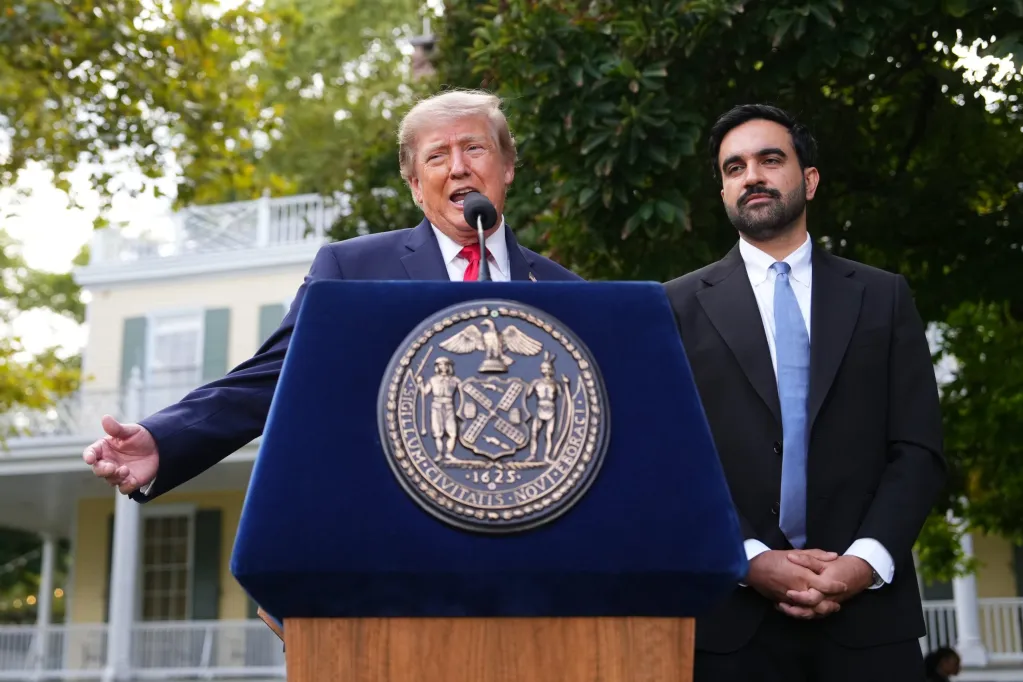
Sunnyside Yard burst into the headlines in February when Mayor Zohran Mamdani went to Washington to meet President Donald Trump, armed with a mock Daily News front page that read “Trump to City: Let’s Build” and a pitch that the two of them could erect an enormous housing project over the Queens railyard.
Trump, the city’s most famous former real estate developer, took an unexpected shine to the mayor — and apparently to the idea. The proposal took center stage when the two met again in September at Gracie Mansion, after which Mamdani said Trump had “agreed to set up a new level of conversation” about the proposal.
Mamdani is asking the federal government to provide the city with $21 billion to build a deck over the yard that will lay the foundation for 12,000 new affordable units. That comes to $1.75 million per unit — before any affordable housing is actually built.
It costs about $700,000 to build an affordable housing apartment in New York, according to the Mamdani administration. So even if the development over Sunnyside Yard was done on the cheap, the price tag would well exceed $2 million per unit, including the deck the feds would hypothetically pay for.
That $21 billion alone is an extraordinary request. By comparison, the federal government sends $7.2 billion to the city annually for housing, including $5.3 billion for housing vouchers and other aid and $833 million in assistance for developments, according to the Furman Center’s 2024 State of New York City’s Housing and Neighborhoods.
The total 2026 budget for the federal Department of Housing and Urban Development is $77 billion, and Mamdani’s $21 billion request is more than what Washington spends nationally on community development block grants and public housing combined.
The extreme cost is only one of several reasons why the Sunnyside Yard plan appears to be about politics, not housing — using the plan as a ploy to intrigue Trump and keeping him from demonizing the mayor ahead of the crucial midterm elections.
But the distraction comes at a cost.
Queens Borough President Donovan Richards questions the entire premise of the project. “Given the housing crisis, we have got to focus on things that are in front of us,” Richards told The City Reporter. “And I could name at least 15 projects in Queens alone that would do that.”
“By the time a shovel is in the ground at Sunnyside Yards, Mamdani won’t even be mayor,” Richards said.
The borough president said a better use of federal money and the city’s efforts would be to redevelop Flushing Airport, which closed in 1984. The Eric Adams administration once proposed building 3,000 apartments there; the site needs substantial infrastructure work to make it viable for housing.
Undeveloped areas at Willets Point and land near the Resorts World project at Aqueduct, which has excellent access to the A train, are also high on Richards’ list.
The City Reporter also spoke to real estate executives who have been involved in other projects involving platforms, as well as longtime experts in the city’s land use process. The real estate executives declined to be identified since they all do business with the administration and fear antagonizing officials, but many characterized the administration’s focus on Sunnyside Yard as “ridiculous.”
The Mamdani administration did not provide a response to a request for comment on the cost estimate and other hurdles Sunnyside Yard would face.
“The biggest risk of pursuing Sunnyside Yards isn’t that it might not happen — it’s what else might not happen,” said Howard Slatkin, another longtime city planning official who is now executive director of the Citizens Housing and Planning Council.
“When government chooses to subsidize a very expensive affordable housing development, it leaves less funding for other projects, meaning less affordable housing gets built overall,” he told The City Reporter.
Back to the Future
Mayor Mamdani is not the first to look longingly at Sunnyside Yard.
Eric Kober, a longtime city planning official and now a fellow at the Manhattan Institute, recalls that the state Urban Development Corporation issued a report on developing it in the 1970s.
In 2014, Dan Doctoroff, who had been Mayor Michael Bloomberg’s first deputy mayor for economic development from 2002 to 2007, proposed moving the Javits Convention Center to Sunnyside Yard, financing the platform with the hefty sums developers would pay to build housing on the convention center’s West Side site.

A year later, Mayor Bill de Blasio unveiled his own Sunnyside Yard plan, calling for building about 11,500 affordable housing units at a cost of about $14 billion. That idea was soon forgotten, until last year when the Mamdani team suddenly sprang it on Trump, with what real estate insiders believe uses the de Blasio plan with some updated numbers.
“Sunnyside Yards has always been the place of the future for the last 50 or 60 years,” said Kober.
His back-of-the-envelope calculations estimate that an economically available project would need to involve 70- to 80-story towers of condos or market rate apartments.
Some real estate executives remember a briefing on the de Blasio plan that outlined so many construction difficulties that they came away convinced such an undertaking was simply not feasible.
Less ambitious projects have also gone nowhere.
More than 20 years ago, developer Bruce Ratner and the Bloomberg administration pursued an Atlantic Yards project to combine the arena now called the Barclays Center with housing built on a platform over a Long Island Railroad repair and storage facility.
The platform has yet to be built.
Real estate executives say the LIRR kept imposing conditions and expenses that were simply not possible to meet, in addition to how the platform made the apartments too expensive. A spokesperson for the MTA said the claims were not true.
The one railyard success is at Hudson Yards, where Related Companies was able to construct half of the platform needed for that project, largely because of a tax break and the high value of the office, retail and residential buildings built there. Yet even there, a companion platform needed over the western tracks languishes as Related Companies insists it needs substantial city money for it. Mayor Adams agreed to finance it with $2 billion in taxpayer funds, a deal that Mamdani is under pressure to scuttle.
“Sunnyside has a lot more tracks than there were on the West Side where the Hudson Yards platform is — which you have to build over while maintaining traffic,” said Robert Paaswell, a distinguished professor of civil engineering at the City College of New York.
He adds that any effort would require someone to “knock heads together” to avoid infighting among Amtrak, the LIRR, the city and a private developer who would presumably be responsible for building the platform.
It does not appear that Mamdani has enlisted other members of his administration to tout the Sunnyside Yard plan. The new head of the city’s Economic Development Corp., Anthony Shorris, was surprisingly noncommittal when asked about it at a recent meeting of the Association for a Better New York business group.
“It’s an unbelievably expensive site,” Shorris said. “If there weren’t very dramatic federal support, I don’t think that’s a particularly viable site. With massive amounts of federal support? Certainly worth the conversation for 12,000 units or more.”
There is a way to build some housing at Sunnyside Yard, says the former planning official Kober, if the city concentrated on a significantly smaller portion of it. It would be close to the Court Square subway stop and involve coordination primarily with the MTA.
“Building at Sunnyside Yards should not be dismissed as pie in the sky,” he said, “but it’s not a plan based on what de Blasio proposed.”
Our nonprofit newsroom relies on donations from readers to sustain our local reporting and keep it free for all New Yorkers. Donate to THE CITY today.
The post The High Cost of Mamdani’s Sunnyside Yard Gambit With Trump appeared first on The City Reporter.