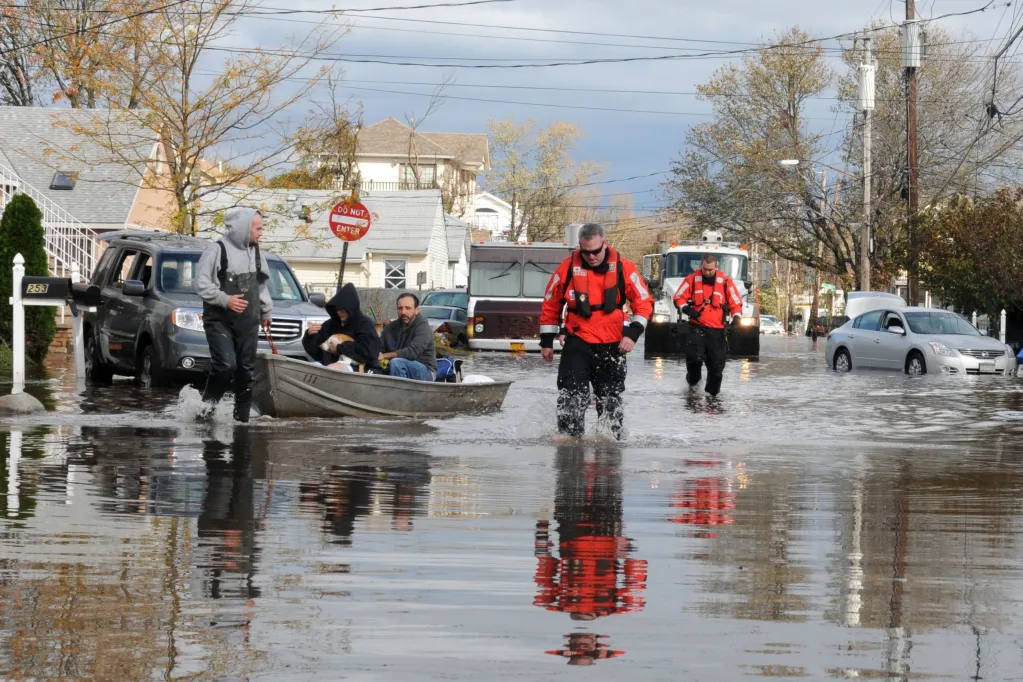
Will New York be on its own when disaster strikes?
That may be the future after the next Superstorm Sandy or Hurricane Ida, according to recent remarks from the leader of the Federal Emergency Management Agency, Administrator Cameron Hamilton.
At an annual meeting for state emergency managers on Tuesday, Hamilton indicated FEMA would shift financial responsibility for disaster preparation and recovery to states and localities in the next six months, as Politico first reported.
“Federal dollars should be building greater capability, not creating greater dependency,” he said in his remarks.
Despite his comments, the Trump administration has not officially announced any changes. Still, experts say such a shift could leave New York reeling after major storms that cause protracted damage and typically need major federal dollars to help.
“It would be devastating for New York State — and, frankly, any state — and underscores the need for investing in pre-disaster resilience infrastructure to ensure that communities don’t suffer in the first place,” said Amy Chester, director of the nonprofit resiliency organization Rebuild by Design. “The dollars that flow after climate disasters are absolutely critical for not only building back what was there, but helping communities withstand future events.”
Post-disaster funding to New York has been significant over the years.
New York State received over $16.5 billion from FEMA in the past 15 years, including in response to Hurricane Irene in 2011, Superstorm Sandy in 2012, the COVID-19 pandemic, Hurricane Ida in 2021 and Tropical Storm Lee in 2023, according to figures from the state comptroller’s office.
A spokesperson for Gov. Kathy Hochul said she’d fight against policy changes and funding cuts that would put New Yorkers at risk.
“Any attempt by the Trump administration to cut financial assistance to communities stricken by disaster is an abdication of their responsibilities and is indefensible,” said spokesperson Jess D’Amelia.
Jeremy Edwards, a spokesperson for Mayor Zohran Mamdani, also condemned FEMA’s new position.
“As we approach the 14th anniversary of Hurricane Sandy, which took 44 New Yorkers’ lives and caused billions of dollars in damage, it is unconscionable that the federal government would cut disaster aid without a clear plan or timeline — leaving cities and states without the resources or certainty they need to prepare,” Edwards said in a statement. “Coupled with reckless cuts to emergency preparedness and mitigation funding, this decision endangers New Yorkers.”
Part of a Pattern
In a statement, Charles Wollenhaupt, the associate administrator in FEMA’s office of external affairs, emphasized the frontline role of state and local officials after disasters.
“Federal assistance is meant to support state and local response, not to replace it, and cannot make individuals or communities whole after a disaster,” he said. “While FEMA supplements local efforts where needed through federal support, FEMA’s primary focus is on empowering communities to lead and execute disaster response and recovery.”
Kenny Stancil, a deputy research director at watchdog group Revolving Door Project, said states can’t make up for federal dollars by themselves.
“New York is one of the biggest and most well-resourced states. Even that doesn’t mean that it’s equipped to handle disasters on its own,” Stancil said. “It doesn’t make sense, just in terms of efficiency and economies of scale, for every state to try to reproduce what FEMA does. That’s why FEMA exists. It’s nonsensical to imagine that states could do this all by themselves.”
Stancil pointed out that FEMA’s indication it would back away from supporting states and localities was only the latest move in a pattern.
“The federal government’s abandonment of communities reeling from extreme weather is already a reality. That includes New York,” he said.
The Trump administration in July denied the state’s request for a major disaster declaration following the severe winter storms in February, and then subsequently denied the state’s appeals. The Trump administration’s cancellation of $400 million of grants in New York State that were to pay for flood protection projects further diminished the state’s resiliency.
Facing down a future of more intense and frequent rain and coastal storms, New York City has a ways to go to improve extreme weather preparation, and the road gets longer if federal assistance becomes less reliable.
The local Department of Environmental Protection in 2024 estimated it would cost $30 billion over three decades to significantly improve resiliency in areas of the city most vulnerable to flooding from heavy rains. Another estimate, by Rebuild by Design, found New York City’s cost to adapt holistically to the effects of climate change through 2050 came to $387 billion.
Rep. Grace Meng of Queens, which deals with frequent flooding, in a statement said she’d fight any plan for FEMA to abandon states after disasters.
“The Northeast has never weathered a superstorm alone. Irene, Sandy, Ida: Each time, federal disaster assistance pulled communities out of the wreckage and helped us rebuild,” she said. “One of my very first votes in Congress was for Superstorm Sandy relief, because not even New York can absorb that kind of devastation alone. No city or state was ever intended to.”
Our nonprofit newsroom relies on donations from readers to sustain our local reporting and keep it free for all New Yorkers. Donate to THE CITY today.
The post FEMA Soon Won’t Help States With Disaster Relief. For NY, That Means a Loss of Billions. appeared first on The City Reporter.