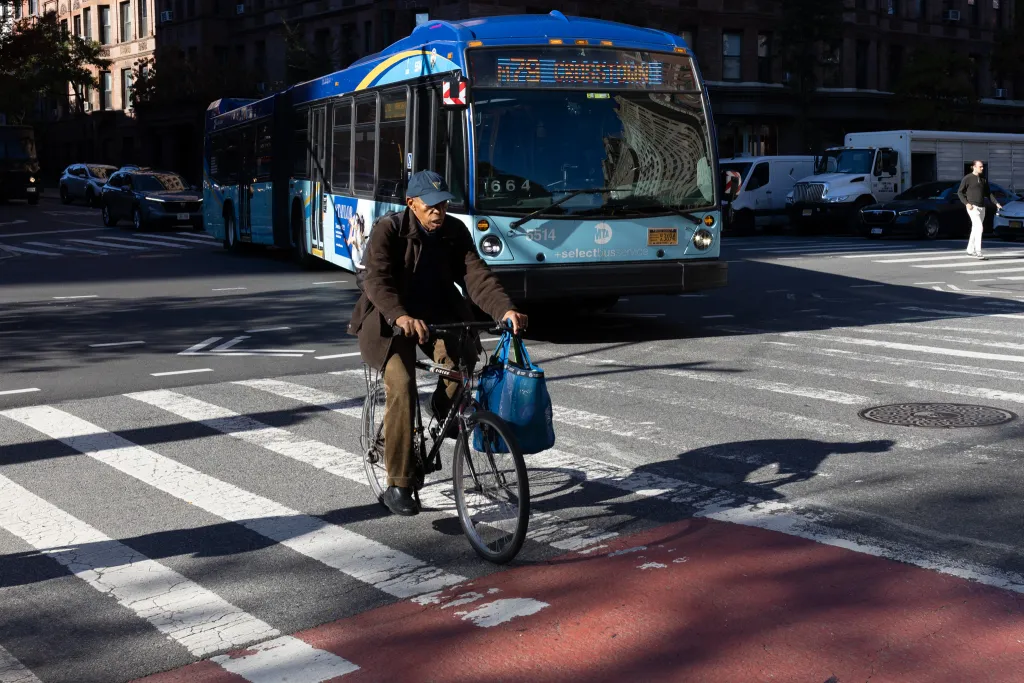
The MTA is looking to significantly boost the number of buses in its fleet that alert drivers about would-be hazards while they’re behind the wheel.
With the number of collisions between buses and bicycles this year down 16% from the same time period in 2025, according to MTA data, the transportation authority plans to add up to 150 buses to the six equipped with collision-avoidance systems that it began testing in 2024.
Sensors outside the buses detect when a person or object is too close, with small panels to the left and right of the bus operator lighting up the outline of a pedestrian in orange or red lights, and occasionally beeping an added warning.
“This is a safety feature that we’ve piloted, it’s effective, our operators like it,” Frank Farrell, head of buses at the MTA, told The City Reporter. “They find it effective, so we want to move forward with putting it on more buses.”

The development is being rolled out as buses contend for space on the road with pedestrians and other forms of transportation.
“You got bicyclists, then you got the skateboarders and the motorcyclists and these battery-powered bikes,” said Donald Yates, a Transport Workers Union Local 100 vice president who represents Manhattan and Bronx bus drivers. “And the bus operator has to avoid all of it.”
To date, the MTA has put the safety devices to the test on just six buses, all from the Michael J. Quill Bus Depot in Manhattan and the Far Rockaway Depot in Queens. The authority last month issued a solicitation for a five-year contract to retrofit between 100 and 150 additional buses out of a fleet of close to 6,000 by sometime next year. Future bus orders could also come equipped with collision-detection systems.
The contract solicitation carries an estimated range of $1 million to $5 million and was issued after what MTA records describe as the “successful outcome” of a trial run that bus operators signed off on after Yates said they initially noted the sensors “didn’t pick up everything” during early testing phases.
“It’s really an obstacle course out here,” Yates said, adding that bus operators face a “shortening of the real estate we have to operate with” from the other forms of transportation on the road.
According to the MTA, buses and bicycles have collided 61 times so far in 2026, 26 fewer than during the same period in 2025, while there have been 84 physical contacts with pedestrians, one fewer than last year.
Since 2019, transit agency numbers show 275 instances of buses coming into contact with increasingly popular forms of micromobility.
The number of bus and micromobility vehicle collisions peaked at 65 in 2023, MTA numbers reveal, including 47 with e-scooters and 18 with e-bikes. So far this year, buses have collided 24 times with e-scooters or e-bikes, while there were 39 contacts in all of 2025.
Under Mayor Zohran Mamdani, City Hall has put the installation of bike lanes into high gear and micromobility has boomed, as well. For all of 2019, there were just four collisions involving e-scooters or e-bikes, according to MTA numbers.
“We definitely welcome [a collision-avoidance system] because it has everything to do with safety,” Yates said. “We want to embrace anything that avoids collisions, especially pedestrian collisions.”
The move to expand the use of sensors on buses also drew praise from Transportation Alternatives, which advocates on behalf of cyclists and pedestrians.
“Glad to see them scaling up a proven safety technology,” said Ben Furnas, the group’s executive director.

Buses on which the collision avoidance devices would be installed would also be equipped with an “Intelligent Pedestrian Turn Warning” system that has been in use for more than a decade on approximately 3,000 buses.
The turn-warning system essentially puts a voice on buses, with pedestrians hearing a warning at intersections. But the next-generation setup is designed to be slightly less vocal.
“This is a bit smarter where it only alerts when there is someone in the area,” Farrell said. “If there is nobody or any object or anything out there that could potentially come into contact, the bus will not put out that audible.”
More than 4,000 bus operators are also trained annually on simulators that are designed to mimic the conditions and challenges of New York City streets.
“Any action we can take to provide safer service and safe operation of our buses, we always look for,” Farrell said.
Our nonprofit newsroom relies on donations from readers to sustain our local reporting and keep it free for all New Yorkers. Donate to THE CITY today.
The post Crash-Detecting System Rolling Out on More City Buses Navigating Crowded Streets appeared first on The City Reporter.