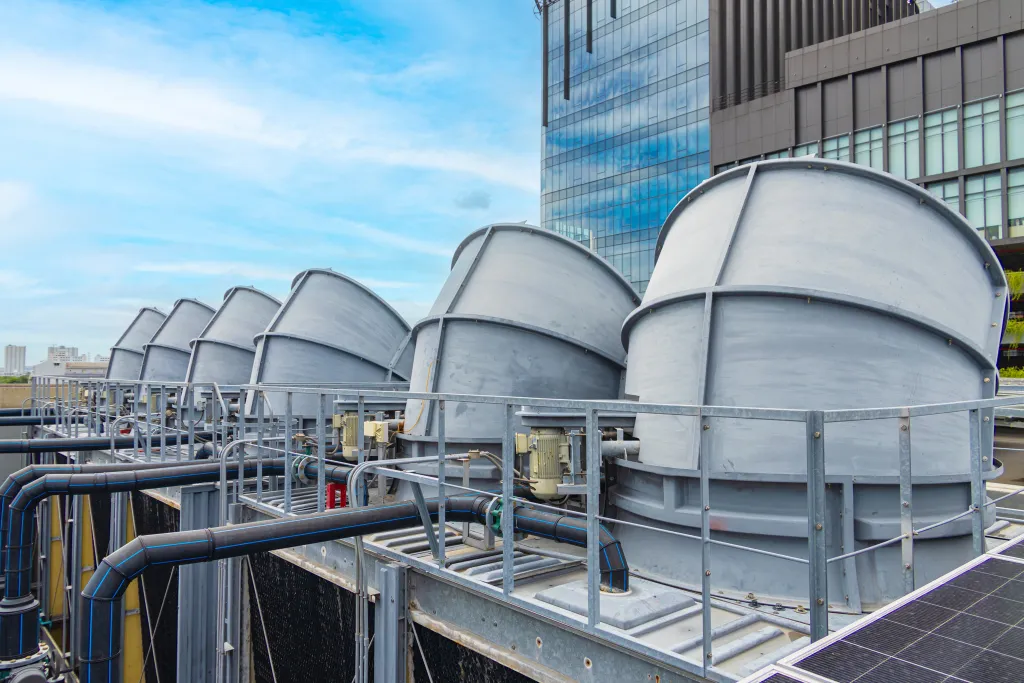
New York City property owners with working cooling towers — the cylinder rooftop structures spiking the city’s skyline — will soon be required to step up their testing for the Legionella bacterium.
It’s the city’s latest effort to prevent outbreaks of Legionnaires’ disease, which killed at least seven people in Harlem last summer.
A spokesman for the New York City Department of Health and Mental Hygiene said Friday the new cooling tower regulations go into effect on May 8 citywide. The rules were published in the City Record, a database of records and notices that includes public hearings and agendas, on Wednesday, and registered tower operators were notified. Property owners will also face higher fines for noncompliance.
The final rules were shared with all elected officials and community boards citywide Thursday.
The new regulations come after the City Council in October approved legislation to ramp up requirements for testing building cooling towers for Legionella microbes. In the past, cooling tower operators were required to conduct Legionella sampling every 90 days.
Building owners will now need to test for the presence of Legionella at least every month when the cooling towers are in use, which is generally during warmer weather months. The bill further requires that all such testing be performed by, or under the supervision of, a “qualified” professional.
Legionnaires’ disease is a severe form of pneumonia caused by the Legionella bacterium. It spreads through airborne water droplets, not by drinking water or through person-to-person spread. Many of the outbreaks in New York City are caused by water vapor spewing from rooftop cooling towers.
Central Harlem was the center of a Legionnaires’ outbreak last summer in which health officials say at least seven people died and more than 100 were sickened, many of them hospitalized. The outbreak was linked to contaminated cooling towers at several locations, including Harlem Hospital, which also had an outbreak in 2021. In that case, health officials determined the facility had not properly managed one of its cooling towers in accordance with local law.
Last month, Gothamist reported that Harlem Hospital ignored its own cooling tower maintenance plan in the weeks before last year’s outbreak when it failed to conduct rapid, weekly tests for Legionella.
In a separate Harlem case, two residents in one of the city’s largest residential complexes were diagnosed with Legionnaires’ disease, prompting local health officials in January to open an investigation.
Residents were advised to take baths or sponge baths instead of showers so that they wouldn’t breath in contaminated mist.
Harlem is particularly vulnerable to Legionnaires’ outbreaks, because of its high density of tall buildings with cooling towers, and the concentration of chronic disease — a risk factor for Legionnaires’ — in Upper Manhattan and the Bronx. The health department has also cited historic disinvestment and structural racism as factors.
Legionnaires’ disease tends to emerge more frequently in neighborhoods with older populations and higher rates of poverty, according to health officials. From 2019 to 2022, the city’s highest annual Legionnaires’ disease rates were concentrated in parts of Harlem and the Bronx. Among residents with Legionnaires’ disease in that period, more than 90% had at least one chronic medical condition, and more than 50% were previous or current smokers.
In what seemed like an odd anomaly to Harlem residents, city health inspectors in February found two tenants with Legionnaires’ disease in an apartment building on the Upper East Side.
“I started to believe that Legionella only knew Black and brown neighborhoods,” Marquis Harrison, chair of Manhattan’s Community Board 10 in Harlem, said March 31 on a panel with city health officials hosted by the CUNY Graduate School of Public Health & Health Policy. “We only saw it in the South Bronx and in Harlem, and only communities of color. We were having these outbreaks. … Maybe it doesn’t just exist in our neighborhoods.”
More Inspectors Needed?
The city held public hearings after last summer’s outbreak.
Health officials testified last September that they needed more inspectors to strengthen oversight and enforcement and hiring has begun. Speaking about the preliminary budget before the City Council’s Health Committee on March 20, health officials said that when fully staffed, the department will have about 56 scientists and water ecologists to oversee work related to the inspections. The city has some 6,000 cooling towers.
“The additional staffing that we got will enable us to conduct the annual inspection and any follow-up that’s needed of every cooling tower in the city, which, as you know, has been our goal,” said Corinne Schiff, deputy commissioner of the environmental health division in the health department.
The preliminary budget plan notes that the health department is devoting more money toward community outreach, cooling tower inspections, disease surveillance and laboratory testing. In the budget hearing, chief financial officer and deputy commissioner Aaron Anderson said $9 million will go toward surveillance and testing in the fiscal year 2027, along with 50 employees. Another $2.5 million will be devoted to the cooling tower inspections and 28 employees, and community outreach efforts will receive $1.1 million and 15 employees.
The outbreak has prompted lawsuits against the city and the construction firms involved in maintaining the cooling towers, with the backing of civil rights lawyer Ben Crump and the Rev. Al Sharpton. In his lawsuit, Crump alleged that the city failed to learn that water towers were unregistered or went uninspected. He also argued that the official death toll was an undercount.
The seven people who died last summer have not been publicly identified.
Harrison said their names may have been lost in the confusion surrounding the summer outbreak.
“It’s very sad for us, because the community couldn’t send their condolences or even celebrate their lives,” Harrison told Healthbeat on Friday, adding that he would renew his request to learn more about the people who died.
At the March budget hearing, City Council Health Committee ChairLynn Schulman asked Schiff if the health department required further help.
“Do you need additional resources to prevent future outbreaks?”
“The program is to promote compliance with the rigorous requirements that New York City has, and as we discussed in the fall, that is designed as a prevention measure,” Schiff said. “We can’t commit that nothing bad will ever happen again.”
Our nonprofit newsroom relies on donations from readers to sustain our local reporting and keep it free for all New Yorkers. Donate to THE CITY today.
The post New Cooling Tower Testing Rules Aim to Quell Legionnaires’ Disease Outbreaks appeared first on THE CITY – NYC News.