There is a moment in the evolution of art when representation loosens its grip and something far more exhilarating takes hold—a kind of cerebral tailspin in which creation emerges through reconfiguration, through a willingness to let form slip just enough to reveal its inner logic. Abstraction did not arrive politely. It unfolded through a series of radical recalibrations, each artist pushing further beyond the visible and toward the conceptual. Marcel Duchamp stands among its most formidable minds, a true heavyweight not of image, but of idea.
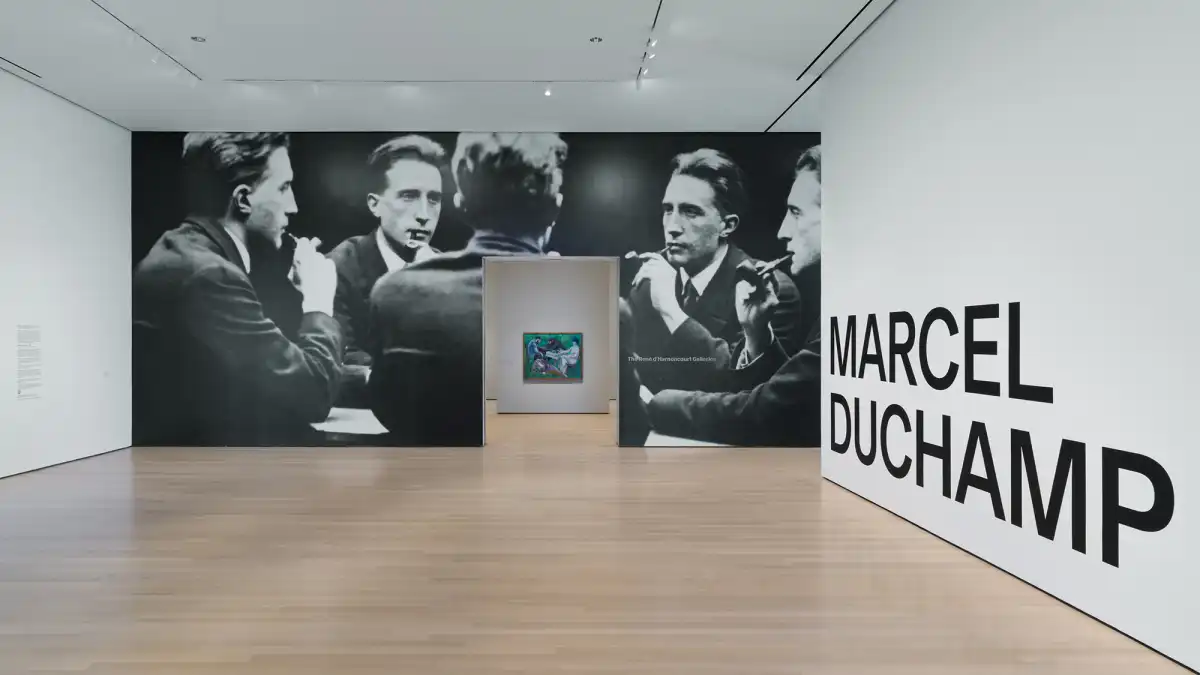
The morning began before the doors opened at Museum of Modern Art, in that rare, almost sacred stillness where the work can be encountered without interruption. There is something quietly generous about seeing Duchamp this way. His practice does not compete for attention; it asks for presence, for patience, for a willingness to sit with complexity and allow it to unfold at its own pace.
What struck me first, and most unexpectedly, were the paintings. Duchamp has been so thoroughly reduced in popular imagination to the readymades, to the urinals and provocations that have come to define him in shorthand, that one almost forgets the depth of his painterly command. Positioned as the conceptual counterpoint to Pablo Picasso and often sidelined by those still devoted to the lingering seductions of Impressionism, his early works feel, in this context, like a quiet revelation.
They are, quite simply, beautiful.
Lush, confident, and deeply considered, they reveal an artist entirely in command of his hand before choosing, quite deliberately, to move beyond it. The nudes carry an exquisite sensitivity to both form and environment, with figures held in spaces that feel alive with color and pattern. There are moments that gently echo Henri Matisse in their compositional ease, others that recall Paul Gauguin in their tonal warmth and flattened decorative backdrops, where wallpapers in rose and green seem to hum softly behind the figures. The portraits move with a different kind of gravity, more interior, more searching. In the portrait of his father, one encounters not simply likeness, but a deeply felt emotional register—a look of quiet worry, of wandering thought, something almost tender in its restraint.
This is an artist who understood how to paint, which makes what follows feel less like rejection and more like evolution.
In 1911, Duchamp articulates a shift that alters everything. He speaks of wanting to move away from the physical act of painting and toward the recreation of ideas within it, and that pivot begins to surface almost immediately. The palette softens into something more muted, more restrained. Forms begin to fracture, influenced by Cubism though never confined by it, and figures dissolve into planes and sequences that suggest movement rather than stillness. The canvas becomes a site of thinking, a place where perception is gently unsettled and reassembled.
Portrait of Chess Players stands at the center of this transformation, its figures bending into angular tensions that feel quietly charged with cognition. Chess operates not merely as subject, but as structure—a language of anticipation and logic, where each move unfolds in relation to what has yet to occur. That same sensibility permeates the work, creating compositions that feel less like captured moments and more like fields of thought in motion.

By 1913, the introduction of the readymades marks a decisive and rather extraordinary expansion. The artist no longer needs to make; the artist chooses, and that shift from craft to intention carries a profound elegance. Taste, in this framework, becomes the enemy, not as pleasure, but as limitation—an inherited system of judgment that narrows possibility. Duchamp gently, though firmly, dismantles it, offering instead a model in which meaning is fluid, contingent, and open to reconsideration.
There is a striking alignment here with chess, where everything hinges on choice, on foresight, on the understanding that each move reverberates beyond itself. Duchamp approaches art in much the same way, each gesture deliberate, each decision part of a larger conceptual structure that continues to unfold.
What emerges across the exhibition is not a rejection of painting, but a redefinition of its purpose. Color gives way to structure, form to thought, and the image itself becomes less fixed, more expansive. Duchamp does not abandon tradition; he reorients it, allowing space for a more rigorous and intellectually charged understanding of what art can be.

Standing within this exhibition, there is a quiet realization that settles in slowly, though unmistakably. Duchamp was never the enemy of painting. He was its liberator.
That may be the thesis that lingers most.
He did not strip art of beauty; he freed it from obligation. He did not diminish the hand; he elevated the mind. In doing so, he expanded the field of possibility so completely that we are still, in many ways, learning how to see within the space he opened.
On view now until August 22nd– 6th floor.
