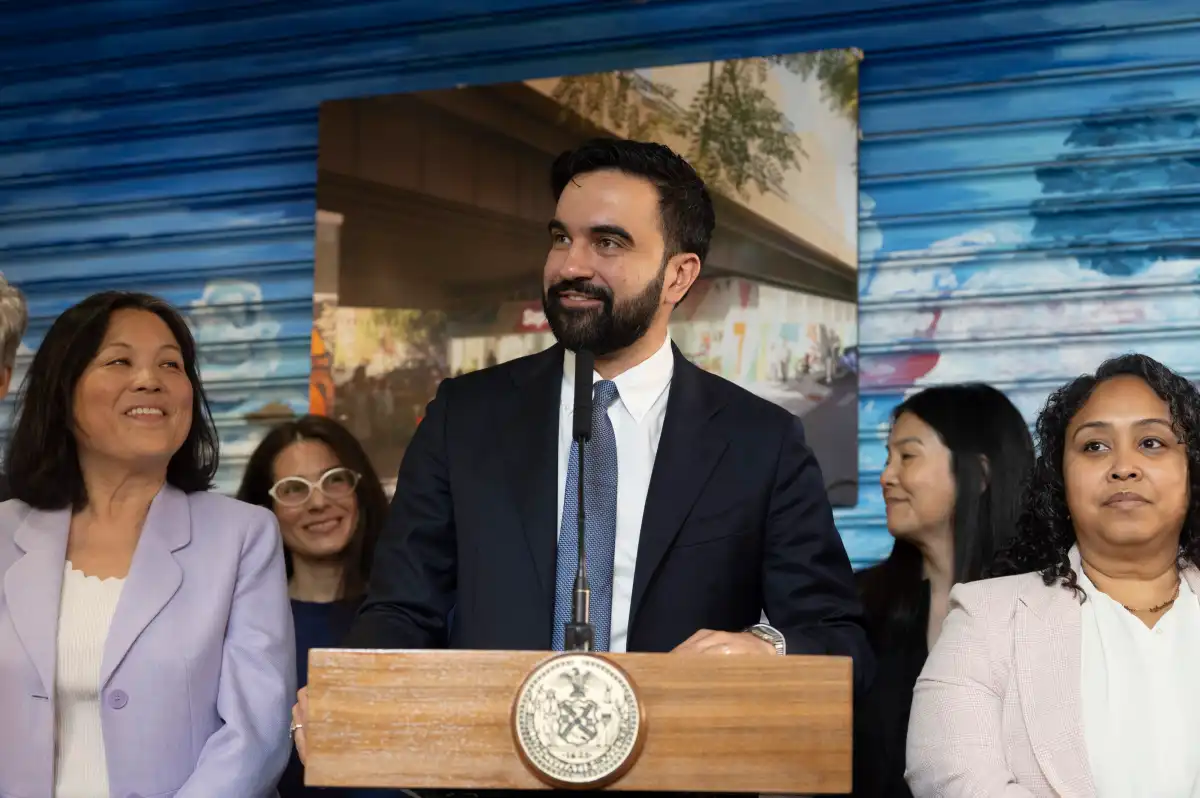
Mayor Zohran Mamdani said during a press conference on Tuesday that New York City’s planned city-run grocery stores would not be traditional municipally staffed supermarkets. Instead, the city would own the land, cover major overhead costs and bring in a private operator to sell staple foods at discounted prices, starting with a Manhattan site near La Marqueta in East Harlem.
The press conference answered some basic questions about the plan, but left others open-ended — from pricing and labor standards to neighborhood impact and cost.
The April 14 event was the first press conference devoted entirely to the grocery-store plan since City Hall announced on Sunday that La Marqueta would be the first site identified in the five-borough program. Mamdani used Tuesday’s appearance to move past the announcement itself and describe the model’s structure.
“The city will subsidize a core set of staples,” he said. “A private operator will run the store, but they answer to the standards that the city will set.” Those standards, he said, would mean lower prices on basics like bread and eggs.
Hurry up and wait for East Harlem city-run supermarket
The administration says the Manhattan store will be 9,000 square feet and open by 2029. But despite the La Marqueta branding, the store is not planned for the existing public market hall itself. Mamdani said it would be built from the ground up on a vacant city-owned lot one or two blocks away.
He said that the site is being announced first, even though the first city-owned grocery store overall is expected to open in late 2027. All five city-run stores are due to open by 2029 and no other sites have been announced.
Mamdani said the East Harlem site has the longest timeline because it has to be designed and built from scratch, constructed with prevailing wages and coordinated across multiple agencies and levels of government. Some of the later stores, he said, will open sooner because they will use preexisting spaces rather than requiring new construction. That makes La Marqueta the symbolic flagship of the program, but not the first operational test of whether the model actually works.
City Hall’s case for East Harlem is both practical and political. Mamdani said 65,000 New Yorkers live within a 10-minute walk of the proposed site, with 5,000 NYCHA residents on either side of Park Avenue.
He and Deputy Mayor Julie Su both cited the share of East Harlem residents receiving SNAP or public assistance, arguing that the neighborhood reflects the kind of affordability crisis the administration says it is trying to address. Su described the proposal as a response to “a policy failure,” saying the city would use public land “to make food cheaper.”
Other speakers filled in the local context.
Manhattan Borough President Brad Hoylman-Sigal argued that the neighborhood’s problem is not just affordability, but uneven access to high-quality food, linking that to elevated rates of diabetes and heart disease in East Harlem. Carey King, director of Uptown Grand Central, pointed to the closure of the old Pathmark on 125th Street and said the neighborhood has relied for years on a farm stand model now threatened by federal cuts.
Council Member Elsie Encarnacion described La Marqueta as a long-standing neighborhood institution and framed the project as part of a broader fight against food insecurity rooted in dignity, culture and access. Mamdani also noted that La Marqueta served 25,000 customers a day at its peak. In a press release, the administration said the current site supports more than 20 small businesses and 120 workers.
The impact on other local businesses
At the same time, the press conference itself underscored that East Harlem is not devoid of grocery retail. Reporters pressed Mamdani on why the city was moving ahead with a publicly backed store in an area that already has a supermarket and several smaller groceries nearby.
Mamdani responded that the city-run store is only one part of the administration’s broader response to food insecurity, and argued that earlier approaches based on subsidies and tax breaks had failed to guarantee lower prices for consumers. He singled out the city’s Fresh program, saying it had not delivered the affordability New Yorkers were promised.
That argument — that City Hall is offering a guarantee where previous programs offered only hope — is at the heart of the plan. In the official announcement, the administration said the city would own the land and cover overhead costs like rent and construction, while a private operator selected through a request for proposals would be “contractually required” to pass savings directly to customers on a core basket of everyday staples. Su said the procurement process would begin this summer.
Jeanny Pak, the interim president of the New York City Economic Development Corporation, said the city intends to offer a fixed discount on fresh and everyday groceries so shoppers can rely on predictable prices from week to week across all five stores.
But City Hall still has not publicly explained how that discount will be set. Asked for a simple example of how much cheaper a basic item might be, Mamdani declined to offer one. Pak said the discount would be a certain percentage off an average price, but added that the administration had “not determined exactly how it’s going to be calculated.” For a proposal built around lower prices, that remains a major missing piece.
Another unresolved issue is labor. Su said workers at the stores would have “union-level standards,” and Mamdani repeatedly used the phrase “union standards.” But when reporters asked directly whether he was committing to make the jobs union jobs, he stopped short.
Instead, he said those standards referred to the pay levels the city would budget toward, and explicitly did not promise that the stores themselves would be unionized, saying that going further would preempt contract negotiations with private vendors.

Mamdani’s grocery proposal also lands at a tense political moment at City Hall, and as the city seeks to plug a $5.4 billion inherited budget deficit. The $70 million in capital funding the mayor wants for the five stores would require City Council approval, and the speaker has not embraced the plan. A spokesperson for Council Speaker Julie Menin said only that “Speaker Menin looks forward to reviewing details on the mayor’s proposal.”
The funding request also comes as Menin and Mamdani navigate a visibly strained but still active working relationship. “Since taking on our respective roles, the mayor and I have met or spoken at least every week, if not more often, to discuss the issues facing New Yorkers,” Menin said in a statement on Tuesday focusing on their partnership. “We both love our city, and we share a deep commitment to tackling the affordability and fiscal challenges ahead. We won’t agree on every issue, and that’s part of the nature of city government, but we remain focused on working together and delivering for New Yorkers.”
That statement followed POLITICO reporting Tuesday on what it described as an “increasingly contentious feud” between the two over budget proposals, appointments and public messaging. The outlet also reported that an internal union email indicated Menin had asked the United Federation of Teachers (UFT) to send about 20 people to protest outside Mamdani’s 100-day speech Sunday in Queens. Menin’s office denied that account. The UFT also denied that any such conversation took place and said the union representative who sent the email was misinformed and had likely confused the Sunday protest with a larger rally planned for later.
Meanwhile, Andrew Rein, president of the Citizens Budget Commission, offered a cautious response to the grocery proposal.
“It’s good that the administration plans to use a private operator,” Rein said. “Still, New York City has a challenging budget landscape. Moving this forward should depend on an analysis that shows it is the most cost-effective way to promote food security.”
For local businesses near the proposed East Harlem site, the possible cost of the venture is more immediate. Khalil Howard, a store worker at American Deli Mini Market, told amNewYork that his store already sells staples like bread and coffee and that he worries it will be forced to compete with a publicly backed rival. “I don’t think it’s fair if you have a city-owned grocery store for competition,” Howard said.
He said the store employs just under 10 people at that location, pays more than $8,000 a month in rent and would rather see the city lower taxes, fees and licensing burdens on existing small businesses than open its own subsidized competitor.

Howard said he had not heard from the city before the announcement and argued that City Hall should help neighborhood businesses lower their own costs if it wants groceries to be more affordable. “We have everything that they need,” he said. “So why would they need that type of business?”
Mamdani did not offer a detailed answer when asked whether the city had studied the economic impact on nearby businesses. He said only that he was confident the stores would be “a critical part of not just the business ecosystem, but also the civic ecosystem across the city.” He also argued that city-run grocery stores would differ from bodegas, which often rely on tobacco and lottery sales, because the city stores would focus on food and produce.
Outside advocates for municipal grocery models say the broad outline of Mamdani’s approach makes sense.
Taylor Jo Isenberg of the Economic Security Project said the public-private structure could allow the city to tap grocery expertise it does not have in-house and move faster than if it tried to build operating capacity itself. But she also said New York’s next crucial step will be choosing a private vendor aligned with the program’s vision.
And she said the administration’s unanswered pricing questions are not trivial ones: grocery pricing is “extraordinarily complex,” she said, and what counts as a staple can vary by neighborhood and community.
A feasibility study tied to municipal grocery work in Chicago reached a similar conclusion about structure. The report found a municipal grocery model could be “necessary, feasible, and implementable,” but said a city’s best role may not be as a direct store operator.
Instead, it said cities can provide space, resources and support while a private operator handles day-to-day operations. The study also warned that single stores tend to face high upfront costs and thin operating margins, and that smaller formats may need 3% to 5% operating profit to be sustainable — making operator quality, site selection and public support critical to success.
Isenberg pointed to a handful of other places experimenting with public grocery models, including Atlanta and Kansas, and said cities have taken different approaches depending on local conditions. Some have opted for direct municipal ownership, she said, while others have leaned on private vendors or market-style models.
A recent Chicago Tribune report suggests how hard it can be to move a public grocery concept from proposal to reality. Chicago Mayor Brandon Johnson first floated a publicly owned grocery store in 2023, but the city later pivoted to a year-round public market instead. As of February, the Tribune reported, Chicago still had not publicly settled key details including location, funding and operating model.
