Just a short hour and change away from New York City— lies a jewel that, honestly, people do not speak about nearly enough. Philadelphia has the Liberty Place tower sharpening the skyline, the Rocky Steps rising toward the Philadelphia Museum of Art and enough revolutionary theater to feel faintly mythic. The Barnes Foundation, however, left me gobsmacked. For the art-obsessed, it is nearly ethereal in reach and grandeur—a place for gleeful fangirling over Degas, Cézanne and Matisse, while makers whose identities history lost command equal visual consequence. Fame glitters, naturally, yet cannot monopolize genius.
Rain lacquered the walkway and deepened the green. Lush trees swayed with wet, almost operatic drama, while the reflecting basin created a moat-like sequence between the city and the collection. Water, stone and foliage seemed to lower life’s volume, as though the eye required gentle preparation.
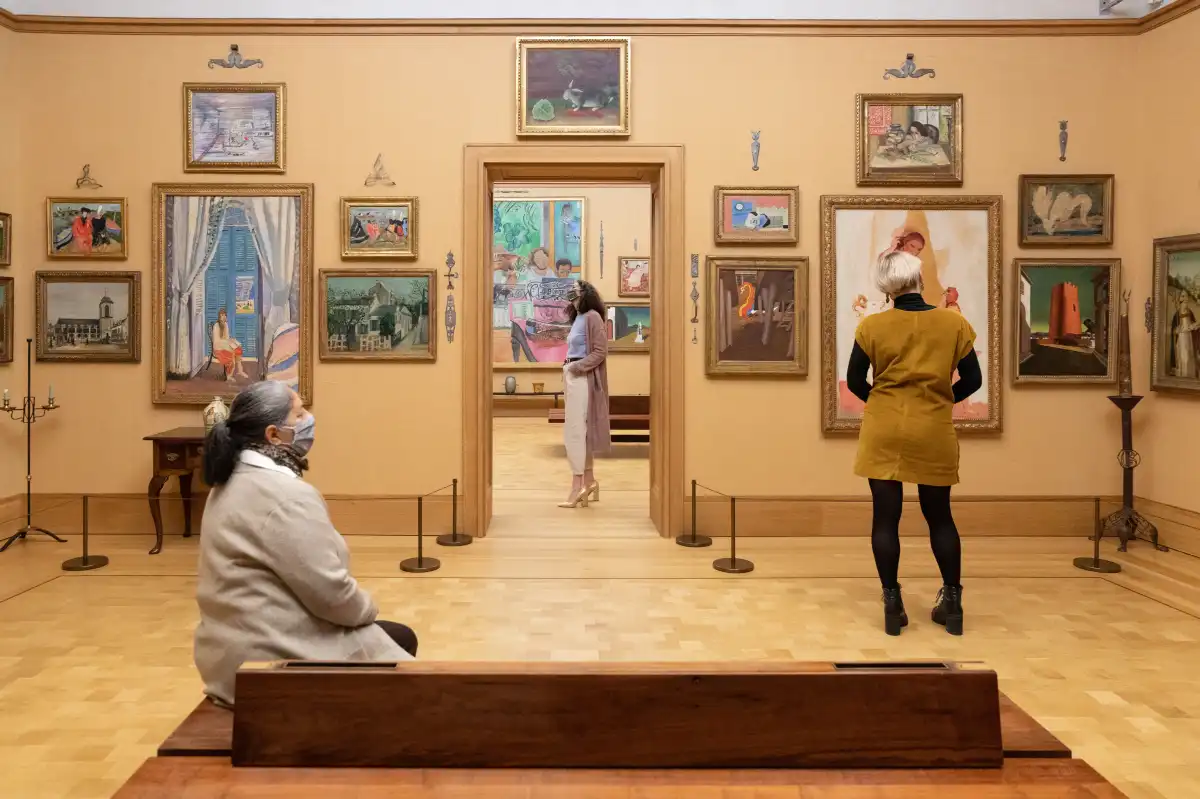
Inside, Degas, Cézanne and Matisse appeared almost immediately. The collection took my breath, then continued without waiting for its return. More followed until abundance became atmospheric and “masterpiece” lost its usefulness. The greater astonishment lay in Albert C. Barnes’s ensembles, arrangements governed by line, color, light and form rather than chronology or prestige. European modernism shares the walls with African sculpture, Asian art, Native American pottery, furniture, antiquities, household objects and wrought iron.

“Salon-style hanging” is accurate, although somewhat too polite. These rooms feel closer to visual polyphony, perhaps even a glamorous argument. A curve in an African figure answers a European body; an Asian composition quietly revises French painting; a hinge echoes a shoulder. Nothing is merely adjacent, since everything appears, somehow, to be listening.
That conversation creates a leveling I have rarely experienced elsewhere. Matisse cannot sit alone upon the throne of Western genius while an unnamed maker waits to be classified as artifact or influence. The anonymous artist is not voiceless; the record failed to retain the name. The Barnes cannot repair that erasure, of course, although it refuses to reproduce the hierarchy behind it.
The effect upon brain and heart is almost physical. A mind trained by institutions and algorithms to identify, rank and move along begins, rather gratefully, to surrender to relation. The eye notices rhythm before reputation and kinship before geography, while the heart recognizes our shared compulsions: to picture the body, house the sacred, make grief visible and leave evidence that we were here.

These histories do not become innocent through proximity. Colonial extraction and the Western appetite for possession remain present. Still, the ensembles gently reveal modernism as a porous story rather than a sealed miracle, with African, Asian, Indigenous and ancient traditions visible within a complicated exchange of admiration, borrowing, desire and appropriation.
That proposition feels urgent in a society increasingly devoted to separation. We are sorted into identities, political camps and algorithmic preferences until complexity can seem almost impolite. The Barnes offers another possibility, however imperfectly: difference may remain distinct without requiring isolation, since no culture invented beauty alone and no meaningful history stayed obediently within its assigned border.
Somewhere among those intimate rooms, while recovering from Cézanne’s structure and Matisse’s color, I turned and found myself in an unannounced rendezvous with Amedeo Modigliani. My fascination began years ago and has never become entirely sensible. His elongated bodies seem stretched by longing, while those almond-shaped eyes make looking feel almost indecent. Rust, ochre, bruised plum and blue-gray burn with an intensity matching his colorful, ruinous life.

The legend offers opium, alcohol, lovers and women of the night with suitably bohemian generosity. Some accounts suggest Toulouse-Lautrec corrupted him, although chronology inconveniently intervenes: Lautrec died before Modigliani reached Paris in 1906. Influence, admittedly, can be posthumous, and bohemia has never let a date spoil a delicious scandal.
Modigliani’s story also contains Jeanne Hébuterne, the gifted young French painter who became his partner, frequent subject and the mother of their daughter. Studying at the Académie Colarossi when they met in 1917, she was already developing a language informed by Fauvism and the Nabis. The canon usually remembers her through his gaze, although her scarce surviving works reveal a direct, experimental and wonderfully unsparing eye. Her circa-1917 Self-Portrait sold for €247,500 at Christie’s Paris in 2018, while Femme au chapeau cloche realized €478,000 there the following year. Market value is hardly destiny, naturally, yet those results reject the notion that her significance began and ended as someone else’s muse.
The ending remains almost unbearable. Modigliani died in January 1920; Hébuterne, only 21 and pregnant with their second child, died by suicide two days later. Their deaths are often varnished into bohemian romance, though that framing feels terribly cruel. A young woman, mother and serious painter disappeared before her language could fully unfold, while art history preserved her face far more carefully than her hand.

By the time I reached the fire pit outside, I needed the reprieve. Visitors gathered near the flame with the stunned civility of people who had survived the same exquisite weather system. The rain had softened, the trees kept swaying and the fire pressed its orange reply into the gray afternoon.
All that energy coursing through small rooms filled with art, memory and their implications had left me spent, saturated and terrifically sanguine. The Barnes had not merely shown me celebrated objects; it had, perhaps rather permanently, rearranged the hierarchy inside my gaze, reminding me that beauty becomes most powerful when it loses its borders and the past, honestly assembled, is never a solo performance.
barnesfoundation.org