The art of photography becomes revolutionary when it shows us more of a person than our prejudices know how to accommodate. Gordon Parks captures Blackness as a living abundance: poised, restless, tender, self-directed. His subjects possess the quiet authority of lives whose meaning remains theirs to determine. Certainly, the pictures are stunning, and their splendor draws us toward an unsettling intimacy: the flattering portrait we have composed of ourselves begins to fracture.
At Jack Shainman Gallery, Voices in the Mirror pairs photographs with reflections from those depicted and from their relatives and collaborators. Among the contributors are Kathleen Cleaver and the families of Muhammad Ali and Malcolm X. Marking the Gordon Parks Foundation’s twentieth anniversary, the exhibition takes its title from his 1990 memoir. The testimony invites us to regard even a celebrated face as someone whose experience extends beyond the public story.
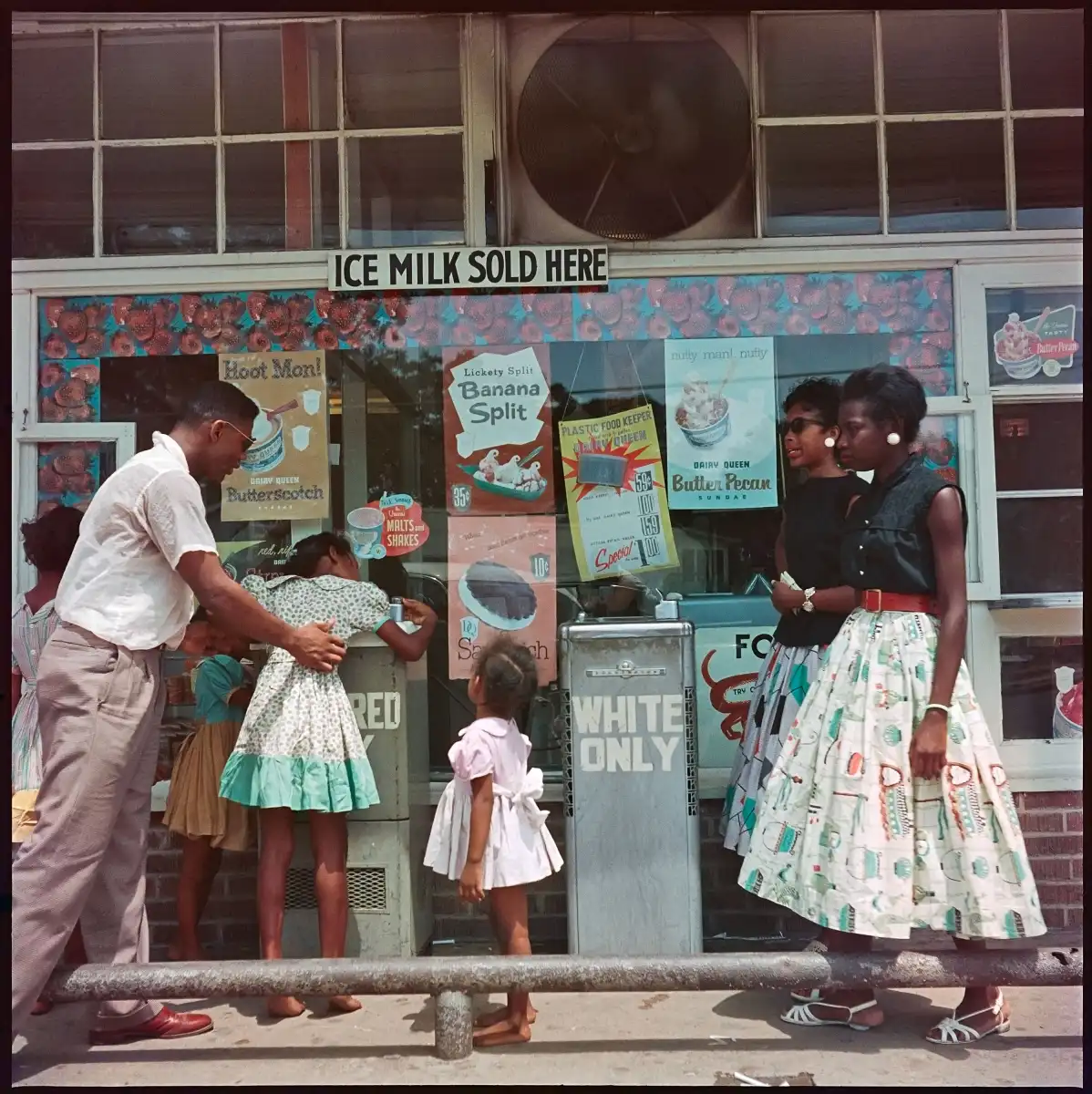
The stakes sharpen in At Segregated Drinking Fountain, Mobile, Alabama (1956), where a girl is helped up to drink at a segregated fountain while two women look on. Cora Taylor, one of the onlookers, recalls not knowing whom to trust and alerting her mother about the photograph in case something went wrong. Her recollection makes recording a moment feel perilous.


When even a photograph could prompt such apprehension, depicting Black existence in its fullness assumes a defiant significance. To my mind, this is the exhibition’s insurgent proposition: a varied, buzzing body of experience, with its joy, contradictions, ambitions, and autonomy, refusing the narrow roles assigned to it. A society bent on racial degradation depends upon reduction. Parks’s expansive vision interrupts that process, giving the viewer no stable caricature through which to evade the individual.
The struggle over representation predates him. In the nineteenth century, Frederick Douglass embraced photographic portraiture, considering it less susceptible to an artist’s racist distortions. At the 1900 Paris Exposition, W. E. B. Du Bois assembled images of African American life that challenged the assertions of racial pseudoscience. These were interventions in the machinery of belief, asserting the right to appear with particularity. The medium could contest a public imagination already prepared to diminish those before the lens.
Parks, born in Fort Scott, Kansas, in 1912, taught himself photography and became Life’s first Black staff photographer in 1948. His practice moved between fashion and social reportage; he understood the camera as a weapon against poverty and racism. That range is crucial to his expressive power. Light concentrates attention, texture invites proximity, and composition gives an ordinary gesture the presence of something worthy of contemplation. We are drawn close enough for our generalizations to begin failing us.
Kathleen Cleaver’s reflection on Eldridge Cleaver and His Wife, Kathleen, Algiers, Algeria (1970) offers another measure of that artistry. Remembering the remote place where they lived, she describes photography’s capacity to isolate the essential. Her recollection directs attention toward selection itself: how framing can give an unassuming setting historical weight. Political identities coexist with the intimacies of a shared life, dimensions that the familiar designation of Black Panther cannot exhaust.
Consider the lace gloves and A-line dresses of the 1950s and ’60s: the restraint, the class, the almost ceremonial pleasure of being dressed. This is the sensuous intelligence of self-presentation, the delight of deciding how to enter the day. Even so, these women’s worth never depended upon refinement. What matters is the right to cultivate an existence with appetites and preferences of one’s own. Such sovereignty resists the humiliating demand to prove oneself respectable.
Black peace, meanwhile, becomes an exacting confrontation with our visual education. How can an ordinary human happiness feel so unfamiliar? Perhaps the unease reveals how fluently we recognize injury, and how rarely our expectations admit ease. Parks allows an inward world to remain active beyond our comprehension. The people within these frames have attachments and aspirations that need never arrange themselves around the observer’s comfort.


Sure, there is longing, pain, and innocence in the quieter faces, with scarcely an ounce of rage. The anger rises on this side of the image. I believe Parks lets that response gather in the viewer, although righteous indignation can coexist with unexamined complicity. Feeling furious at an injustice does not absolve us of the habits through which we continue to misrecognize another person. The harder question is how our reflexes sustain the order we condemn.
By then, the photographs have crawled inside me. What follows feels like a detonation of the self: particles of inherited racism, hatred turned outward or inward, and certainties absorbed from propaganda come spilling onto the floor. The beliefs we mistook for personal judgment reveal their borrowed origins. Alternatively, a viewer estranged from their own reflection may recognize how that alienation was taught. Such recognition can be exhilarating, albeit disorienting; the self must make room for a world its old categories could scarcely contain.
Ava DuVernay locates the accomplishment precisely: “He captured the elegance that is Black life.” With that in mind, Parks’s greatness lies in the relationship he alters between the subject and the spectator. The people he depicts remain irreducible; we are left with the debris of what we thought we knew. Art has made the observer answerable to those they presumed to understand.
Gordon Parks: Voices in the Mirror is on view through November 6, 2026, at Jack Shainman Gallery, 46 Lafayette Street.