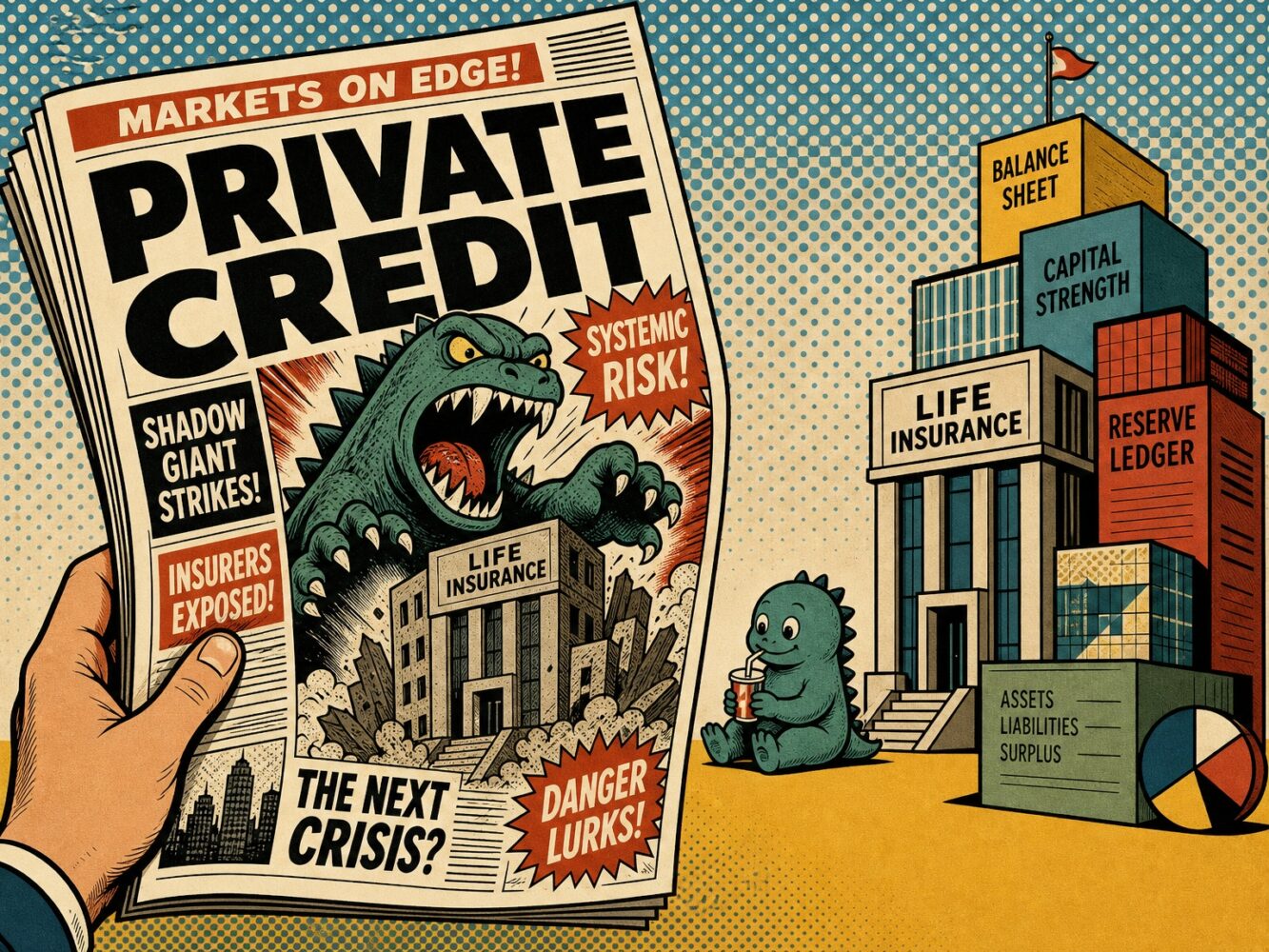
Private credit has become the financial system’s latest designated villain: opaque, fast-growing, and—depending on the headline—one bad quarter away from dragging insurers, banks, and retirees down with it.
For the past two years, warnings about life insurers’ private-credit investments have become a staple of financial commentary. In 2024, the International Monetary Fund cautioned that private credit’s rapid growth and limited transparency could eventually threaten the broader financial system. Researchers at the Federal Reserve Bank of Boston examined whether the sector’s expansion poses stability risks, especially through bank credit lines to private-credit funds. Moody’s has flagged liquidity and concentration risks in insurers’ growing allocations. Axios suggested that annuities could transmit private-credit losses to ordinary households, while a Forbes columnist argued that rising defaults are already testing both banks and insurers.
The concern is not hard to understand. Life insurers hold $9.9 trillion in general-account assets against annuity and life-insurance obligations that may stretch decades into the future. Private loans do not trade on public markets, so insurers value them through models and appraisals rather than observable prices. Many also carry private ratings disclosed to the insurer but not to the market. If those valuations or ratings prove too rosy, insurers may hold less capital than their actual risks require—and the gap may surface only when policyholders expect payment.
That makes private credit a plausible source of risk. It does not make it a proven one. Whether the danger exists in practice is an empirical question, and regulators already collect the data needed to answer it.
In a recent International Center for Law & Economics (ICLE) white paper, Lars Powell and I used National Association of Insurance Commissioners (NAIC) annual-statement data to test whether life insurers with larger private-credit holdings are financially weaker than their peers. They are not.
Private Credit: Define Your Terms
The first problem is definitional: “private credit” has no settled meaning. The term generally covers lending outside public bond markets and traditional bank balance sheets, especially direct loans to midsized companies and structured securities backed by cash flows such as equipment leases or receivables. But insurers’ regulatory filings contain no line item labeled “private credit,” so researchers must decide what counts.
That choice matters. Recent estimates of insurers’ exposure range from $289 billion to $1.8 trillion, while a Federal Reserve Bank of Chicago working paper puts the figure at $849 billion. The highest estimates rely on definitions broad enough to include privately placed bonds that differ little from public bonds in liquidity or transparency.
Our study uses a deliberately narrow definition aimed at the assets critics actually worry about: privately placed debt classified as direct loans, plus nonmortgage structured securities with private-letter ratings. On that basis, private credit accounted for about 6% of life insurers’ general-account assets in 2025, up from roughly 3% in 2020. Annual growth has also slowed sharply as insurers approach their target allocations.
The holdings are unevenly distributed. Of 342 insurer groups, more than half report no private-credit exposure at all. Among those that do, the mean allocation is 4.2% of assets, the median is 3.1%, and the 95th percentile is 10.8%.
Those proportions offer some reassurance. Whatever risk private credit poses must depend partly on how much of an insurer’s portfolio it occupies. An insurer with half its assets in hard-to-value loans would merit close scrutiny. One with 3% could likely absorb even a severe write-down through surplus. Nearly every U.S. life insurer looks much more like the latter, and diversification rules and concentration limits help keep it that way.
The Data Decline to Panic
Small allocations could still matter if private credit were weakening insurers’ financial health. To test that possibility, we estimated the relationship between private-credit holdings and the risk that a life insurer becomes insolvent.
Using NAIC annual-statement data and the historical record of insurer failures, we estimated the probability that each insurer would enter formal regulatory proceedings within the next one or two years. The model incorporated financial ratios, as well as measures of size, leverage, profitability, organizational structure, and group affiliation. We then tested whether those estimated insolvency probabilities were related to the share of assets invested in private credit through two regression analyses.
The first regression controlled for economywide and industrywide conditions affecting all insurers. It found a negative relationship: insurers with larger private-credit allocations had lower estimated insolvency risk on average. The result was statistically significant at the 1% level, although private-credit exposure explained only a small share of the overall variation in financial strength.
A natural objection is that financially stronger insurers may simply be more likely to invest in private credit. To address that possibility, we compared each insurer against its own history. If private credit weakens insurers, then increasing an insurer’s allocation should raise its insolvency risk. It did not. Changes in an insurer’s private-credit holdings showed no statistically detectable relationship with its estimated probability of insolvency.
None of this proves that private credit makes insurers safer. It does show that insurers with larger private-credit portfolios are not financially weaker than their peers and, on average, appear somewhat stronger. It also shows that, during the sample period, increasing private-credit exposure within an insurer was not associated with greater insolvency risk.
Two caveats are worth keeping in mind. First, these are correlations, not proof that private credit causes stronger financial performance. Second, the findings reflect insurers’ current portfolios, where private credit rarely exceeds 11% of assets. They do not speak to portfolios far outside that range. Within the range that actually matters for current policy, though, the claim that private credit is undermining insurer solvency finds no support in the data.
A Match Made in Maturity
The economics also point in the same direction. Start with a simple reality: life insurers promise to make payments decades into the future. They therefore need assets that generate predictable cash flows over similarly long horizons. Economists call this asset-liability matching, and long-term private loans are well suited to the job.
Private credit also tends to earn higher returns for a reason. Nobel laureate Oliver Williamson described assets like these as “idiosyncratic.” Unlike publicly traded bonds, each loan is individually negotiated, subject to its own covenants, and typically held until maturity. That makes the loans costly to evaluate and difficult to sell. Investors who might need to exit quickly demand extra compensation for accepting that illiquidity. Researchers at the Federal Reserve Bank of Chicago estimate the premium at as much as 80 basis points over comparable public bonds.
Life insurers are in a different position. Because they generally expect to hold these loans to maturity, they can collect the illiquidity premium without bearing much of the liquidity risk that justifies it in the first place.
Private credit may also benefit the broader economy. Analyzing more than 18,000 loans, Franz Hinzen and his co-authors find that when banks tighten lending standards, borrowers shift to private-credit funds in large numbers. That substitution helps keep credit flowing to businesses, supporting investment and employment during downturns.
Private Credit Is Not a Bank
Much of the concern about private credit comes from applying risk models designed for banks. That is a category error. Bank risk and private-credit risk are fundamentally different.
Banks fund long-term loans with demand deposits that customers can withdraw at any time. If confidence falters, depositors may rush to pull their money, forcing banks to sell assets at distressed prices and potentially triggering a bank run.
Private-credit funds operate very differently. In the largest study of private-credit fund balance sheets to date, covering roughly 1,300 funds and 60% to 70% of U.S. private-credit assets, Gregor Matvos, Tomasz Piskorski, and Amit Seru found that the median fund finances 98% of its assets with investor equity committed for at least a decade. By comparison, equity accounts for only about 11% of U.S. commercial banks’ funding.
That difference matters. Private-credit funds typically last 10 to 12 years, longer than the loans they hold, so investors cannot demand their money back before the assets mature. When losses occur, they are absorbed by institutional investors who knowingly accepted that risk.
Business development companies (BDCs)—the primary vehicles for direct lending—are also conservatively financed. Federal law limits their borrowing, and they averaged about $0.91 of debt for every dollar of equity in early 2025. Sergey Chernenko, Robert Ialenti, and David Scharfstein estimate that the median BDC holds capital equal to roughly 36% of risk-weighted assets, compared with about 13% for the large banks in the Federal Reserve’s stress tests.
Reviewing this evidence in its 2025 annual report to Congress, the Office of Financial Research concluded that private credit poses limited financial-stability risk because the sector relies on low leverage and long-term funding. Where meaningful links to the banking system do exist—notably banks’ credit lines to private-credit funds—regulators already receive detailed, loan-level reporting from the largest banks.
Oversight Is Not the Missing Piece
Some concern about insurers’ private-credit holdings rests on a mistaken premise: that the relevant firms operate in a regulatory void. They do not. Private lenders, private-credit funds, and life insurers all face oversight, though through different regimes.
BDCs register under the Investment Company Act, file annual and quarterly reports with full investment schedules, and must value illiquid assets in good faith under Securities and Exchange Commission (SEC) rules. Advisers to private-credit funds operate under the Investment Advisers Act, owe fiduciary duties to their clients, and submit confidential SEC reports on holdings, borrowing, liquidity, and performance. Banks’ loans to the sector also appear in regulatory filings.
Life insurers, meanwhile, operate under state solvency regimes that impose risk-based capital requirements, conservative statutory accounting, diversification rules, concentration limits, own-risk assessments, periodic examinations, and continuous supervision.
The real policy question, then, is not whether regulators are watching. It is whether private credit creates risks that this combined system fails to detect. So far, the evidence offers little reason to think it does.
That point matters because the same state-based insurance regime carried the life-insurance industry through the 2008 financial crisis. And the assets that caused the damage then were not obscure private loans. They were publicly traded securities bearing published ratings from the largest credit-rating agencies.
Regulate the Risk, Not the Headline
Private credit raises legitimate questions about valuation, data quality, bank-nonbank connections, private-equity ownership of insurers, and offshore reinsurance. Those issues deserve close regulatory attention. They do not, by themselves, show that private credit is weakening insurer solvency.
That distinction matters. The evidence points toward better disclosure, stronger data collection, closer supervisory coordination, and more refined measures of risk—not broad restrictions or punitive capital charges.
Heavy-handed rules could backfire. They would reduce insurers’ access to assets that are well matched to their long-term liabilities while pushing more lending into less-transparent markets. That would leave regulators with less visibility and the financial system no safer.
The Perils of Assuming the Worst
Regulators are not standing still. The NAIC is already reviewing how insurers’ private-credit holdings should be treated for capital purposes.
A bit of background helps. Every security an insurer owns receives a risk designation that determines how much capital the insurer must hold against it. For most bonds, ratings from recognized credit-rating agencies automatically translate into those designations through a process known as “filing exemption.” Many private placements instead rely on private-letter ratings, which are provided only to the insurer. In 2024, more than 152,000 securities received regulatory treatment through one of those two mechanisms.
The NAIC is now reassessing how filing-exempt and private-letter ratings should translate into capital requirements. Its basic approach is sound. Rather than second-guessing individual ratings, it evaluates each rating provider’s overall performance.
The details, though, matter. The current proposal would treat asset classes with limited data or short performance histories as high risk by default. That risks conflating uncertainty with danger. Private assets naturally generate less public data than exchange-traded securities, but that is not the same as proving they are riskier. When evidence is limited, the better response is to collect more of it, not to assume the worst.
The proposal also includes powerful remedies, including withdrawing filing-exempt status from an entire asset class. Those tools could disrupt insurers’ portfolios and the broader credit market. They should be reserved for cases with clear evidence of persistent rating failures, applied prospectively, and paired with lengthy transition periods.
The NAIC is also revising risk-based capital charges for collateralized loan obligations (CLOs), which are securities backed by pools of corporate loans, and plans to extend that work to other asset-backed securities. The proposed charges rely on modeling assumptions that are substantially more conservative than those applied to ordinary corporate bonds, despite CLOs’ strong historical performance, including through the 2008 financial crisis. In comments to the NAIC, ICLE recommended a different sequence: improve data and disclosure first, revise capital factors only as the evidence warrants, and avoid sharp regulatory thresholds that invite arbitrage.
Europe offers a cautionary tale. Solvency II imposed capital charges on securitized assets that market participants—and eventually the European Commission itself—concluded overstated their actual risk. European insurers largely exited the market until the Commission moderated those requirements. U.S. regulators need not repeat that mistake.
Don’t Mistake Private for Peril
Reforms should be prospective, transparent, and tied to evidence of actual risk. Sweeping restrictions or punitive capital charges would impose costs on both sides of the balance sheet. Insurers would lose access to long-duration assets that fit their liabilities unusually well, while lending would migrate to corners of the financial system with fewer disclosures and less supervision. Regulators would see less, not more.
Policyholders would pay, too. The extra yield on private credit helps insurers offer more competitive annuity and life-insurance products. Overcorrection would raise costs without any demonstrated gain in solvency.
Private credit deserves continued scrutiny, and the current supervisory attention is appropriate. But the case that it threatens the life-insurance industry remains unproven, while the available evidence points the other way. Regulators should improve the system through better data, disclosure, and risk measurement—not punish an asset class for the sin of being private.