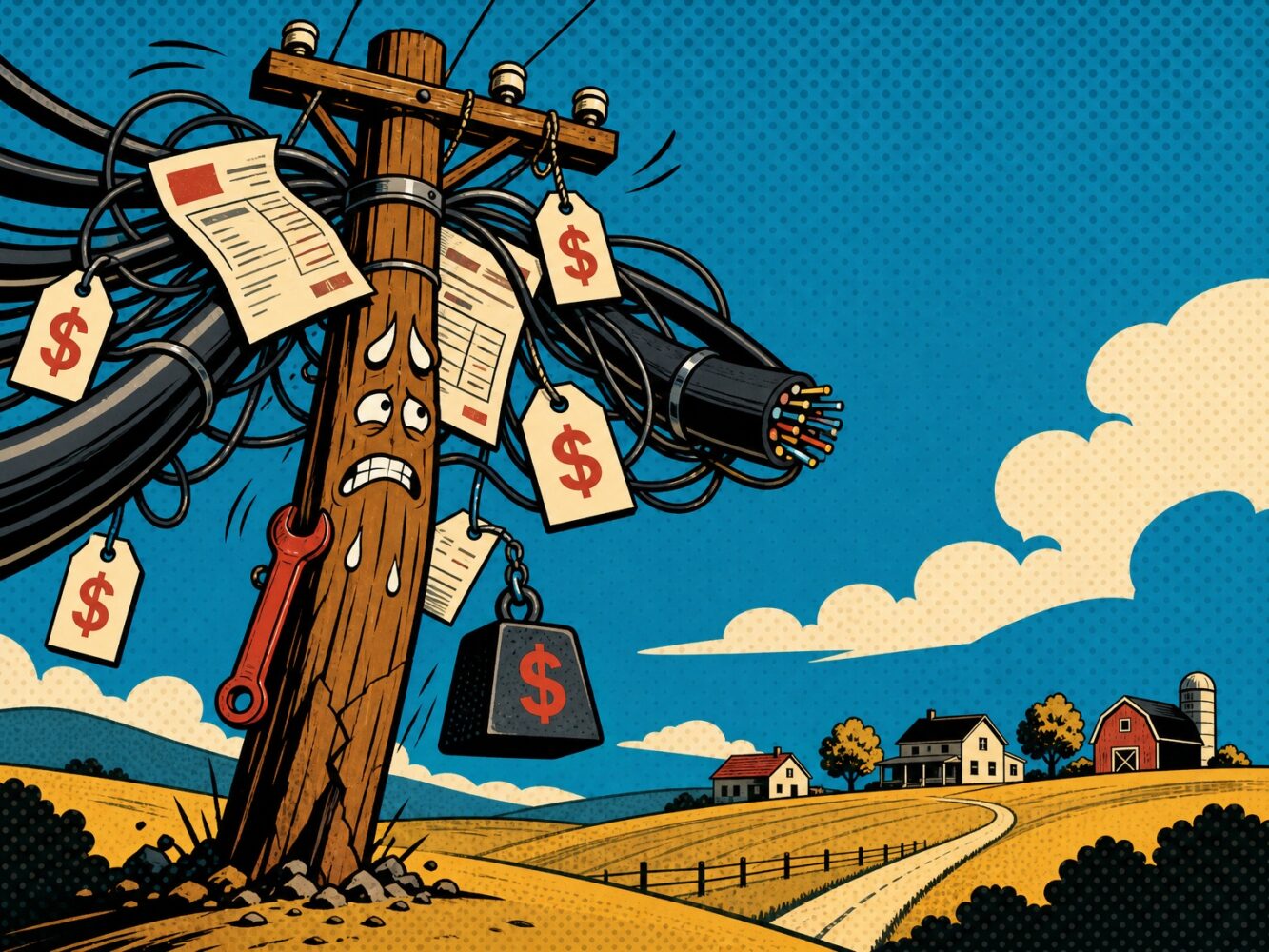
America’s multibillion-dollar broadband push rests on an unglamorous piece of infrastructure: the utility pole. Fiber may carry the future, but first someone has to pay for the wood holding it up.
Broadband providers rarely own the poles their networks use. Reaching a new community usually requires attaching equipment to poles owned by a utility or another company. Who pays the resulting costs can determine whether a rural build makes economic sense—or never gets built.
The trouble often starts with the poles themselves. Many are old, overloaded, or burdened by safety and code violations left by earlier attachers. Pole owners may then try to make the newest provider pay to fix problems it did not create.
Appalachian Power Co.’s (APCo) “cost causer” policy put that practice squarely before the Federal Communications Commission (FCC). When Comcast sought to attach to a pole carrying someone else’s violation, APCo required Comcast to pay to replace the entire pole. In effect, APCo treated the arrival of a broadband builder as an opportunity to shift deferred-maintenance costs onto the party least responsible for them.
In February 2026, the FCC sided with Comcast and struck down the policy. In the first decision under its accelerated docket for pole-attachment disputes, the FCC held that APCo could not force a new attacher to pay the full cost of replacing a pole that was already out of compliance. The new attacher could be charged only for the incremental cost of installing a taller or stronger pole needed to accommodate its equipment beyond what correcting the existing violation would require.
The ruling should have settled the matter. It did not.
Rather than apply the FCC’s cost-sharing standard, APCo continued billing Comcast a flat 20% of the full replacement cost, whether or not Comcast’s attachments caused that expense. Comcast returned to the FCC earlier this month with a new complaint.
The dispute now tests more than one utility’s billing policy. It will show whether the FCC’s landmark broadband-deployment order has real force—or merely looks good on paper.
The Pole Was Broken Before Comcast Got There
Broadband and cable providers cannot build networks without access to the utility poles along their routes, yet they rarely own those poles. Section 224 of the Communications Act therefore requires pole-owning utilities to offer access on “just and reasonable” rates, terms, and conditions.
The exception is narrow. An electric utility may deny access on a nondiscriminatory basis only when a pole lacks capacity or when safety, reliability, or generally applicable engineering concerns require it. In states such as Virginia, which do not regulate attachments to electric-utility poles, the FCC oversees those rates, terms, and conditions.
Most pole attachments require some preparatory work. The central economic question is who pays the “make-ready” costs—the labor and materials needed to prepare a pole for new equipment, sometimes including replacement of the pole itself.
Two rules govern that allocation. The general rule, 47 C.F.R. § 1.1408(b), requires parties that gain access to or directly benefit from a modification to share its cost proportionately. A more specific rule, adopted in the FCC’s 2018 Pole Attachment Order and codified at 47 C.F.R. § 1.1411(e)(4), bars utilities from charging a new attacher to correct violations caused by someone else before the new attachment.
Those protections matter most in unserved and underserved areas, where unnecessary replacement costs can kill a broadband project before construction begins. In Virginia, Comcast must attach to poles owned by APCo, some of which already carry code or construction-standard violations caused by other parties.
Under the 2025 policy that was challenged before the FCC, APCo required the new attacher to pay 100% of the replacement cost up front, subject to a possible 50% refund. The preexisting violator could not move its equipment to the replacement pole unless it paid the other half.
The catch was obvious. Comcast received a refund only if the violator chose to transfer its equipment and paid its share. If the violator walked away, Comcast recovered nothing. Either way, Comcast remained responsible for between half and all of a replacement cost caused by someone else.
When Pole Costs Pull the Plug
Who pays for replacing a utility pole is not an accounting detail. It can determine whether a rural broadband project gets built at all.
The economics of rural deployment are especially unforgiving. In cities and suburbs, each pole serves many homes, spreading its fixed cost across a large subscriber base. In the unserved and underserved communities targeted by programs such as the Broadband Equity, Access, and Deployment (BEAD) Program and the earlier Rural Digital Opportunity Fund (RDOF), providers often need several poles to reach a single additional home. Every dollar spent on pole replacements is therefore spread across far fewer customers, making those costs disproportionately important where expanding broadband matters most.
Providers’ experience bears this out. Charter Communications, for example, reported that pole-replacement charges accounted for roughly one-quarter of the construction cost for a rural build serving about 57,000 locations.
The problem is not just the size of the bill, but its unpredictability. Providers often do not discover which poles have disqualifying conditions until they survey a route, after they have committed to the project and, for subsidized builds, submitted bids based on much lower expected costs. Because utilities would eventually have to replace aging poles anyway, requiring a new attacher to pay the entire replacement cost charges far more than the costs the attachment actually causes. It simply accelerates an expense the utility would otherwise bear, while injecting substantial uncertainty into projects that already operate on thin margins.
That uncertainty has real consequences. In April 2024, Charter notified the FCC that it was relinquishing RDOF awards covering locations in three states because unexpected pole-replacement costs had made the projects uneconomical.
When replacement costs are both unbounded and assigned to the new attacher, abandoning a marginal project becomes the rational business decision. The FCC has recognized as much, warning that forcing attachers to bear costs they did not cause diverts scarce capital away from network expansion. APCo’s policy exemplified that problem, transforming uncertain liabilities into certain—and often substantial—costs across deployments involving thousands of poles.
You Break It, You Buy It
The FCC ruled for Comcast in February 2026 and struck down APCo’s policy. The decision closely followed the agency’s rules. Section 1.1411(e)(4) prohibits a utility from charging a new attacher to bring a pole, attachment, or third-party equipment into compliance when the violation resulted from someone else’s earlier work. That is precisely what APCo had done. The poles were already out of compliance before Comcast applied, yet APCo required Comcast to pay the full cost of replacing them. The FCC concluded that this violated both the regulation and the agency’s long-standing principle that a new attacher pays only the costs its own attachment actually causes.
The FCC also rejected APCo’s central defense: that Comcast was the ultimate “cost causer” because the original violator might someday remove its equipment, leaving Comcast as the only remaining beneficiary of the replacement. The agency found that argument too speculative. APCo presented no evidence that violators were removing their equipment, and its own policy contemplated that the violating attachments could remain on a “stub pole” indefinitely. Nor did APCo’s promise of a possible 50% refund solve the problem. A provider forced to pay the entire replacement cost up front is not made whole by a partial reimbursement that depends on someone else’s future choices. If anyone should bear the remediation costs, the FCC concluded, it is the party that caused the violation.
The FCC did not, though, embrace Comcast’s broader position that a preexisting violation eliminates any obligation for the new attacher. Instead, it harmonized the two governing rules. The existing violator must pay to correct the preexisting problem. But if the new attachment requires a pole that is taller or stronger than the one needed simply to remedy that violation, the new attacher must pay the incremental cost under Section 1.1408(b).
The FCC illustrated the distinction with a simple example. Suppose fixing the existing violation requires replacing a 40-foot pole with a 45-foot pole costing $5,000. If accommodating the new attacher instead requires a 50-foot pole costing $5,500, the violator pays the $5,000 needed to correct the existing deficiency, while the new attacher pays only the additional $500. In short, the FCC drew a straightforward line: correcting someone else’s violation is not the newcomer’s responsibility, but paying for the extra capacity its own attachment requires is.
Twenty Percent of Wrong
A clear rule matters only if utilities follow it. Here, implementation has become the problem.
Rather than charge Comcast the incremental cost the FCC described, APCo has continued billing a share of the entire replacement cost—a blanket minimum of roughly 20% per pole. As Comcast argues, that figure has no meaningful connection to the FCC’s standard. The extra cost of installing a taller or stronger pole may be only $100 to $200. By contrast, 20% of a full replacement costing several hundred or several thousand dollars sweeps back in the very remediation expenses the FCC said Comcast cannot be forced to pay.
APCo has also suggested that 20% is a floor, not a ceiling, and that it may seek an even larger share. That turns the FCC’s holding on its head. The agency did not invite APCo to devise whatever split it considered fair. It adopted a specific cost-causation rule: Comcast must pay only for the additional pole capacity its attachment requires.
A flat percentage of the total replacement cost is not that. It is the same cost shift the FCC rejected in February, dressed up as compliance. Multiplied across thousands of poles and pressed against federal funding deadlines, even a modest-looking percentage becomes exactly the kind of unpredictable, deployment-deterring expense the rules were designed to prevent.
The Bill Comes Due
Stripped of its technical details, APCo’s policy required a broadband provider to pay for a problem it did not create, on poles someone else left out of compliance, in communities that federal and state programs are spending billions to connect.
The FCC rejected that arrangement and drew a sensible line. The party responsible for a preexisting violation must pay to correct it. A new attacher must pay only for the additional pole capacity its own equipment requires. That rule vindicated Comcast’s position and, more importantly, protected the broadband-deployment goals behind the agency’s regulations.
What remains is enforcement. By continuing to charge a fixed share of full replacement costs despite the FCC’s order, APCo is testing whether the agency’s first accelerated-docket pole-attachment ruling binds utilities in practice or only on paper.
The FCC has already said who should pay. It should not let APCo send the bill elsewhere.