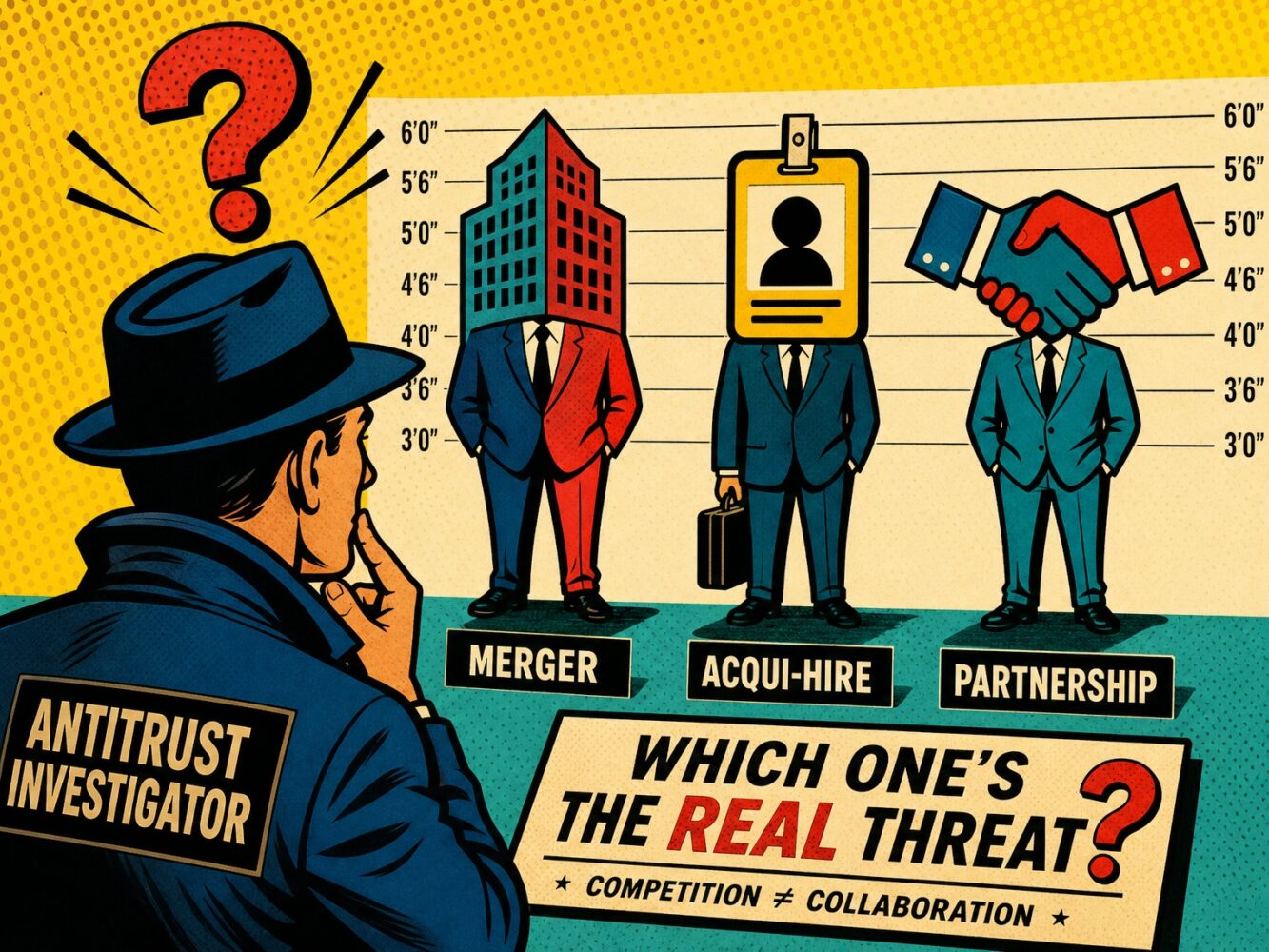
Antitrust agencies have a habit of giving new labels to old anxieties. In artificial intelligence, the latest worry is that partnerships between large technology firms and startups are not partnerships at all, but mergers in clever disguises.
In the first article in this series, we examined how Brazil’s Administrative Council for Economic Defense (CADE) has approached this new generation of artificial-intelligence partnerships. We focused on the agency’s treatment of “reverse acqui-hires”—deals in which a company hires much of a startup’s team without formally buying the company—as concentration acts; its renewed reliance on Article 88, §7 call-in powers, which allow CADE to review certain transactions that fall outside Brazil’s mandatory-notification thresholds; and the practical distinctions that pushed Microsoft/Inflection—but not Google/Character.AI—into formal merger review.
Those procedural moves raise a deeper question: What theory of harm is driving CADE’s enforcement agenda?
CADE’s decisions suggest that the agency is increasingly borrowing from international debates over “killer acquisitions,” “talent hoarding,” and the loss of potential competition in digital markets. A “killer acquisition” occurs when an incumbent buys a smaller firm to shut down a potential future rival. “Talent hoarding” is the related claim that large firms hire scarce technical workers not to deploy them productively, but to keep them away from rivals. These theories sound tidy enough. The harder question is whether they rest on evidence sturdy enough to support intervention.
Before CADE completes its review of Microsoft/Inflection or opens further investigations into AI partnerships, that question deserves a closer look. This second article takes it up.
The Theory Comes Before the Evidence
At CADE’s May 13 court session, interim President Diogo Thomson gave an oral “preamble” statement that the agency later incorporated into the decisions. He warned that “transactions in the digital, technology, and AI markets may lead to significant exchanges of assets, capabilities, technology, intellectual property, key employees, and competitive advantage, even if the companies involved have no significant turnover in Brazil.” In those cases, he said, CADE “performs as an outstanding mechanism to fix the mandatory notification system, exhausting all possibilities of potential competition concerns within the legal limits.”
That is the language of “killer acquisitions” and “acqui-hires,” with a visible assist from the 2024 Joint Statement by the U.S. Department of Justice (DOJ), Federal Trade Commission (FTC), European Commission, and the United Kingdom’s Competition and Markets Authority (CMA) on competition in generative-AI foundation models and AI products, as well as from the CMA’s Microsoft/Inflection inquiry decision. Both Commissioner Camila Alves and Commissioner José Levi Mello do Amaral Júnior anchor their reasoning in this frame.
Alves identifies four possible theories of harm related to AI partnerships: (i) the loss of potential competition and abandonment of an independent innovative path, which “engage in dialogue with the killer-acquisition literature, although they are not entirely synonymous with it” (§80); (ii) the absorption of organized technical capacity; (iii) the reinforcement of ecosystem integration and asymmetric exploitation of technology licenses; and (iv) potential effects on specialized talent markets and innovation incentives—the so-called “talent hoarding” theory.
Amaral’s opinion, which led to the order requiring formal notification of Microsoft/Inflection, goes further. He writes that “there is a growing understanding that reverse acqui-hire transactions may constitute killer acquisitions” (§67) and that the record contains sufficient evidence that the transaction is “highly likely to give rise to anticompetitive effects” (§69). The killer-acquisition theory thus became the main doctrinal basis for the call-in decision. It deserves scrutiny.
Start with the evidence. The original paper by Colleen Cunningham, Florian Ederer, and Song Ma found that roughly 5%-7% of acquisitions resulted in discontinuation of the target’s development projects. But that evidence came from the pharmaceutical sector, where drug pipelines, patent rights, regulatory approvals, and product-development timelines look very different from software and AI markets. As Selçukhan Ünekba? has cautioned, those findings cannot simply be airlifted into digital markets and treated as proof of the same problem.
In an Antitrust Law Journal article, Marc Ivaldi, Nicolas Petit, and Ünekba? find no support for the killer-acquisition theory in European digital-merger cases:
We focus on transactions reviewed by the European Commission in information and communication technology industries. Pursuant to the theory of killer acquisitions, some of these cases should have led to reduced competition. Focusing on publicly available information through financial disclosures, our analysis suggests that no transaction was followed by the disappearance of the target’s products, a weakening of competing firms, and/or a post-merger lowering or absence of entry and innovation. Skepticism about the killer acquisitions theory should prevail.
Even Ederer, one of the original killer-acquisition authors, has complicated the story. In a recent working paper with Reginald Seibel and Timothy Simcoe titled “Digital (Killer?) Acquisitions,” the authors examine “the effects of 1,200 acquisitions by major technology firms on innovation.” Their conclusion is worth quoting at length:
[O]ur findings complicate the popular narrative that digital acquisitions by large incumbents are predominantly anti-competitive. While we do not rule out the possibility of killer acquisitions in individual cases, our evidence suggests that most deals by GAFAM and related firms are motivated by complementarity rather than suppression. Innovation tends to rise rather than fall in the wake of acquisition, particularly in technological domains where the acquirer has prior experience and continues to make follow-on investments.
Here, GAFAM refers to Google, Apple, Facebook (now Meta), Amazon, and Microsoft. The point is not that acquisitions by large technology companies can never harm competition. The point is narrower, and more important: the evidence does not support treating such deals as presumptively suspect.
The “talent hoarding” variant rests on similarly fragile foundations. Geoffrey Manne recently dissected a paper by Shaolong Wu of Harvard Business School and Zefan Qian of Georgetown, “Talent Hoarding and Upstream Innovation: Labor Market Distortions by Large Incumbents,” that has been offered in support of the theory. Manne shows that its headline claims of “idle benches,” foreclosed rivals, and lost innovation follow from the model’s assumptions, not from the data. The data are also consistent with a more prosaic explanation: firms efficiently retain employees who embody proprietary know-how.
Manne also notes that today’s AI incumbents are doing the opposite of what the hoarding story predicts. Between 2019 and 2025, the largest technology firms added nearly 1 million employees while increasing capital expenditures from $77 billion to $370 billion. That looks less like firms benching talent and more like firms racing to deploy it.
Importing these theories into Brazilian case law on the back of a still-forming literature—one that, for now, often points the other way—is hardly a prudent course.
Acqui-Hires Aren’t Mini-Mergers
A merger usually transfers durable business assets: companies, product lines, customer relationships, intellectual property, and control. An acqui-hire mainly transfers people. That distinction matters because people are not factories. They can leave, start companies, join rivals, publish papers, and take their know-how with them.
Onyeka Aralu and Dirk Auer explain the point well. Talent transfers are temporary because workers can leave. Team acquisitions are often more transient and speculative than the durable structural changes merger law targets. AI-talent supply is expanding, not fixed. And target companies that retain their intellectual property and customers can, and often do, keep operating, sometimes with a new strategy.
Ünekba? has also cataloged the legitimate efficiency reasons for these deals. They may help a firm reposition strategically, avoid the high information costs of assembling a cohesive team one hire at a time, or manage the failure of promising but struggling startups. In plainer terms: Sometimes a team deal is not a plot. Sometimes it is a way to salvage talent, technology, or both.
AI’s “moats” are also unusually permeable. In business jargon, a moat is a durable competitive advantage that protects a firm from rivals. But AI often works differently. As one of us has explained elsewhere, the field’s scientific ethos—open publication, mobile talent, and paper-driven diffusion—means the “capabilities” transferred in an acqui-hire often do not remain proprietary for long.
Google’s 2017 Transformer paper is the classic example. By publishing “Attention Is All You Need,” Google released the architectural blueprint for much of the generative-AI boom, while several of the paper’s authors later left to found or join competing AI ventures. Treating today’s licensing-and-hiring deals as quasi-acquisitions of durable market power risks missing how AI knowledge and talent actually spread.
The policy risk is asymmetric. Auer and Mario Zúñiga have warned that aggressive scrutiny of AI partnerships and acqui-hires may create the “very harms that policymakers wish to avert”: deterring incumbents from entering generative-AI markets through strategic relationships and making it harder for AI startups to obtain the funding they need to scale and compete.
That concern is not theoretical. The deals CADE has reviewed funded the startups involved. Character.AI received roughly $2.7 billion through its Google deal; Inflection received roughly $650 million through its Microsoft deal. Jonathan Barnett similarly argues that preemptive antitrust fits poorly in the early-stage generative-AI ecosystem, where uncertainty is high and premature intervention can suppress efficient arrangements that combine the complementary assets needed to build AI models and applications.
Taken together, these considerations counsel against an intensive enforcement focus on early-stage AI partnerships. A more measured skepticism toward antitrust intervention is the sounder posture, given the market dynamics and funding structures that characterize AI startups, and given the absence—at least in the current literature and available evidence—of a credible theory of harm for digital killer acquisitions.
A Cautious Start, With One Big Exception
CADE’s recent decisions show that Brazil is entering a new phase of antitrust enforcement in AI markets. The authority has made clear that emerging partnerships between incumbents and startups deserve close scrutiny. That is a defensible position. Scrutiny, though, is not the same as a presumption of harm.
To its credit, CADE took the prudent course by dismissing the Administrative Procedure for Investigation of a Concentration Act (APAC) proceedings in NVIDIA/Run, Microsoft/Mistral, and Google/Character.AI. The Tribunal also emphasized that the Article 88, §7 call-in power is an exceptional tool, to be used only when there is solid evidence of likely competitive harm in Brazil. That approach is consistent with what we have argued elsewhere: Brazil’s antitrust regime should resist the temptation to recreate the European Union’s Digital Markets Act (DMA) by other means.
CADE did not exercise the same restraint in Microsoft/Inflection. The agency will now subject a transaction completed in 2024 to ex post merger review roughly two years after closing, even though the CMA cleared the same transaction after concluding there was no “realistic prospect of a substantial lessening of competition” on the same facts. In doing so, CADE elevated the digital killer-acquisition theory from an academic debate to the doctrinal foundation for intervention.
If the 2024 Joint Statement called for international convergence, the irony is hard to miss. The agencies championing that effort have thus far found no competitive harm in the AI partnerships they have reviewed. CADE reached that same conclusion in three cases. Microsoft/Inflection stands as the exception.
The story is far from over. Microsoft/Inflection will now receive a full substantive merger review. Amazon/Anthropic remains pending, with a decision expected after further inquiry into the “notorious facts” identified by Amaral. Google/Windsurf and Google/Hume AI are also making their way through the same APAC process.
CADE will have many more opportunities to shape its approach to AI partnerships. The hope is that it follows the evidence rather than the narrative. In markets that move this fast, antitrust should be careful not to mistake investment for foreclosure, or collaboration for consolidation.
