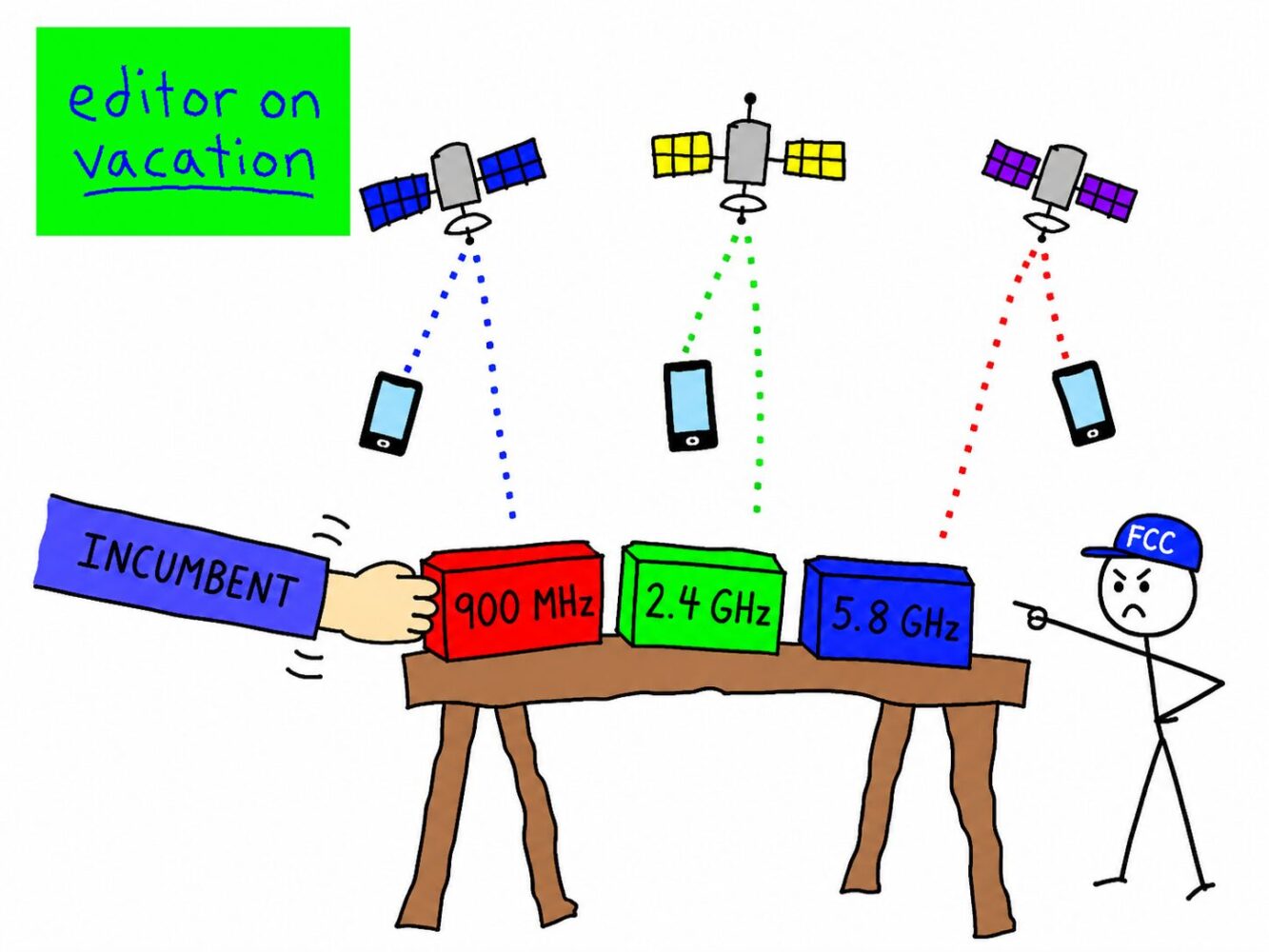
Note: Our editor is on vacation. The image for this post and any errors in the body are solely the fault of the author.
At its August 6 open meeting, the Federal Communications Commission (FCC) is scheduled to vote on a notice of proposed rulemaking (NPRM) titled “Unleashing Unlicensed Spectrum for Direct-to-Device.” This proceeding will examine whether devices operating across more than 225 megahertz of unlicensed spectrum in the 902-928 MHz, 2400-2483.5 MHz, and 5725-5850 MHz bands should be authorized for satellite communications. The item represents a commendable step in the Commission’s already-productive spectrum work.
Firms have entered the direct-to-device (D2D) market with great speed since the Commission’s 2024 “supplemental coverage from space” framework first authorized satellites to serve ordinary smartphones over spectrum licensed to terrestrial carriers. Satellite operators have also sought to acquire their own standalone spectrum for mobile service. SpaceX acquired 65 megahertz of spectrum from EchoStar for $17 billion, while Amazon and Rocket Lab struck deals collectively approaching $20 billion to acquire Globalstar and Iridium, respectively, and SpaceMobile leased spectrum from Ligado in a deal values at about $120 million. FCC Chairman Brendan Carr counts nearly $50 billion in D2D spectrum transactions over the past year alone. SpaceX has launched approximately 650 satellites for such use, with authorization to deploy as many as 7,500 satellites. And just last week, Amazon’s Leo unit asked the Commission for authority to deploy a constellation of more than 5,100 satellites dedicated to direct-to-phone service. The Commission’s willingness to modernize legacy spectrum rules has been an important enabler of this investment.
The draft NPRM extends that approach to unlicensed spectrum. The item proposes to add Earth-to-space allocations in the three bands where Part 15 rules already permit higher-power unlicensed operation, and therefore require no change to existing power limits, out-of-band emission limits, or other technical rules. All satellite operations would proceed on a strictly non-interference basis: they could not cause harmful interference to authorized services and would have to accept any interference received.
And because devices would transmit at the same power levels they use today, the Commission tentatively concludes that the interference environment would not change.
The decision to examine low-, mid-, and high-band unlicensed spectrum together is particularly notable. Each band presents a distinct engineering tradeoff. The 902-928 MHz band offers superior propagation and building penetration, making it well-suited to low-power, wide-area uplinks from Internet-of-Things sensors and trackers. The 2.4 GHz band is globally harmonized and home to billions of Wi-Fi and Bluetooth radios, which is the installed base that Hubble’s operations already leverage.
And while the item’s affirmative proposal is limited to the Earth-to-space direction, the NPRM seeks comment on space-to-Earth operations as well. That particular item is focused principally in the 5725-5850 MHz band, whose shorter wavelengths permit smaller, more directional satellite antennas that could confine a downlink beam’s footprint on the ground.
Which combination of these bands ultimately proves suitable for satellite links is precisely the kind of question a rulemaking record exists to answer. Spectrum suitable for D2D service remains scarce relative to projected demand. The surest way to relieve the spectrum constraint is to keep multiple options open.
Indeed, the one respect in which the item could aim higher is precisely here. As drafted, the NPRM proposes allocations only for uplinks, while downlinks are considered only as questions for further consideration. An uplink-only framework would support telemetry-style applications such as sensors, trackers, and asset monitoring, whereas two-way service requires downlink capacity. Without it, D2D operators would continue to face the very bottlenecks this proceeding could help relieve: acquiring scarce mobile-satellite spectrum or leasing rights from terrestrial carriers.
Ideally, the rules that ultimately emerge from this proceeding would therefore include space-to-Earth allocations as well, subject to the power-flux-density and beam-footprint limits on which the Commission has already sought comment.
The record does contain some dissent. For instance, NextNav, a licensee in portions of the lower 900 MHz band, has pressed the Commission to drop the 902-928 MHz band from the item entirely. The context for that request is the company’s own pending 2024 petition for rulemaking, which asks the FCC to reconfigure the band around a terrestrial positioning, navigation, and timing (PNT) network that NextNav would operate alongside its own 5G service. That petition has drawn opposition from a broad coalition of incumbent users that includes amateur radio operators, utilities, and the security industry, as well as from analysts skeptical of its technical claims.
Whatever the ultimate merits of the NextNav petition, it supplies no reason to narrow this proceeding. An NPRM decides nothing but only asks questions and gathers evidence. Removing the 900 MHz band before a single comment has been filed would effectively prejudge the record in deference to one licensee’s preferred business model.
This is a familiar dynamic in telecom policy that Thomas Hazlett has documented in earlier spectrum fights, where incumbents use procedural leverage to forestall competing uses. Within the satellite arena, a similar dynamic unfolded in the 2 GHz band, with DISH opposing SpaceX’s application to use the band for D2D service before it was even accepted for filing. This obstructionism defeats the purpose of the regulatory process. If concerns about coexistence are well-founded, the rulemaking record is exactly the place to substantiate them.
This is not a dry technical matter, ultimately, as it has major implications for closing the digital divide. For consumers in rural and remote areas beyond the reach of both cellular networks and terrestrial Wi-Fi, satellite connectivity in unlicensed bands would offer an additional path to coverage using the billions of inexpensive, unlicensed devices already deployed. And in emergencies that redundancy can be lifesaving.
The FCC should seek comment on all three bands and decide the 900 MHz question on the resulting technical record. Excluding it at the NPRM stage would deny commenters the chance to test coexistence claims before the Commission has developed the evidence needed to resolve them.
