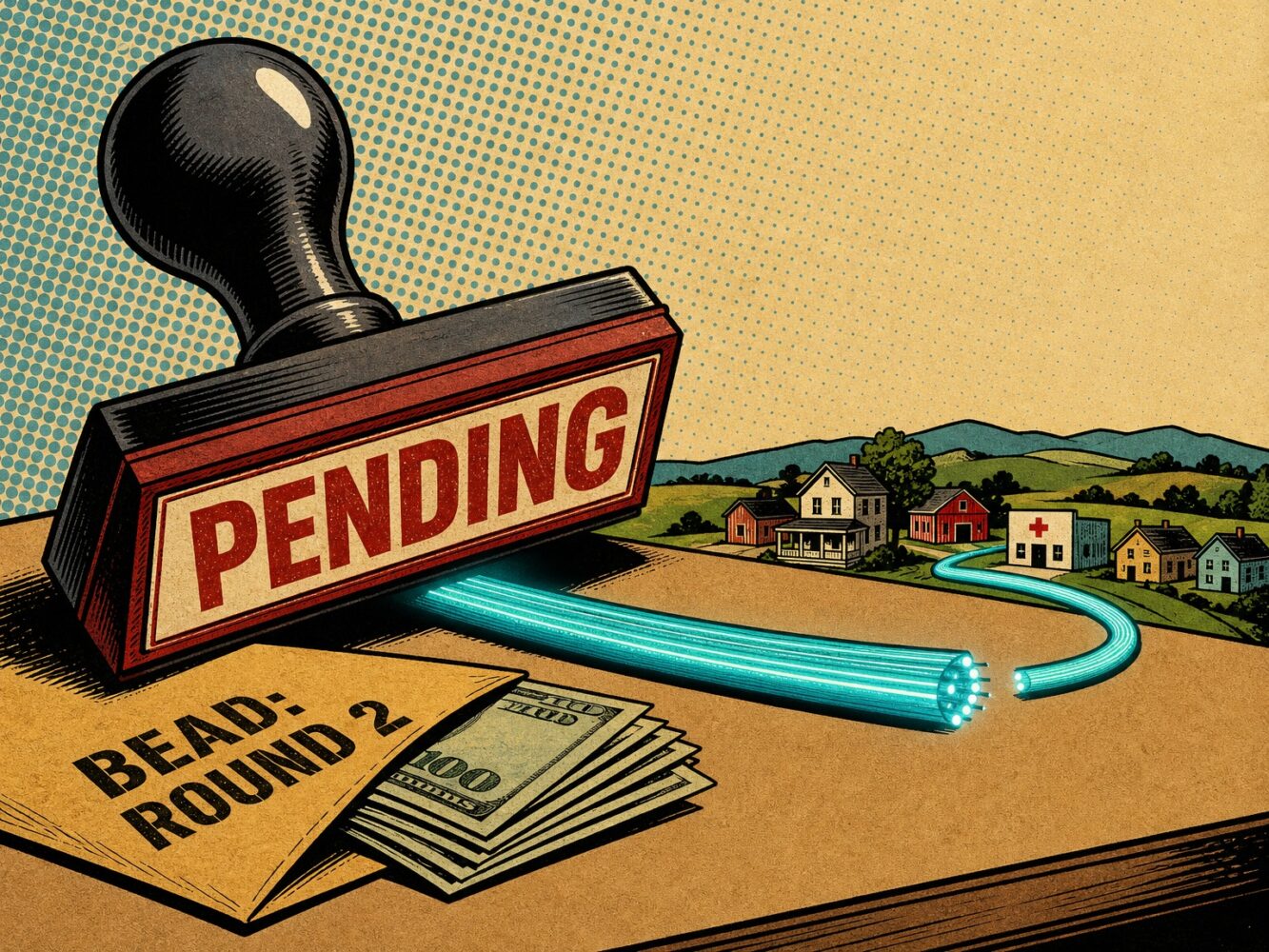
The road to rural access to AI-enabled services runs through the permit office. Chips, data centers, and electricity get the attention, but delivering AI to a farmer’s field, a rural clinic, or a factory floor takes a broadband network. Building it means navigating utility poles, road crossings, and public rights-of-way—each with a gatekeeper who can keep the future waiting.
Private investment will connect most of America. In many rural areas, however, getting that investment to pencil out will require policies that improve the incentives to build. The potential benefits are substantial—AI-assisted diagnostics at rural hospitals, precision agriculture that streams field imagery in real time, and reliable home broadband that lets higher earners work remotely and settle outside major metropolitan areas.
Much of that value spreads through communities in ways no provider can capture on a monthly bill. Without policies that lower construction costs, the places least likely to attract private capital will also be the last to get AI-ready infrastructure. That would widen the gap between connected and unconnected regions just as connectivity becomes central to economic competitiveness.
That makes the next phase of the Broadband Equity, Access, and Deployment (BEAD) Program more consequential than it might appear. After restructuring the program, the National Telecommunications and Information Administration (NTIA) has roughly $21 billion in unspent funds and has told states to direct that money toward more construction. But as in the first funding round, money alone won’t clear the path. Successful builds depend on timely, predictable access to public rights-of-way and the infrastructure along them.
Broadband’s Next Stop: The Permit Office
BEAD’s merits have long been debated, but the program offers rural areas that might otherwise remain unconnected a path to broadband capable of supporting advanced services. NTIA’s 2025 “Benefit of the Bargain” overhaul restored a technology-neutral, competitive grant process—allowing providers using different technologies to compete for funding. NTIA Administrator Arielle Roth said the changes saved about $21 billion of the program’s $42.45 billion allocation.
On Sept. 3, NTIA directed states to use the remaining funds first for additional deployment. Eligible locations include newly identified unserved addresses missing from the Federal Communications Commission’s (FCC) broadband map and those that became eligible after defaults or changes in other federal and state programs. Guidance on broader “non-deployment” uses remains pending.
Prioritizing deployment makes sense, but a second grant round will encounter the same obstacles as the first. A subsidy can pay for fiber, but it can’t make a utility replace a pole on time or make a county process a permit. Even with funding, providers face substantial risk when remote areas offer few potential customers.
Nationwide, BEAD projects may require as many as 86,000 permits. Each represents yet another place where a funded project can stall.
A Pole Tax on Rural Broadband
For many rural projects, securing permission to build costs more than building the network itself. “Make-ready” work—preparing poles for new equipment—and pole replacements can cost thousands of dollars per pole. Those costs become prohibitive when providers must attach to more poles to reach fewer subscribers. And when each company already on a pole must move its equipment in sequence, the wait can stretch for months.
The FCC has made real progress in addressing these buildout costs. One-touch make-ready lets a single qualified crew handle simple work in one pass, saving providers from waiting on each incumbent attacher in turn. The FCC’s July 2025 order added timelines for large applications, expanded providers’ ability to arrange work themselves when utilities miss deadlines, and sped approval of qualified contractors. In December 2023, the FCC also clarified that a new provider shouldn’t bear the full cost of replacing a pole the utility had already marked as unsafe or needed to upgrade anyway.
But two gaps remain, and both matter for BEAD. First, Section 224 of the Communications Act exempts poles owned by municipal utilities and electric cooperatives. Those owners control a substantial share of poles in the rural areas BEAD targets. Providers seeking access face rates and timelines unconstrained by federal rules, often without comparable state protections. Congress should extend Section 224—or equivalent enforceable deadlines and cost-allocation rules—to these poles while still allowing nonprofit owners to recover legitimate costs.
Second, the pole-replacement rule works only if providers can enforce it. When a utility demands full payment for a replacement, that opening bid effectively sets the price while the dispute drags on.
The FCC’s expedited “rocket docket” provides firm deadlines for resolving disputes. Codifying the cost-allocation principle would protect it from changes in FCC leadership, while targeted reimbursement funds could help cover replacements that warrant shared costs. Yet pole owners continue to try to sidestep FCC decisions and extract additional payments from broadband providers. Clearer statutory guidance could strengthen the FCC’s hand in enforcing its replacement-cost rules.
The Road to Broadband Could Already Be Open
For underground fiber, much of the cost comes from digging trenches and burying cables or conduit—the protective tubing that carries them. Coordinating broadband construction with roadwork can therefore deliver substantial savings.
A 2021 Federal Highway Administration rule already requires state transportation departments that receive federal-aid highway funds to designate a broadband utility coordinator and set up processes for registration, notification, and coordination. A January 2026 Government Accountability Office review found most states had made progress, though the effect on deployment remains hard to measure.
But weak “dig-once” policies simply notify providers when crews plan to tear up a road. While that helps providers whose construction plans happen to align with the roadwork, middle-mile and backhaul routes—the links connecting local networks to the wider internet—often won’t.
Stronger policies would require agencies overseeing federally funded road projects to install spare conduit whenever they open the ground, then lease it to providers. Proponents estimate that this adds only a few percentage points to a road project’s cost while sparing future builders the costs of another dig.
States are well placed to act. The governments administering BEAD grants also run the highway departments. Pairing second-round broadband construction with mandatory conduit installation on state road projects would stretch both pots of money.
Permitting processes need the same discipline. Right-of-way fees should cover a government’s actual costs, not serve as a tax on providers’ investment. Deadlines also need teeth. A “shot clock”—a deadline for deciding a permit application—does little to prevent delay if its only consequence is letting the provider sue after the clock runs out.
A self-executing “deemed granted” remedy would automatically approve an application when the deadline passes. That approach already applies to qualifying modifications of small wireless facilities. Extending it to ordinary right-of-way and construction permits would give BEAD grant recipients predictable schedules for projects with strict federal construction deadlines.
The Future Needs a Right-of-Way
BEAD’s second round gives policymakers a rare do-over. The first round showed how competition and technology neutrality could stretch federal dollars further than expected. The second can go further still—if pole-access costs and permitting delays stop eating into every grant.
NTIA should encourage states to prioritize permitting reform and financial backstops for pole replacements when allocating any remaining non-deployment funds. States should pair second-round builds with meaningful dig-once policies, cost-based permit fees, and automatic approval when permitting deadlines expire.
For its part, Congress should extend pole-access protections to municipal and cooperative poles and codify the FCC’s cost-allocation and one-touch make-ready reforms. Investors shouldn’t have to bet on a 20-year asset under rules a future FCC could undo at any time.
AI reaches users through networks that cross public land, local rights-of-way, railroad tracks, and utility poles—one approval at a time. Winning the next technology race will take computing power, electricity, and rules that let providers build connections to the people.
BEAD can buy the fiber. But first, reform must clear the path.
