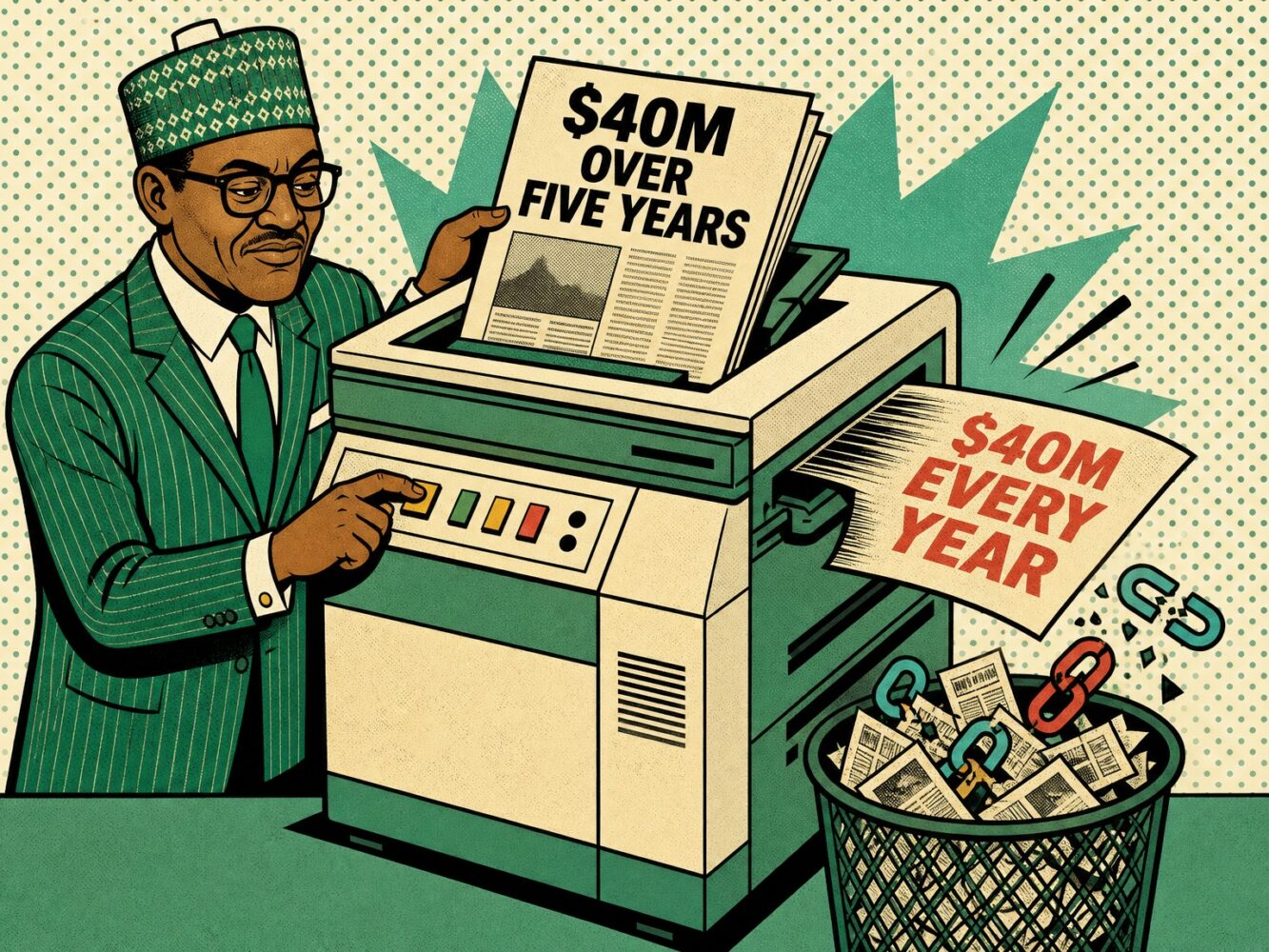
Nigeria has looked south and seen a $40 million payday for the press. The trouble is that it misread both the price tag and the fine print—and its attempt to collect may leave Nigerian publishers with fewer readers and no comparable payday.
On July 6, Nigeria’s Federal Competition and Consumer Protection Commission (FCCPC) announced investigations into Meta, Alphabet, X, and unnamed generative artificial intelligence (AI) companies. The announcement followed a petition to the Nigerian presidency from the Nigerian Press Organization (NPO).
The FCCPC identified three concerns: market dominance, the use of copyrighted news content to train AI models, and the absence of “equitable commercial engagement.”
The press release’s final paragraph makes the FCCPC’s model explicit. It claims that a similar inquiry in South Africa ended with Google agreeing to pay South African news organizations 688 million rand ($40 million) annually for three to five years. As I explained in a previous piece, regulatory ambition has its own politics: An agency’s next move often follows the path laid by its counterparts abroad.
But the FCCPC has misread the South African precedent in two important respects. First, 688 million rand is the total Google committed over five years, not an annual payment. Second, Google negotiated that payment under a statutory market-inquiry regime, a formal process that may give the South African Competition Commission (SACC) real power to impose remedies. Nigeria has no comparable regime.
Nigeria is importing South Africa’s answer without South Africa’s legal machinery.
The Fine Print Behind Google’s Check
Google’s media package emerged from the SACC’s Media and Digital Platforms Market Inquiry (MDPMI), which ran from October 2023 through November 2025. A market inquiry begins as a diagnostic exercise. The SACC asks whether a market feature harms competition, a much lower threshold than proving a legal violation. Its findings do not establish that any firm broke the law.
Yet the inquiry comes with considerable remedial power. Under the Competition Amendment Act 18 of 2018, the SACC may take any remedial action it considers reasonable and practicable to address an adverse effect on competition. The exception is divestiture, which requires a firm to sell part of its business and which only the Competition Tribunal may order. The MDPMI’s final report bases its remedies squarely on sections 43C through 43E of the act.
That discretion is extraordinary, though not unlimited. The remedial power lacks an enforcement mechanism, and South African courts have already held that the SACC cannot disguise a coercive divestiture order as voluntary compliance.
Google negotiated with those powers in view. In its February 2025 provisional report, the SACC recommended annual payments of 300 million to 500 million rand. It also signaled that platforms that voluntarily adopted the proposed remedies could avoid final penalties or a digital levy.
Google then proposed a package comprising 71 million rand annually for five years for national media through Google News Showcase, 45 million rand annually for three years for an AI innovation fund, and 38 million rand annually for three years—plus matching funds—for a Digital News Transformation Fund serving small and community outlets. The full package totaled 688 million rand over five years, or about $40 million.
Meta, TikTok, Microsoft, and OpenAI accepted commitments covering revenue tools, access to their platforms, and publishers’ ability to withhold content. None involved payments. The SACC reportedly could not reach an agreement with X.
A Remedy in Search of Jurisdiction
The FCCPC lacks the powers of its South African counterpart. Sections 17(b) and 17(d) of the Federal Competition and Consumer Protection Act (FCCPA) allow it to review economic activity and report on market practices, while section 18(1)(g) allows it to publish studies.
The FCCPA provides nothing resembling South Africa’s “quasi-regulatory” regime. It establishes no procedure for initiating a market inquiry, no adverse-effects standard, no binding force for the resulting report, and no remedial powers tied to the process. To obtain a remedy, the FCCPC must leave the study format behind and prove that a specific business abused a dominant position. A targeted firm is unlikely to accept such a finding without protracted litigation.
Of the FCCPC’s three stated concerns, only the first—market dominance and anticompetitive conduct—falls within its competition mandate. Even that concern must eventually become an abuse-of-dominance case, with all the evidentiary burdens that entails. The other two suggest an agency either untroubled by its jurisdictional limits or unaware of them.
Consider the FCCPC’s investigation into the unauthorized use of copyrighted news content to train generative AI models. Nothing in the FCCPA turns possible copyright infringement into a competition or consumer-protection matter. Copyright claims fall under the Copyright Act 2022, and copyright holders must enforce their own rights.
Even under copyright law, the claim remains unsettled. Section 20(1) of the Copyright Act 2022 replaced the repealed act’s closed list of permissible fair-dealing purposes with an open, U.S.-style provision. It imported the four-factor test that American courts are now applying to AI training cases, with mixed results. Whether using Nigerian journalism to train a commercial AI model constitutes infringement or fair dealing remains an open question.
If the NPO and its members object to the use of their content for AI training, they should sue in court. Publishers elsewhere have followed precisely that course, including in the United States and India.
The third concern fares no better. The FCCPC alleges that “affected media organisations have been denied meaningful opportunities to negotiate fair compensation or appropriate commercial arrangements for the use of their journalistic content.” Although sections 124 and 127 of the FCCPA allow the FCCPC to police unfair contract terms in some circumstances, those powers belong to its consumer-protection mandate.
Section 167(1) defines a consumer to include anyone “to whom a service is rendered.” Unlike the parallel definition for goods, the provision covering services contains no exclusion for business use. On a literal reading, a Nigerian publisher using Google’s advertising tools or Meta’s monetization programs could itself qualify as a “consumer,” with the platform serving as the “undertaking,” or business, that supplies the service.
A careful reading of the FCCPA, though, shows that its consumer-protection provisions govern transactions. They police the terms and conduct of an existing supply relationship. The central grievance here—that Google crawls, indexes, and summarizes news while the publisher receives no payment and, increasingly, no click—involves no service supplied to the publisher and no price.
The press release inadvertently casts news organizations as suppliers of an input. Because the FCCPA regulates how businesses supply services, the FCCPC cannot use it to create a duty to transact or to require payment for an input that a platform uses outside a transaction.
The underlying complaint concerns bargaining power. Australia and Canada have pursued legislative solutions to this same controversy, with consequences discussed below that should give Nigeria’s National Assembly pause. The NPO should not have routed its grievance through the presidency. That political involvement will cast a shadow over whatever the investigation concludes.
Pay Up—or Link Out
The FCCPC’s compensation theory rests on a one-way account of value: Publishers supply content, and platforms take it. Yet search engines and social platforms are two-sided intermediaries that connect publishers with readers. They send publishers referral traffic—visitors who follow links from a platform to a news site—that publishers actively pursue through search optimization and distribution teams.
Economic research confirms that platforms also create value through a “market expansion effect”: By helping readers discover news, they increase its total audience.
When Spain’s 2014 ancillary-copyright law prompted Google to close Google News in the country, economists Joan Calzada and Ricard Gil found that visits to Spanish news sites fell by 8% to 14%. Using individual browsing data, Susan Athey, Markus Mobius, and Jen? Pál found that Google News users’ overall news consumption fell by roughly 20%. Small publishers suffered most, while large outlets barely noticed the shutdown.
Spain was no outlier. When a contract dispute removed Associated Press content from Google News for seven weeks, Lesley Chiou and Catherine Tucker found that news aggregation increased visits to publishers’ sites. They found no evidence that readers simply scanned headlines or summaries instead of clicking through, as publishers often claim.
German publishers even lobbied for an opt-in law that allowed them to withhold content from Google News. After those that opted out experienced massive traffic losses, they returned. None ultimately chose to remain outside Google News.
The same pattern appears in countries that have required platforms to negotiate with publishers. Australia’s bargaining code initially produced deals, but Meta declined to renew agreements worth an estimated 70 million Australian dollars annually in 2024. Meta said news carried little commercial value for its platform.
Canada’s Online News Act sought to ensure “that dominant platforms compensate news businesses when their content is made available on their services.” Meta responded by removing news from its platform.
Australia is now proposing a 2.25% charge on large platforms’ Australian revenue to force them back to the bargaining table. The rate would fall to 1.5% for platforms that make deals with publishers.
As Dirk Auer and Ben Sperry have explained, these media bargaining codes could create “legally sanctioned cartels” that facilitate price fixing and group boycotts. Consumers would likely bear the cost through “paid tiers or increased ad loads.”
Compelling platforms to pay for links gives them a reason to stop carrying links. The publishers most dependent on referral traffic then suffer the greatest losses. Enforcement becomes extraction, and extraction operates like a tax. If that tax applies only to U.S. companies, it may also violate international trade rules against discriminatory treatment.
The compensation theory also misdiagnoses journalism’s economic troubles. Newspaper decline largely reflects the unbundling of services that newspapers once sold together. Robert Seamans and Feng Zhu found that Craigslist’s entry reduced classified-ad rates at affected U.S. newspapers by more than 20%. Michael Gentzkow showed that online attention can command higher advertising prices than newspaper attention. Advertisers followed audiences to platforms. The display of news had little to do with it.
Nigeria has little leverage and a history of overestimating it. A platform’s willingness to pay is limited by the profit it earns locally, and Nigeria’s digital-advertising market remains small in dollar terms relative to its population.
Nigerian regulators have already brought Meta close to the exit. Penalties imposed during 2024 and 2025—including a $220 million FCCPC fine that Meta continues to contest—led the company to warn that it might have to leave the Nigerian market.
Meta may stay regardless, but the possibility of exit is real. News is among the least costly content for a social platform to drop. The NPO and its members would bear the consequences of a Nigerian news blackout.
The FCCPC has based its expectations on a South African settlement figure inflated by as much as fivefold. It is pursuing firms with smaller local stakes and a demonstrated willingness to withdraw services. Nigeria may think it is following South Africa. It is instead courting the Canadian outcome.
The High Price of Imagined Payments
Google may negotiate anyway. It has done so when the legal compulsion was genuine, even if contested. In Canada, Google agreed to pay 100 million Canadian dollars annually, indexed to inflation, under the Online News Act. In South Africa, statutory authority gave the SACC leverage, while the parties negotiated the final sum.
But a payment extracted through an investigation with no legal foundation is not legitimate competition law enforcement. It is coercion that works only while a firm considers the local market worth the toll. It also teaches global companies that their regulatory exposure in Nigeria may depend on political pressure rather than law.
Google may pay because its search business depends on offering comprehensive results. Meta has already shown that it will remove news instead, and X may make the same choice. The petitioners would then have exchanged real referral traffic for imagined compensation.
Publishers already have lawful options. If Nigerian news organizations believe AI developers infringed their copyrights, the Copyright Act 2022 allows them to sue, and courts can decide the claims. If unequal bargaining power is the problem, the National Assembly may consider legislation—but it should first study the consequences in Australia and Canada.
Nigerian news organizations also face the harder task of updating their business models, as some foreign publishers have done. The FCCPC cannot investigate a viable business model into existence.